Meeting Analytics
Meeting Analytics Guide: Metrics, Governance, and Improvement
Learn what meeting analytics is, which metrics matter, and how leaders use meeting data to improve meeting culture.
Measure meeting efficiency, decide what to remove, replace, shorten or improve, and verify the result without weakening coordination.
After looking at company calendars for years, I have learned not to celebrate a cancelled meeting too early. The status call disappears on Monday. By Thursday, the same work has returned as three follow-up calls, a long chat thread, two people chasing decisions and a manager wondering why nobody is aligned.
The calendar got smaller. The coordination burden did not.
Meeting efficiency is the extent to which an organization gets the coordination outcome it needs without using more collective meeting time and attendee capacity than necessary. That is Flowtrace's operating definition, not a universal scientific formula. It forces two questions to stay together: what capacity did the meeting consume, and did the work get the result it required?
This Guide is for leaders who need to improve a meeting system across teams. It gives you a practical way to decide what to keep, remove, replace, shorten or improve, then verify that the change saved capacity without slowing decisions, weakening alignment or shifting the same burden into a less visible channel.
An efficient meeting uses proportionate collective time to produce a necessary coordination outcome. The outcome may be a decision, an agreed plan, shared understanding, risk resolution, creative work, relationship repair or another result that genuinely benefits from people interacting at the same time.
The word proportionate matters. A ten-minute meeting can be inefficient if nobody needed to attend. A ninety-minute meeting can be efficient if the group resolves a complex, expensive decision that would otherwise take days of fragmented negotiation.
The unit is collective capacity. A one-hour meeting with eight attendees uses eight attendee-hours before preparation, transition time or follow-up are counted. That does not make the meeting bad. It makes the resource choice visible.
| Term | The question it answers | Useful evidence |
|---|---|---|
| Meeting effectiveness | Did the meeting achieve the required outcome? | Decision made, issue resolved, owners clear, useful feedback |
| Meeting efficiency | Was the collective capacity proportionate to that outcome? | Attendee hours paired with outcome evidence |
| Meeting productivity | What useful output followed from the time spent? | Completed work, reduced rework, delivery or decision progress |
| Meeting cost | What financial value did the attendee time represent? | Attendee time combined with salary or cost assumptions |
These ideas overlap, but they should not be collapsed into one score. A meeting can be effective and still use more people or time than necessary. It can be cheap and ineffective. It can feel fast while creating rework later.
Meeting research also argues against treating the calendar block as the whole event. In their review of the science of workplace meetings, Joseph Mroz, Joseph Allen, Dana Verhoeven and Marissa Shuffler organize meeting practice around what happens before, during and after a meeting. That lifecycle is a useful correction. Preparation affects the conversation. The conversation affects the decision. Follow-through determines whether the decision becomes work.
If you need the measurement category in depth, start with the Meeting Analytics Guide. If the main question is financial, the Meeting Cost Guide covers calculation and cost-reduction programs.
The instruction to "cut meetings" sounds decisive because the visible metric moves quickly. Cancel a weekly series and the dashboard shows fewer hours. But a company does not exist to produce an empty calendar. It exists to make decisions, coordinate dependent work, serve customers, manage risk and learn.
Research supports this trade-off. A 2025 Business Horizons field study of 199 full-time employees described a meeting load paradox: meeting participation and creative performance rose with meeting load up to a point, then fell as the burden increased. One field study cannot give every company a universal threshold. It does show why "more is bad" and "less is good" are both incomplete rules.
The practical failures are easy to recognize:
Reduction works when the coordination mechanism changes with the calendar. Our detailed guide to having fewer meetings without losing alignment covers that replacement problem. The task here is broader: decide which action fits each part of the meeting portfolio.
Start with the outcome the work requires. Then choose one of five actions: keep, remove, replace, shorten or improve. Verification surrounds all five because no calendar change proves its own value.
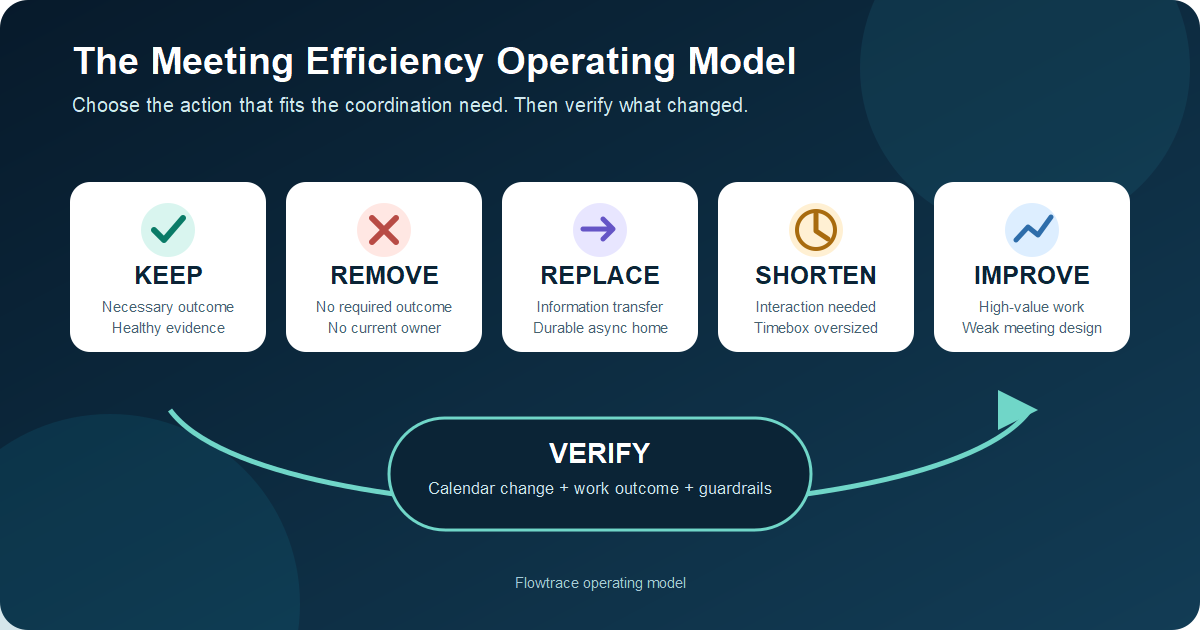
| Action | Use it when | Evidence to check |
|---|---|---|
| Keep | The outcome is necessary and the meeting produces it proportionately | Outcome completion, relevant attendance, stable or improving feedback |
| Remove | No required outcome, customer or current owner remains | No harmful change in decisions, delivery or stakeholder awareness |
| Replace | The work is mainly information transfer and has a durable async home | Update use, response time, decision closure, fewer follow-up questions |
| Shorten | Real-time interaction is necessary, but the timebox or attendee window is oversized | Same outcome with fewer attendee-hours and no rise in follow-up meetings |
| Improve | High-value coordination remains, but preparation, participation or follow-through is weak | Better decision clarity, action ownership, relevance and meeting feedback |
This is a management model, not a verdict produced by software. Analytics can show that a recurring meeting is large, long, frequent or growing. The meeting owner still needs to explain the purpose and the work around it.
The model also prevents a common mistake: applying one company rule to unlike meetings. Incident response, one-to-ones, candidate debriefs, weekly status calls, customer escalations and executive decisions do different jobs. A useful review respects those differences before it compares them.
A meeting-efficiency baseline needs two evidence lanes and a set of guardrails. The first lane shows what happened to the calendar. The second shows what happened to the work. The guardrails catch harm that a simple reduction number would miss.
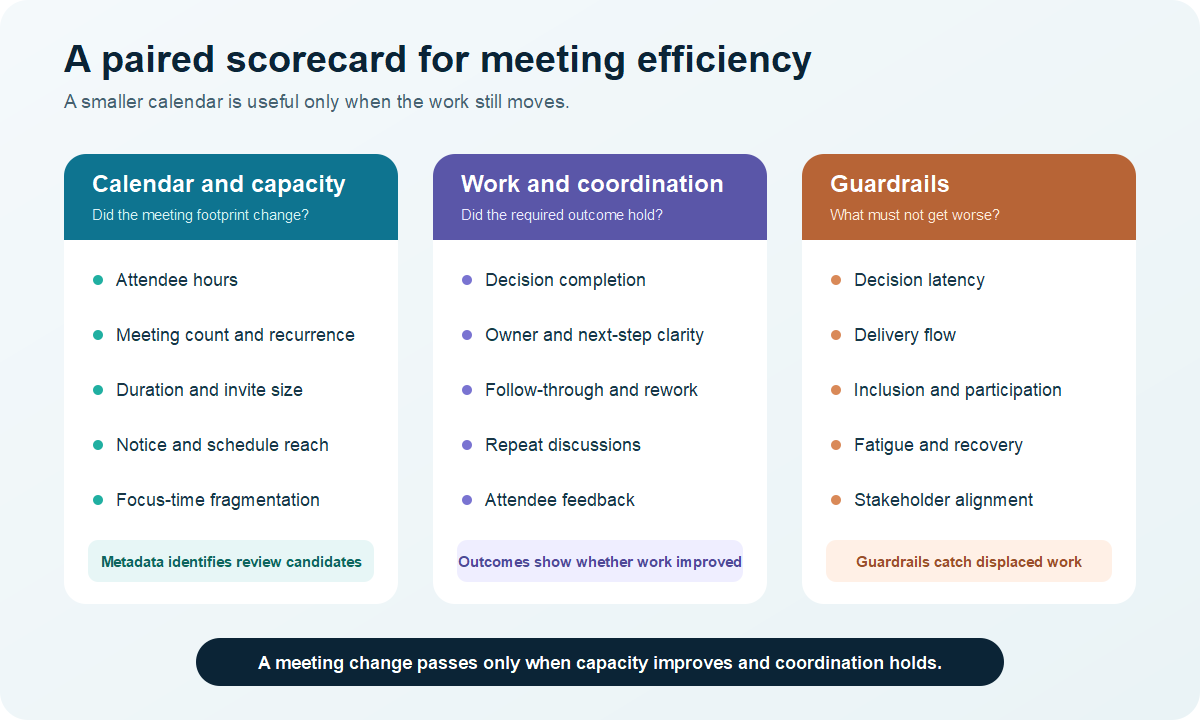
Useful signals include:
The Calendar Analytics Guide explains schedule shape and fragmentation in more depth. For efficiency work, these measures define the footprint of a meeting group and show whether an intervention changed it.
Select measures that match the reason the meeting exists:
Large-scale empirical work by Yasaman Hosseinkashi and colleagues paired survey responses with observable attributes from real-world remote meetings to study effectiveness and inclusiveness. Their method is instructive even beyond remote work: objective attributes can help identify patterns, but perceived effectiveness and inclusion still require direct evidence. A proxy is not the outcome.
Choose two or three things that must not get worse. Useful guardrails include decision latency, delivery flow, inclusion, fatigue, recovery time and stakeholder alignment.
Recovery deserves attention because meeting cost does not end when the call ends. A cross-sectional study of 195 US full-time workers found that perceived meeting satisfaction and effectiveness were related to reported recovery after virtual meetings. The study does not establish causation, and it did not find the same relationship for measured transition time. It still gives operators a sensible warning: do not pack the calendar so tightly that every meeting hands cognitive residue to the next task.
Calendar metadata can show count, duration, recurrence, invite reach, timing, notice, agenda signals and cost. It cannot prove that a decision was sound, that an employee performed well, that a participant felt included or that a meeting was wasteful.
Use metadata to find review candidates and measure calendar change. Use business outcomes, meeting records and direct feedback to judge the work. If you need a practical method for the latter, use the post-meeting feedback collection guide.
There is no responsible company-wide answer to "How many meetings is good?" The answer changes with the work. A support escalation team, a distributed product group, an executive committee and a hiring team face different coordination costs and risks.
External benchmarks can provide context, but they should not become a quota. A reported average often combines different roles, company sizes, calendar coverage, meeting types and working patterns. It may also count scheduled time when the business needs actual attendance, or count calendar events that are not comparable meetings.
Build targets from four layers instead:
Suppose three product teams spend 120 attendee-hours each month in weekly status meetings. The important question is not whether 120 is above an internet average. Ask whether the same risk visibility and dependency resolution could be achieved with 90 attendee-hours, while decision speed, blocker age and team feedback remain stable.
That creates a local experiment: specific cohort, visible denominator, operational outcome and guardrails. If the test passes, the company has evidence for that meeting family. It still has not discovered a universal rule for everybody else.
The same discipline applies to meeting length and quantity. Use the right amount of meetings and ideal-duration guidance as diagnostic context, then set the operating target around the work in front of you.
A meeting family is a group of sessions that serve the same purpose in a comparable context. It might be one recurring series, all weekly team status meetings, a set of regional sales reviews or the candidate debriefs used by one hiring function.
This is a better unit of analysis than an employee leaderboard. People inherit meetings. Some roles must coordinate across more teams. A recruiter and a software engineer do not have comparable calendars. Ranking them by meeting hours would confuse job design with performance and invite the wrong kind of management behavior.
Segment by meeting purpose, team, role, cadence, time zone and available data. Then ask whether the group is internally comparable.
Recurring meeting families are often the best first review queue because one decision can change many future calendar events. In Flowtrace's 2026 meeting statistics work, based on 1,240,880 scheduled meetings from 2025, 48.5% were recurring, or 602,387 meetings. That is descriptive evidence, not a waste estimate. Recurring work can be essential. The figure shows why recurrence deserves ownership and review, not why every series should be cancelled.
For the detailed recurring-meeting process, see how to review and reduce recurring meetings.
The decision should follow the required outcome, not a quota.
Keep the meeting when it produces necessary coordination with proportionate attendance and time. A weekly incident review may look expensive, but if it finds recurring risk, assigns corrective work and prevents repeat failures, the burden can be justified.
Keeping does not mean exempting the meeting from review. Give it an owner, purpose and review date. Watch for scope creep, attendee inflation and a cadence that no longer matches the work.
Remove the meeting when nobody can name the required outcome, the original project has ended, another forum already handles the work or the series survives only because it has always existed.
Before cancelling, check what participants actually use it for. A formal status meeting may also be the only place two teams surface risks. Preserve that job elsewhere if it matters.
Replace a meeting when most of the work is reading updates, reporting completed tasks or distributing information that does not need immediate interaction.
The replacement needs a format, owner, deadline and escalation path. An unwatched document is not an operating system. GitLab's public communication handbook is a useful practitioner example because it treats asynchronous and synchronous communication as tools with different jobs and puts heavy emphasis on written context. That model will not fit every company, but the mechanism is sound: removed meetings need durable information and an agreed route back to real-time discussion.
Shorten when interaction is necessary but the timebox is larger than the work. Reduce the number of people who need the whole session, separate information review from discussion or start with the decision that must be made.
Do not simply change a sixty-minute default to thirty minutes and call it done. Check whether follow-up meetings, overruns or unresolved decisions increase. Our guide to choosing the right meeting length covers duration by purpose and complexity.
Improve the meeting when the outcome matters but the path is weak. Common problems include unclear purpose, missing preparation, irrelevant attendees, poor facilitation, unresolved decisions and absent follow-through.
The evidence here is stronger than generic agenda advice. Simone Kauffeld and Nale Lehmann-Willenbrock videotaped 92 regular team meetings and coded the interaction. Constructive behaviors such as problem solving and action planning were associated with meeting satisfaction, team productivity and later organizational success, while dysfunctional communication had negative relationships with those outcomes. Their Meetings Matter study does not turn one behavior into a universal recipe, but it shows that what people do in the meeting matters.
Use the meeting agenda effectiveness guide for scheduling-time purpose and agenda checks. Use six ways to improve meetings across a company for the broader management levers, or the meeting audit checklist when a specific meeting needs a quality review.
Meeting efficiency breaks when everybody is given advice but nobody can change the system. Improvements need to land at the level where the behavior is controlled.
Leaders can remove duplicate forums, clarify decision rights, choose which meeting families matter and assign owners. They can also stop using meeting attendance as a substitute for visibility. If every stakeholder must attend because decisions are poorly documented, the problem is not invite etiquette.
Organizers control purpose, preparation, attendees, timebox, facilitation and follow-through. They are the people who can make a meeting easier to evaluate before it starts and easier to act on afterward.
Policy works more reliably when the better choice appears at the moment an invite is created. Defaults, review dates, purpose fields, agenda checks, attendee guidance and other scheduling rules can turn a document into daily behavior. The Meeting Policy Guide covers policy design and governance in depth.
This is where product mechanism matters. Flowtrace can surface meeting cost and validation guidance in Google Calendar and Microsoft Outlook, while organization-level analytics shows whether the behavior changes over time.
Thirty days is a useful starting boundary for many weekly meeting families. It is not a universal evaluation period. A quarterly governance forum needs a longer window, while a daily stand-up can produce evidence sooner.
The value of a bounded cycle is not the number thirty. It is the discipline of making one visible change, defining the evidence in advance and allowing reversal. That is more credible than announcing a company-wide meeting reduction target and hoping every team can absorb it.
Consider an illustrative product organization with four weekly status meetings. Each session runs for sixty minutes and invites ten people. Several leaders attend all four because the updates are stored in separate places. The meetings consume up to forty attendee-hours a week, although attendance varies.
The required outcome is not "hold four status meetings." It is this: by Tuesday afternoon, each team and its dependencies can see delivery risk, know which blocker needs escalation and identify the owner of the next action.
The review reveals three different jobs hiding inside the meetings:
Cancelling all four meetings would be reckless. Keeping them unchanged would ignore the duplication. The portfolio owner chooses a mixed intervention:
Before the test, the owner records attendee-hours, number of unresolved blockers, time to close cross-team decisions and participant feedback on whether they have enough context. During the test, they also watch ad hoc follow-up calls and chat escalation. If the calendar shrinks but blocker age or follow-up work rises, the change has not passed.
This example matters because efficiency rarely comes from one dramatic cancellation. It comes from separating the jobs a meeting has accumulated, giving each job the right mechanism and checking the result. A clean calendar is a side effect of a better coordination design.
Meeting efficiency needs one accountable program owner and shared operational responsibility.
| Role | Responsibility |
|---|---|
| Executive sponsor | Define the business outcome, risk tolerance and decisions that must not slow down |
| Operations, People or Workplace owner | Run the baseline, meeting-family review, intervention cycle and management cadence |
| IT or collaboration-tool owner | Configure access, integrations, privacy boundaries and calendar-side controls |
| Managers | Review comparable meeting groups, protect necessary coordination and respond to team evidence |
| Meeting organizers | Make purpose, attendance, preparation, decisions and follow-through explicit |
| Employees | Use replacements consistently, challenge low-value invites and report coordination gaps |
The exact accountable function varies. Operations is often well placed because the work crosses teams. People leaders may lead when employee experience is the trigger. IT may lead the technical rollout. Finance may sponsor a cost program.
The mistake is leaving ownership implicit. When nobody owns the portfolio, each organizer optimizes one invite and the company inherits the total.
Flowtrace is a B2B meeting analytics and meeting culture transformation platform. It uses calendar and meeting metadata to show patterns in meeting load, recurrence, duration, attendance, cost and scheduling behavior. It does not need to record, transcribe, summarize or interpret meeting conversations.
The product supports the full improvement loop:
This is an organization-level system. It is not an employee productivity score, AI notetaker or transcript-analysis tool. The point is to help the company change meeting behavior around people, not to monitor what people say.
Use the broad operating model here, then move to the specialist resource that matches the job.
| Reader job | Best next resource |
|---|---|
| Understand organization-level meeting data | Meeting Analytics Guide |
| Analyze schedule load and focus-time fragmentation | Calendar Analytics Guide |
| Build rules and calendar-side governance | Meeting Policy Guide |
| Change the wider behavior system and employee experience | Meeting Culture Guide |
| Calculate financial cost and ROI | Meeting Cost Guide |
| Reduce meeting quantity without losing alignment | How to Have Fewer Meetings |
| Choose duration by purpose | What Is the Ideal Meeting Length? |
| Decide whether meeting frequency is too high | What Is the Right Amount of Meetings? |
| Repair a meeting that still matters | How to Fix Unproductive Meetings |
| Reduce fatigue around necessary meetings | How to Reduce Meeting Fatigue |
| Evaluate meeting-efficiency software | Best Meeting Efficiency Software |
Meeting efficiency is the extent to which an organization gets the coordination outcome it needs without using more collective meeting time and attendee capacity than necessary. It pairs the meeting footprint with evidence that the work achieved its purpose.
Meeting effectiveness asks whether a meeting achieved its required outcome. Meeting efficiency asks how much collective time and attendee capacity the organization used to achieve it. An effective meeting can still be inefficient if it uses unnecessary time or attendance.
Pair calendar and capacity signals, such as attendee-hours, recurrence, duration and invite size, with work outcomes, such as decision completion, owner clarity, follow-through and attendee feedback. Track guardrails so the work is not merely moved into follow-up calls, chat or rework.
No. Fewer meetings can be one result, but the objective is to use the least collective meeting time that still supports the work. Some meetings should be removed. Others should be kept, shortened, replaced or improved.
Calendar and meeting metadata can show meeting count, duration, recurrence, attendee reach, notice time, timing, agenda signals and cost without recording, transcribing or interpreting what people say. Those signals show patterns, not employee performance or meeting quality on their own.
Match the review interval to the meeting's frequency and risk. High-frequency or high-cost meeting families need earlier review. Low-frequency governance meetings may need a longer evidence window. Every recurring series should have an owner and review date, even when it is healthy.
Choose one meeting family. Write down the coordination outcome it exists to produce. Measure the current attendee capacity and two work outcomes. Then choose one action and run a bounded test with guardrails.
Do not start with a company-wide target. Start with a decision you can inspect and reverse.
If you need organization-level visibility to run that cycle, see how Flowtrace meeting analytics works or schedule a demonstration.
Learn what meeting analytics is, which metrics matter, and how leaders use meeting data to improve meeting culture.
Learn how to assess and improve meeting culture with employee feedback, privacy-safe calendar data, clear rules and measurable behavior change.
Learn how to create a meeting policy, set meeting rules, govern calendars, and use analytics to make better meeting habits stick.