Meetings
Why Do Companies Have So Many Meetings?
Why companies have so many meetings and how to streamline them for better productivity and employee morale through strategic management and analytics.
Find the ideal meeting length by purpose. Compare 15, 25, 30, 45, 50, and 60-minute slots, then test what works for your team.
The ideal meeting length is the shortest slot that still produces the required outcome. That may be 15 minutes for a tightly scoped check-in, 25 or 30 minutes for a focused discussion or decision, 45 or 50 minutes for more complex collaboration, and 60 minutes or longer for a workshop that genuinely needs the time.
There is no universal number. A 20-minute meeting can be wasteful when an update should have been written. A 60-minute meeting can be appropriate when a team must resolve a complex tradeoff together. The useful question is not, “How short can we make every meeting?” It is, “How much shared time does this outcome require?”
That distinction matters because calendar defaults are powerful. Once a 30- or 60-minute slot becomes normal, people tend to fill it. The guide below gives you a practical starting point, then shows how to test whether the duration works for your team.
Use this table as a starting point, not a company-wide law.
| Starting duration | Good fit | What must be true | Warning sign |
|---|---|---|---|
| 15 minutes | Daily check-in, escalation, quick handoff | The scope is narrow, people are prepared, and no substantial debate is expected | The same issue is repeatedly deferred because the slot is too tight |
| 25 or 30 minutes | Focused decision, one-to-one, project review, problem framing | The desired output is explicit and background material is available before the meeting | The first half is spent finding context or deciding what the meeting is for |
| 45 or 50 minutes | Cross-functional decision, design review, structured working session | Several perspectives must be heard and the facilitator can keep the discussion moving | Discussion expands because the agenda has no priorities or decision rule |
| 60 minutes | Complex planning, retrospective, interview panel, multi-part review | Each segment earns its time and the meeting produces a concrete output | The hour exists because it is the calendar default |
| More than 60 minutes | Workshop, training, strategy session, incident review | The work cannot be split sensibly, participation is active, and breaks are planned | People become observers, repeat points, or start doing unrelated work |
A decision meeting may need 30 minutes one week and 50 minutes the next. The purpose can stay the same while complexity changes. If you need a deeper design for that format, use the decision meeting guide. For broader scheduling tactics, see how to optimize meeting time.
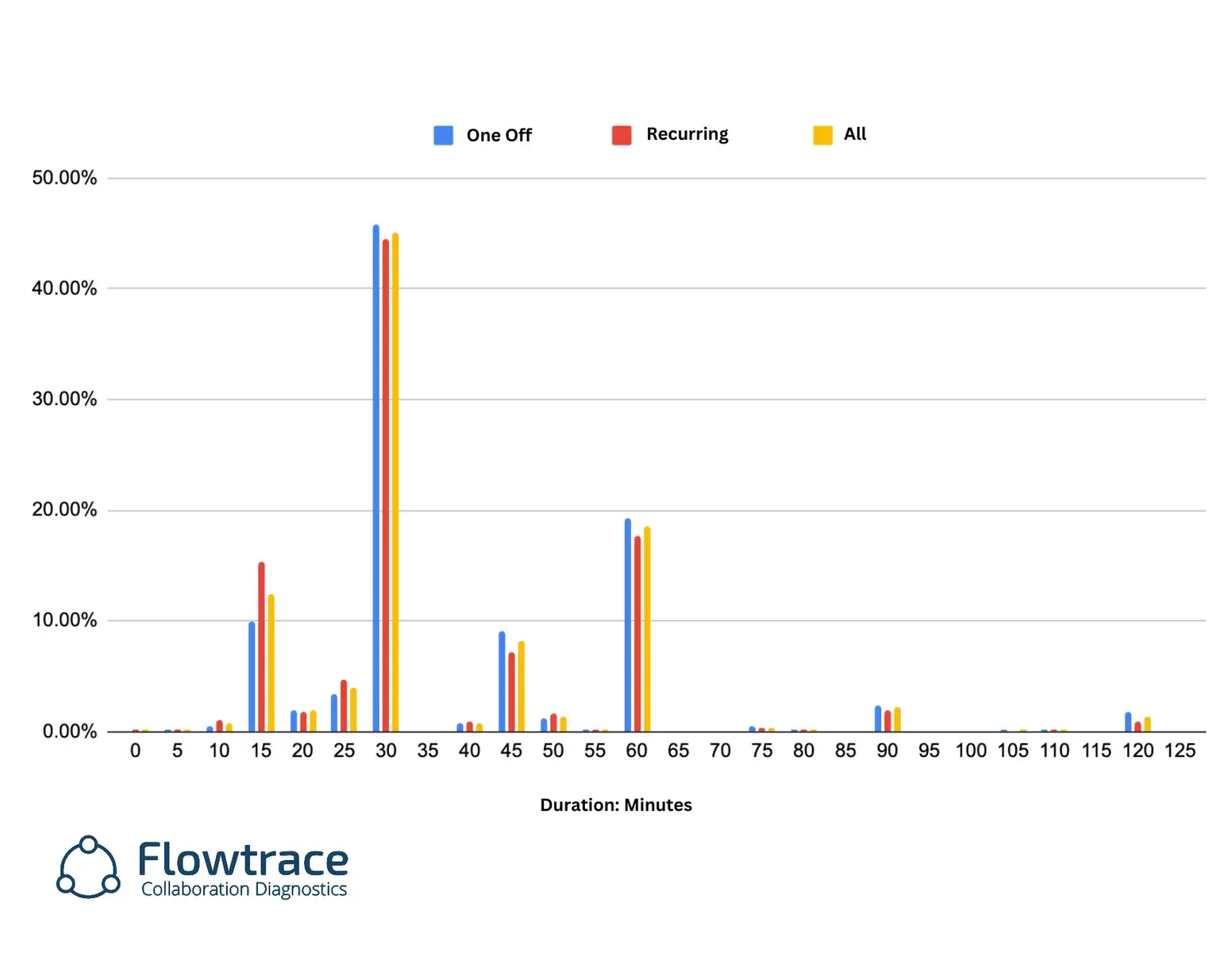
In Flowtrace's 2026 meeting statistics, based on more than 1.2 million scheduled meetings from 2025, 44.9% were set for 30 minutes and 18.9% for 60 minutes. In total, 65.3% were scheduled for 30 minutes or less. Only 5.7% used the auto-shortened 25- or 50-minute slots that create a small buffer between calls.
Those figures show what calendars contain. They do not prove that 30 minutes is ideal, that the meeting ended on time, or that a 25-minute meeting was more effective.
Research points in the same direction. In two studies of workplace meetings, Leach, Rogelberg, Warr, and Burnfield found that duration alone did not predict perceived meeting effectiveness. Meeting design and attendee involvement mattered more. Longer meetings were particularly weak when the agenda was not completed.
That is why shortening a badly designed meeting often produces a shorter bad meeting. Preparation, attendee fit, and meeting agenda effectiveness determine how much useful work can fit into the slot.
Duration still creates risk, especially in remote meetings. A large Microsoft Research study combined anonymized meeting and work telemetry with a 715-person diary study. The researchers found that longer remote meetings were associated with progressively higher odds of email multitasking. Compared with meetings lasting 0 to 20 minutes, the odds were higher in every longer duration band and highest in meetings over 80 minutes.
The researchers did not claim that every email sent during a meeting was harmful. Some multitasking supported the meeting. The pattern still gives organizers a useful warning: as a session gets longer, it becomes harder to assume that everyone is following the same conversation with the same level of attention.
Back-to-back scheduling creates a separate problem. In a small experiment with 14 information workers, Microsoft's Human Factors Lab compared four consecutive 30-minute video meetings with the same schedule separated by 10-minute breaks. Stress-related brainwave activity accumulated without breaks and stayed steadier when participants had time to reset. The sample was small, but the operational lesson is sensible: the space around a meeting can matter as much as shaving a few minutes from the meeting itself.
Before setting the end time, answer five questions.
Name the output. A decision, ranked list, approved plan, clarified owner, candidate assessment, or resolved blocker can be tested. “Discuss the project” cannot.
If the meeting has no required output, an asynchronous update may be better. This is also where meeting length and meeting volume separate. If the problem is too many events rather than oversized slots, review the right amount of meetings or consider how companies reduce meetings.
Reading, status reporting, data collection, and first reactions often belong before the call. Shared time is most useful for interpretation, disagreement, tradeoffs, and commitment.
Preparation should not become homework theater. Give people only the context they need, state what input is expected, and make the decision rule visible. Better preparation is what allows a shorter slot to remain useful.
More attendees do not automatically justify more time. They often indicate that the meeting has mixed roles.
Separate contributors from informed observers. If six people must shape the outcome, plan enough time for their input. If twenty people only need the result, send them the decision afterward.
A routine approval can fit into 15 minutes. A cross-functional choice with incomplete data and conflicting incentives may need 50. Complexity should buy time; status should not.
When uncertainty is high, define how the group will decide before the meeting starts. Otherwise, extra time merely gives the disagreement more room.
A 30-minute meeting between two focus blocks has a different cost from a 30-minute meeting inside a chain of six calls. Check travel, preparation, transition, and follow-up time.
This is why 25- and 50-minute defaults can help. They create a small recovery window without asking each organizer to remember it. Outlook currently lets users end meetings early or start them late, with separate settings for events under an hour and longer events. Flowtrace also supports behavior change in Google Calendar and Outlook when companies need calendar-side rules and nudges, not another policy document nobody sees.
A meeting is too long when the required outcome could have been produced sooner. The clock is one signal. Behaviour gives you better evidence.
Watch for these patterns:
For ordinary working meetings, 60 minutes is a useful review threshold, not a universal maximum. If a recurring meeting repeatedly needs longer, split the information-sharing work from the decision work. For workshops and training, design breaks and phases explicitly. Do not hide a two-hour workshop inside an oversized calendar block and hope attention survives.
Weekly load matters too. A team can have individually sensible 30-minute meetings and still lose whole days to fragmented calendars. Use average time in meetings when you need to diagnose the total hours rather than one meeting's duration.
A blanket rule such as “all meetings must be 25 minutes” is easy to announce and hard to defend. Run a controlled operating test instead.
Once the test works, a meeting policy can turn the new default into a clear organizational standard. Policy should follow evidence. It should not replace it.
One organizer can improve one meeting with a timer and a better agenda. Leaders face a different problem: they need to know which meeting types, teams, and recurring series consume time across the company.
Meeting analytics makes the pattern visible through calendar and meeting metadata. Flowtrace can show duration distributions, recurrence, attendee patterns, meeting costs, and changes over time without recording or transcribing what people say. Where meeting feedback is configured, teams can pair the calendar pattern with participant experience rather than assuming shorter always means better.
The useful management loop is straightforward:
That loop turns “make meetings shorter” from a slogan into an operating decision.

The ideal meeting length is the shortest slot that still produces the required outcome. Use 15 minutes for a tightly scoped check-in, 25 or 30 minutes for focused discussion or a decision, 45 or 50 minutes for complex collaboration, and 60 minutes or longer only for workshops or work that genuinely needs the time.
No universal evidence shows that 30 minutes is the most effective duration. It is the most common scheduled length in Flowtrace's 2026 data, but meeting purpose, preparation, attendee involvement, agenda quality, and the required output matter more than the calendar default.
A meeting is too long when the decision or output could have been produced sooner, attention drops, the discussion repeats, or attendees stop contributing. Sessions over 60 minutes should normally have a clear workshop purpose and a planned break.
Start with one recurring meeting type, improve preparation, reduce the default slot, protect transition time, and compare the result with the previous baseline. Keep the shorter duration only if the meeting still produces its intended outcome.
The best meeting duration is not a fashionable number. It is a deliberate allocation of shared time.
Start with the outcome, use the matrix as a reasonable default, and look for evidence that the meeting is either running out of useful work or running out of time. Then adjust. When the pattern appears across teams, measure it at company level and change the system that keeps recreating it.
Why companies have so many meetings and how to streamline them for better productivity and employee morale through strategic management and analytics.
Enhance productivity and optimize time management with calendar analytics for Microsoft Outlook. Access valuable insights and tools for efficient...
Calculate company meeting expenses with a transparent payroll formula, separate opportunity cost from cash savings, and build a practical budget.