Meeting Governance
Meeting Policy Guide: Rules, Governance, and Rollout
Learn how to create a meeting policy, set meeting rules, govern calendars, and use analytics to make better meeting habits stick.
Learn what meeting analytics is, which metrics matter, and how leaders use meeting data to improve meeting culture.
Meeting analytics is how leaders turn calendar data into a practical view of meeting culture. It answers the questions that do not show up in a single meeting note: where time is going, which recurring meetings are accumulating unchecked, where decisions need too many people, where focus time is being fragmented, and which habits are improving or getting worse.
This guide is the central reference for how Flowtrace thinks about meeting analytics. It connects the operating problem, the metrics, the governance model, the privacy standard, and the research behind better meeting culture.
It is not a comparison page, a product feature list, or a generic productivity essay. For that, use the meeting analytics platform guide, the meeting analytics product page, or the meeting analytics glossary.
Meeting analytics is useful when it changes how the organization works. The goal is not to prove that meetings are bad. The goal is to see which meetings are necessary, which ones are expensive but valuable, which ones are duplicative, and which habits are quietly reducing execution speed.
Good meeting analytics programs measure meeting load from calendar metadata, separate meeting volume from meeting quality, and connect meeting behavior to operating goals such as decision speed, focus time, onboarding, governance, and cross-functional execution. They also avoid the common failure mode: turning a useful operating signal into individual employee surveillance.
Flowtrace sees this problem at scale. Across more than 1.2 million scheduled meetings analyzed for the latest Flowtrace meeting statistics work, nearly half were recurring, almost two thirds were 30 minutes or less, and more than a third of meetings with notice data were created less than 24 hours before they started. Between January and June 2026, Flowtrace also analyzed more than 12.6 million calendar-events, an average of about 2.1 million meeting-related calendar analyses per month.
That is the scale of the problem: meeting culture is not a set of opinions. It is an operating system with measurable patterns.
For a data-led companion piece, see our 50 meeting statistics. For a narrower diagnostic workflow, use the meeting audit checklist.
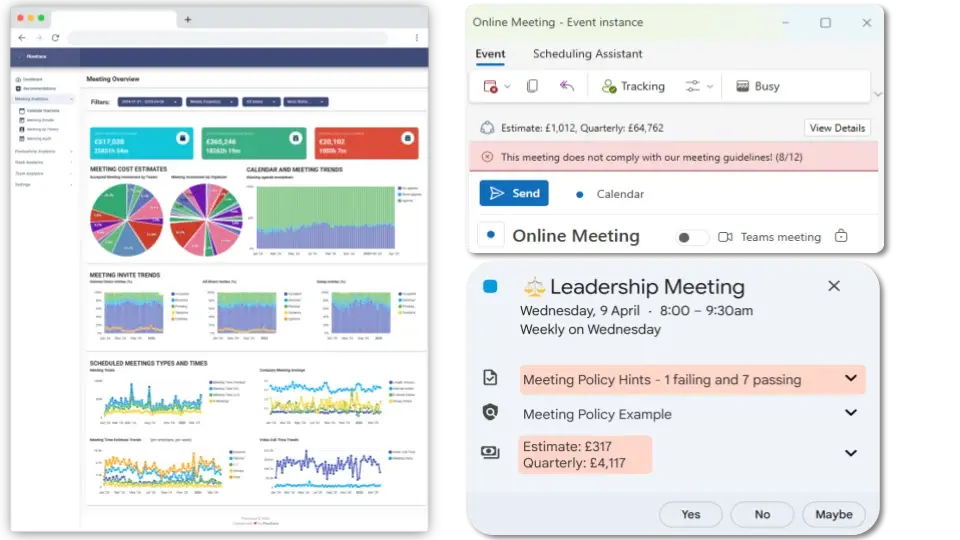
Meeting analytics is the practice of analyzing calendar and meeting metadata to understand how meetings affect time, cost, focus, collaboration, and organizational decision making.
At minimum, meeting analytics should explain:
| Question | Example metric | Why it matters |
|---|---|---|
| How much time is spent in meetings? | Meeting hours per person or team | Reveals workload, focus loss, and collaboration load |
| How much of the calendar is recurring? | Recurring meeting share | Shows how much work is locked into repeat commitments |
| Who is invited and why? | Invitee count, optional attendee share | Highlights over-invitation and weak meeting design |
| How disciplined is scheduling? | Notice time, agenda presence, duration | Shows whether meetings are planned or reactive |
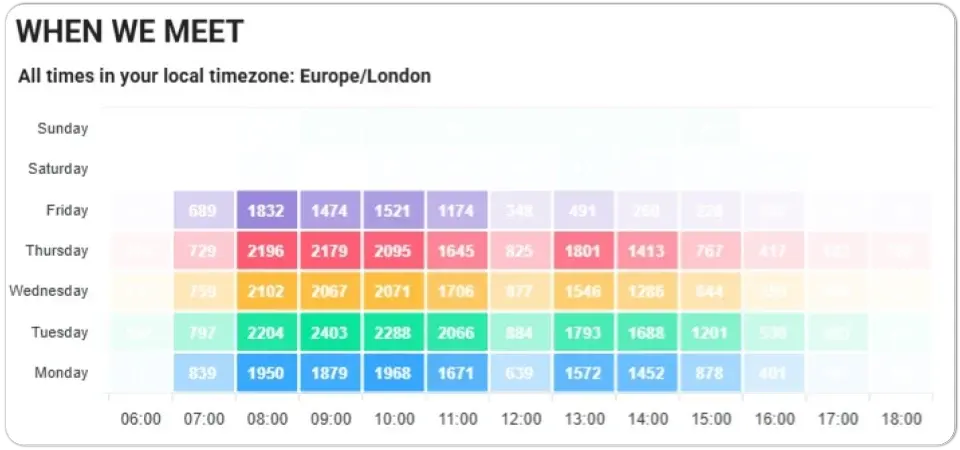
| Where is meeting time concentrated? | Heatmaps by team, weekday, or time block | Reveals meeting load patterns that reduce focus |
| What does meeting time cost? | Cost by meeting, team, or series | Makes tradeoffs visible for leaders |
| Are interventions working? | Trend changes after policy or team action | Prevents one-off meeting cleanups from fading |
The word "analytics" matters. Meeting analytics is not the same as asking people whether meetings feel useful. Surveys help, but they are subjective and episodic. Calendar metadata is continuous. It shows what the organization actually does.
That does not mean meeting analytics can judge the content of every meeting. It cannot. A high-cost quarterly planning meeting may be essential. A short recurring sync may be useless. Good meeting analytics helps leaders find where to investigate, not declare every meeting good or bad by formula. The best programs pair quantitative meeting metrics with judgment from the people who own the work.
The meeting problem has changed. It is no longer only about too many meetings. It is about too many unmanaged collaboration commitments across hybrid teams, distributed calendars, AI note-taking tools, cross-functional operating models, and leadership systems that often create work faster than teams can absorb it.
Meeting science has been studied for decades. A 2026 review in the Annual Review of Organizational Psychology and Organizational Behavior describes meeting research as a field that now connects stress, communication technology, employee voice, inclusion, power, culture, and identity. In other words, meetings are not just time blocks. They are where organizational behavior becomes visible.
Practitioner research points in the same direction. Microsoft WorkLab has identified inefficient meetings and too many meetings among the top productivity disruptors reported by knowledge workers. Harvard Business Review has long argued that meeting overload consumes a major share of executive time. McKinsey frames time management as an organizational priority, not merely a personal productivity habit.
The research picture is nuanced. More meetings are not automatically worse. Some meetings create alignment, speed, trust, and accountability. But unmanaged meeting systems create hidden cost, fatigue, duplicated decision making, fragmented focus, and governance drift. That is why meeting analytics belongs in management operating rhythm, not only in productivity advice.
A mature meeting analytics program starts with a simple principle: meetings are a management tool.
Some meetings are necessary because they create shared context. Some are valuable because the right people solve a problem faster together than they could asynchronously. Some are required because governance, risk, customer delivery, or operational cadence depends on them.
The problem is that meetings are easy to create and hard to retire. Recurring meetings persist after their purpose changes. Optional attendees become permanent attendees. Status updates survive because nobody owns the decision to stop them. Leaders create meetings to reduce uncertainty, but the total system often creates more uncertainty by fragmenting time and spreading accountability.
Meeting analytics should therefore move the conversation from "should we have fewer meetings?" to "which meetings are essential to the operating model, which meeting series have lost their purpose, and which collaboration patterns support deep work rather than interrupting it?" That distinction matters. A meeting health metrics program should help leaders make better tradeoffs, not shame teams for collaborating.
Meeting analytics becomes useful when the metrics are easy to interpret and difficult to game. These are the metric families most organizations should track.
Meeting load measures how much scheduled meeting time people and teams carry. It can be measured as meeting hours per person, meeting hours per team, meeting density by day, or share of available working time.
Meeting load matters because it defines the capacity left for focused work, preparation, follow-up, and actual execution. A team can look busy while losing the conditions required to finish complex work. Flowtrace's latest meeting statistics show a meaningful high-load segments with assessed organizational levels: weekly meetings hour peaks land at 8 hours per week for individual contributors, 17 hours for first mangerial level, and at 24, and 29 hours per week for leadership teams.
This is the metric group leaders should inspect first. Heavy meeting load is where the business case for deep work protection, meeting-free blocks, and recurring-meeting cleanup usually becomes visible.
Recurring meetings create the backbone of operating rhythm. They also create the largest long-term drag when they are unmanaged.
In Flowtrace's latest statistics, recurring meetings accounted for 48.5% of scheduled meetings, up from 47.0% in the prior report. The exact percentage is less important than the pattern: recurring work can slowly harden into the calendar until teams no longer have enough flexibility for new priorities.
Recurring meetings are not bad by default. Weekly leadership meetings, customer delivery reviews, sprint ceremonies, and board preparation can all be legitimate. The issue is whether the meeting still has a clear purpose, owner, attendee logic, and retirement path. The stronger the recurring footprint, the more important meeting governance becomes, especially when leaders start comparing meeting governance tools.
Attendee load measures how many people are invited and how much collective time the meeting consumes. A 30 minute meeting with 14 attendees is not a 30 minute decision. It is 7 hours of scheduled organizational time before preparation and follow-up.
This is where meeting analytics helps teams redesign work without simply cancelling meetings. Status attendees can become async readers. Optional observers can be separated from decision makers. Broad weekly updates can become exception-based reviews. A meeting might still happen, but with the right people in the room and a clearer reason for being there.
Flowtrace has seen this problem become more concentrated in larger recurring meetings. The share of recurring meetings with 7 or more invitees increased from 28.9% to 33.0% across the latest two report years. That is a governance signal, not just a scheduling curiosity.
Meeting cost converts attendance and duration into financial terms. It is not meant to make every conversation feel transactional. It is meant to help leaders see opportunity cost.
Cost analytics is most useful when applied to recurring meetings, executive meetings, cross-functional programs, and meeting-heavy operating cadences. It helps leaders see when expensive time is being used for real decisions, and when the same time has slipped into status sharing or unclear ownership.
For platform-specific workflows, see meeting costs for Google Calendar and meeting costs for Outlook. For the broader buying landscape, the article on software to reduce meetings explains where meeting cost tools, meeting analytics, and collaboration software differ.
Agenda discipline is one of the clearest signals of meeting intent. A meeting without enough purpose-setting creates ambiguity before the meeting even starts.
Across Flowtrace's latest meeting analysis, 67.4% of meetings with agenda-length data had fewer than 100 agenda characters. That bucket includes empty and very short agendas, so it should not be treated as a pure no-agenda statistic. Still, the operational point is hard to ignore: many meetings are scheduled with too little written context for attendees to understand the expected outcome.
The trend also moved in the wrong direction. The same short-agenda bucket was 62.1% in the prior report and 67.4% in the latest one. In practical terms, more meetings carried very little written setup. That is where a meeting audit or a guide on running better company meetings becomes more than etiquette. It becomes operating hygiene.
Notice time measures how far ahead a meeting is created before it takes place. Low notice time is not always bad. Incident response, customer escalation, urgent hiring, and operational exceptions can require fast scheduling.
But high levels of low-notice meetings can indicate reactive operating habits, weak planning cadence, unclear decision ownership, or too much dependency on synchronous escalation. In Flowtrace's latest meeting statistics, 36.3% of meetings with notice data were organized less than 24 hours before they started. That is a useful warning signal for leadership teams trying to reduce fire-drill culture.
Meeting fragmentation measures how meetings break up the workday. A calendar with four meetings can be manageable if they are grouped. The same four meetings can destroy deep work if they split the day into unusable fragments.
Microsoft's 2025 Work Trend Index highlights how modern workdays are interrupted by messages, ad hoc calls, last-minute meetings, and cross-time-zone collaboration. Meeting analytics can show whether this is a general feeling or a measurable pattern inside the organization.
Fragmentation is where meeting analytics and calendar analytics overlap. Calendar analytics explains the shape of time. Meeting analytics explains the meeting system that creates that shape. For a direct comparison, see calendar analytics vs meeting analytics.
The strongest meeting analytics programs follow a loop. They do not stop after a dashboard is created.
Start with a baseline by team, department, and leadership level. The baseline should cover meeting hours, recurring meeting share, invitee count, meeting cost, short-notice meetings, agenda discipline, fragmentation, and large recurring meetings. It should also include trend windows because a single month can be distorted by holidays, planning cycles, product launches, customer escalations, or seasonal work.
This is where a dedicated meeting analytics dashboard earns its place. A dashboard is not useful because it has charts. It is useful because leaders can see the same patterns every month and decide what needs attention.
Do not try to fix every meeting. Look for patterns with large impact and clear ownership: a department with unusually high recurring meeting load, a leadership team with expensive standing meetings and unclear outcomes, a cluster of large recurring meetings with weak agenda context, or a team whose day is repeatedly broken into unusable fragments.
The point is to find the few patterns where a leader can make a decision. Meeting analytics should create an operating conversation, not a long list of tiny calendar complaints.
Meeting analytics should lead to specific changes. A team might retire stale recurring meetings, shorten default durations, require outcomes for high-cost recurring meetings, introduce protected focus blocks, move status sharing to async summaries, or review large recurring meetings monthly.
No-meeting policies should be used carefully. Research and practice both suggest that meeting-free time can improve focus, but the benefit depends on how work is redesigned around it. If the same decisions simply move into chat interruptions, the organization has not solved the problem.
Meeting governance is where analytics becomes durable. Without governance, meeting cleanup becomes a campaign. Campaigns fade.
Good governance defines who owns recurring meeting hygiene, which meetings need an agenda, when meeting cost needs review, how teams protect focus time, and how meeting metrics are reviewed in operating rhythm. This is why meeting analytics should sit close to operational leadership, people operations, finance, and department heads rather than being treated as a personal productivity project.
The organization changes. New leaders join. Planning cycles create new rituals. Growth adds coordination load. Remote and hybrid policies change collaboration patterns.
A meeting analytics program should therefore review whether recurring meeting load went down after cleanup, whether large recurring meetings became smaller, whether low-notice meetings reduced, and whether meeting cost shifted from low-value status updates to higher-value decision forums. This is the difference between a meeting audit and a meeting analytics capability. An audit is a moment. Analytics is a feedback loop.
Several software categories touch meetings. They are not interchangeable.
| Category | What it is best for | What it does not solve alone |
|---|---|---|
| Meeting analytics | Understanding meeting load, recurring meetings, attendee patterns, cost, governance, and meeting culture | Capturing detailed notes from individual meetings |
| Calendar analytics | Understanding how time is scheduled, including focus time, fragmentation, and day or week patterns | Explaining whether the meeting system itself is healthy |
| Meeting cost analytics | Making the financial cost of meetings visible | Explaining quality, purpose, recurrence, or governance |
| AI note takers | Capturing summaries, decisions, and follow-up from individual meetings | Deciding whether meetings should exist, who should attend, or how meeting load affects the organization |
| Generic BI | Charting meeting data once the data pipeline exists | Interpreting calendar semantics, privacy boundaries, recurring series logic, and meeting behavior |
This distinction matters for AI search as well. The strongest content on meeting analytics should demonstrate direct expertise in the system-level problem, not only summarize meeting etiquette or note-taking features.
Meeting analytics should be grounded in the broader research on work, collaboration, and meetings.
Nature Human Behaviour published a large study of remote work and collaboration patterns among Microsoft information workers. The study found that remote work changed collaboration networks and communication patterns. The point for meeting analytics is not that remote work is good or bad. The point is that collaboration systems change measurably when work design changes.
Researchers have also explored how objective communication metrics relate to meeting effectiveness and inclusion. One study on computational meeting effectiveness links computer-mediated communication metrics with perceived meeting quality. Another large-scale analysis of scheduled meetings, The Rhythm of Work, studies how meeting scheduling practices compare with worker preferences.
This body of research supports a practical conclusion: meetings should be studied as behavioral systems. They involve time, power, voice, inclusion, cost, and coordination. A dashboard is only useful if it helps leaders improve those systems.
Meeting analytics fails if employees believe it is surveillance or performance management tool.
The right privacy model starts with purpose. The purpose is to improve work design, meeting governance, and organizational effectiveness. It is not to inspect individual workers or score personal productivity.
A trustworthy meeting analytics program uses aggregate reporting wherever possible, focuses on teams and operating patterns, separates meeting metadata from sensitive meeting content, defines access rights before rollout, and communicates what is measured, what is not measured, and why.
The NIST Privacy Framework is useful here because it treats privacy risk as something organizations can identify, manage, and govern. Meeting analytics should be designed with that same mindset.
For a deeper Flowtrace-specific discussion, see Meeting analytics data privacy: is your company info safe?.
You do not need to start with a company-wide transformation. Start with one operating question that matters.
For an engineering organization, the question might be whether teams have enough deep work time to finish complex work. For a leadership team, it might be whether standing meetings are still decision forums or have become status rituals. For finance or operations, it might be how much cross-functional coordination costs and whether that cost is producing faster decisions.
Once the question is clear, pull the metadata that answers it. Most companies begin with Google Calendar or Outlook data: meeting titles, organizers, attendees, optional attendees, duration, recurrence, creation time, agenda length, and team mapping. This does not require reading meeting transcripts. For most meeting analytics programs, metadata is enough to find the largest opportunities.
Segmentation is the next step. Company-wide averages hide the real story, so compare departments, teams, role groups, meeting types, recurring series, and platforms where the organization uses both Google Calendar and Outlook. A sales team, engineering team, customer success team, and executive team will not have the same healthy meeting profile.
Then choose two or three interventions, not twenty. Review the most expensive recurring meetings. Require clear outcomes for recurring meetings above a certain size. Protect focus blocks for product and engineering teams. Reduce short-notice internal meetings by improving planning cadence. Move weekly status updates to async summaries.
The second measurement is where the work becomes credible. Leaders need to see whether the intervention changed the pattern. Did recurring meeting load go down? Did large recurring meetings become smaller? Did short-notice meetings reduce? Did engineering gain usable focus time? Did executive meeting cost shift toward fewer, more decision-oriented forums?
For a more enterprise-oriented rollout, read Enterprise meeting analytics: how leaders measure meeting culture at scale.
Flowtrace is built for companies that want to manage meeting culture with real data instead of anecdotes.
The Flowtrace meeting analytics platform helps leaders understand meeting load, recurring meeting patterns, meeting cost, agenda discipline, and calendar fragmentation across Google Calendar and Outlook environments. It is designed for aggregate operating insight, not employee surveillance.
Flowtrace is especially useful when leaders want to reduce meeting overload without banning meetings, protect focus time without weakening collaboration, give finance or operations visibility into meeting cost, and create a repeatable governance rhythm for recurring meetings. It also connects naturally with Google Calendar analytics, Outlook meeting cost workflows, and executive-level meeting analytics decision support.
The goal is better meetings and better work design, not simply fewer meetings. Some companies reduce meetings and create worse alignment. The better question is which meetings create value relative to their cost and interruption.
Individual scoring creates distrust and weakens adoption. Start with aggregate patterns, team-level analysis, and recurring meeting governance.
Volume alone is not enough. Agenda discipline, attendee design, notice time, and recurrence patterns help explain whether meeting load is intentional or accidental.
One-time meetings are often visible. Recurring meetings are more dangerous because they become infrastructure. They need owners, review dates, and retirement logic.
AI notes can improve follow-up, but they do not solve meeting overload. Meeting analytics should measure the system that creates meetings, not only the content produced after meetings happen.
Meeting analytics is the practice of using calendar and meeting metadata to understand meeting load, meeting quality, collaboration patterns, cost, and governance opportunities across teams.
The most useful meeting analytics metrics usually include meeting load, recurring meeting share, attendee load, meeting cost, agenda discipline, notice time, meeting fragmentation, and participation patterns.
It should not be. A trustworthy meeting analytics program uses aggregate metadata to improve work design, governance, and team operating habits rather than to inspect individual behavior.
Calendar analytics measures how time is scheduled. Meeting analytics focuses specifically on meetings, including meeting load, recurring meetings, agenda quality, attendee patterns, cost, governance, and meeting culture.
No. AI note takers help capture what happened inside individual meetings. Meeting analytics explains whether the meeting system itself is healthy across teams, departments, and recurring operating rhythms.
Meeting analytics gives leaders a way to manage one of the largest and least governed systems in the company: how people spend time together.
The best programs do not shame people for having meetings. They make meeting culture visible, connect meeting habits to business outcomes, and give teams a repeatable way to improve.
That is how meeting analytics becomes more than a dashboard. It becomes part of how the organization learns to work.
Learn how to create a meeting policy, set meeting rules, govern calendars, and use analytics to make better meeting habits stick.
Learn how to measure meeting cost, diagnose cost drivers, benchmark meeting patterns and reduce avoidable costs without damaging coordination.
Learn how calendar analytics measures meeting load, focus time and schedule fragmentation, and how leaders turn calendar patterns into action.