Meeting Governance
Meeting Management: Policy, Rules, and Analytics
Learn how to manage meetings with policy, rules, analytics, and recurring meeting reviews that improve meeting culture.
Use this meeting audit checklist and scorecard to assess meeting culture, find wasted time, and decide which meetings to remove, shorten, redesign, or govern.
A meeting audit is a structured review of meeting quality: why each meeting exists, whether the right people attend, how well participants prepare, what decisions are made, what follow-up happens, and whether recurring meetings still deserve to continue.
Use this meeting audit checklist as a practical template. It is designed for teams that want to assess meeting culture, review recurring meetings, find weak agendas, reduce unnecessary attendance, and decide which meetings to remove, shorten, redesign, or govern.
This is not a broad calendar audit. A calendar audit asks where company time goes. A meeting audit asks whether the meetings themselves are worth keeping, improving, or replacing.
Key takeaways

A meeting audit is a practical assessment of your organization's meeting culture. It looks at meeting purpose, ownership, agenda quality, preparation, attendee fit, participation, recurrence, length, cost, decisions, and follow-up.
The output should not be a long report nobody uses. The output should be a decision list:
A meeting audit is different from a one-off meeting feedback survey. Feedback tells you how people experience meetings. An audit connects that feedback to observable meeting patterns: invite quality, attendee count, recurrence, cost, ratings, decisions, and follow-up. The best results usually come from using both qualitative feedback from employees and quantitative meeting analytics from meeting metadata.
Most companies do not have a meeting problem because people love wasting time. They have a meeting problem because recurring meetings become the default answer to every uncertainty.
That is why generic advice like "have fewer meetings" rarely sticks. Someone still needs to make decisions, resolve dependencies, onboard new people, update stakeholders, and keep teams aligned. If you remove meetings without understanding the work they were doing, the same coordination problem returns somewhere else.
The data also shows why this deserves a serious review. Flowtrace analyzed 1,240,880 scheduled meetings in its 2026 report dataset, based on complete 2025 production data. In that dataset:
Those are not universal market averages. They are Flowtrace production findings from organizations using Flowtrace data. But they show the kind of patterns a meeting audit should inspect: recurring meeting value, agenda clarity, preparation time, attendee discipline, and whether large meetings are still producing outcomes.
External research points in the same direction. Microsoft's 2023 Work Trend Index found that inefficient meetings were the top productivity disruptor reported by workers, while too many meetings ranked third. Harvard Business Review has also reported that many senior managers see meetings as unproductive and inefficient. The point is not that every meeting is bad. The point is that unmanaged meeting systems quietly become expensive.
Use this meeting audit template to review one meeting, one recurring series, a team, a department, or a company-wide meeting pattern. Score each item from 1 to 5, then add evidence and an action.
| Audit area | What to check | Evidence to collect | Action if weak |
|---|---|---|---|
| Purpose | Does the meeting have a reason to exist now? | Title, owner, stated objective, decision need | Remove, merge, or rewrite the purpose |
| Agenda | Is there a clear agenda before the meeting? | Invite text, agenda length, prep material | Require an agenda or cancel the meeting |
| Attendees | Are the right people invited? | Required vs optional attendees, role fit | Reduce attendees or make some optional |
| Recurrence | Does the cadence still match the work? | Recurring series age, attendance, outcomes | Shorten cadence or add a review date |
| Length | Is the meeting longer than the task needs? | Scheduled duration, overrun patterns | Shorten to 15, 25, or 30 minutes |
| Cost | Is the meeting worth the time invested? | Attendee count, duration, salary-band estimate | Remove low-value expensive meetings |
| Preparation | Can people contribute without catching up live? | Materials, pre-reads, async context | Move updates to async or require prep |
| Participation | Are people engaged for the reason they attend? | Attendance, speaking roles, ratings, feedback | Split decision makers from listeners |
| Decisions | Does the meeting produce decisions or next steps? | Notes, outcomes, owner assignment | Add a decision log or change format |
| Follow-up | Are actions completed after the meeting? | Action items, due dates, status updates | Add owner, deadline, and review loop |
| Governance | Are meeting rules reinforced before invites are sent? | Calendar rules, invite validation, policy checks | Add calendar-side nudges or rules |
This is the core checklist. The rest of the article explains how to use it without creating another meeting about meetings.
Do not start by auditing every meeting in the company by hand. Start with a scope you can act on.
Good starting scopes include:
Search Console data shows readers come to this page for "meeting audit template," "meeting audit," and "audit meeting." That intent is practical. They want a checklist they can use. So the scope should be practical too.
For a first pass, focus on recurring meetings and low-rated meetings. Recurring meetings compound faster than one-off meetings because they keep spending time even after their purpose has expired. Low-rated meetings tell you where employees already feel the format is not working.
Meeting feedback matters, but opinions alone can mislead. One team may complain loudly about meetings while another quietly accepts a broken recurring meeting because it has always existed. A useful audit combines employee sentiment with meeting evidence.
Collect these signals:
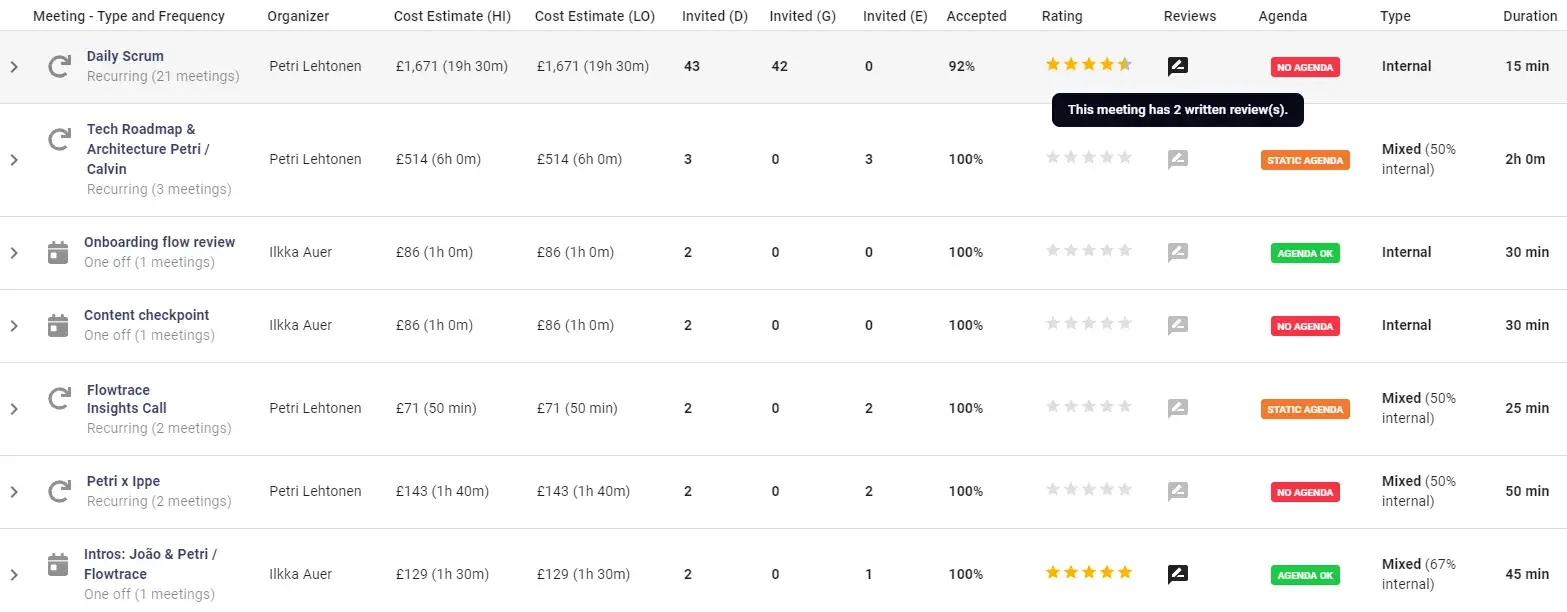
If you use Flowtrace, this is where metadata-first meeting analytics helps. Flowtrace can show recurrence, attendee patterns, meeting cost, agenda use, punctuality, ratings, and scheduling behavior without reading, recording, or summarizing meeting conversations.
Use a 1 to 5 score for each checklist area:
| Score | Meaning | Action |
|---|---|---|
| 1 | No clear reason for the meeting | Remove or replace |
| 2 | Some purpose, but poor structure or weak attendance fit | Redesign |
| 3 | Useful, but inconsistent or too expensive for the value | Improve |
| 4 | Clear purpose and mostly good meeting hygiene | Keep and monitor |
| 5 | High-value meeting with strong decisions, preparation, and follow-up | Protect |
A meeting does not need a perfect score to stay. Some messy meetings are still necessary because the work is messy. But a recurring meeting with no clear purpose, no agenda, too many attendees, poor feedback, and weak follow-up should not survive because it has always existed.
Agenda quality is one of the fastest ways to diagnose meeting culture.
A good agenda answers four questions:
In Flowtrace's 2026 report dataset, 67.4% of meetings with agenda-length data had fewer than 100 agenda characters. That bucket includes both empty and very short agendas, so it should not be used as a pure "no agenda" statistic. Still, it is a strong warning signal. If the invite barely explains the meeting, participants are likely to spend the first part of the meeting discovering why they are there.
For more detailed planning, use a meeting preparation checklist before changing meeting rules.
Bad attendee fit is one of the hidden costs of meeting culture. A meeting with the wrong people can look normal on the calendar while weakening decisions, slowing preparation, and wasting expensive focus time.
Ask:
Flowtrace's 2026 report dataset found that 79.1% of meetings with invite-size data had six or fewer invitees, while 33.0% of recurring meetings with invite-size data had seven or more invitees. Large recurring meetings deserve special review because they combine two expensive patterns: repeated time commitment and broad attendance.
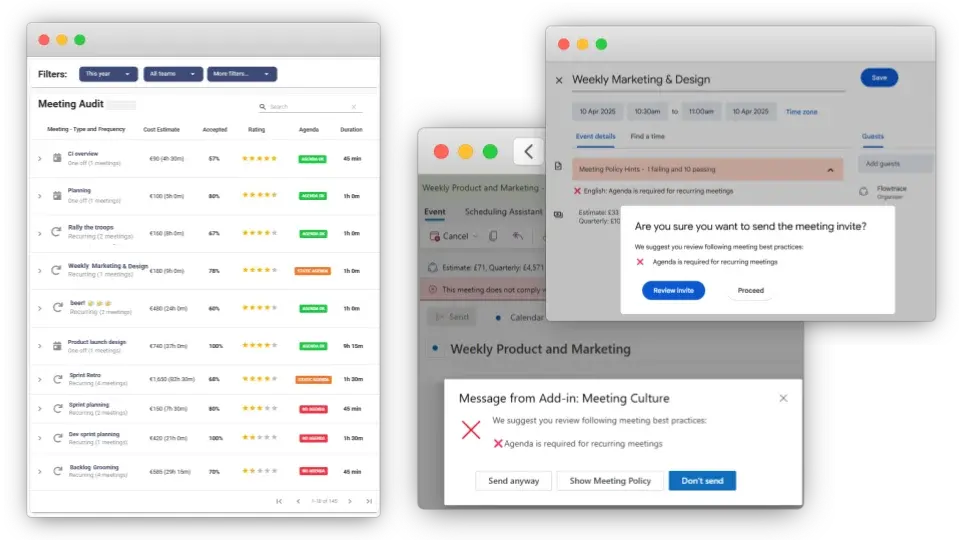
If attendee discipline is a recurring problem, review meeting invite rules and consider calendar-side governance.
Length is not the same as value. A 60-minute meeting can be excellent if it resolves a hard decision. A 15-minute meeting can be wasteful if it only repeats a dashboard.
Still, meeting length is a useful signal. Flowtrace's 2026 report dataset found that 44.9% of scheduled meetings were 30 minutes, while 18.9% were 60 minutes. It also found that 65.3% of scheduled meetings were 30 minutes or less.
Use those patterns as prompts, not rules. The audit question is not "is this meeting too long?" The audit question is "does this meeting need this much synchronous time to produce its outcome?" Ask:
For more depth, read what the ideal meeting length depends on and how many meetings a week is too many.
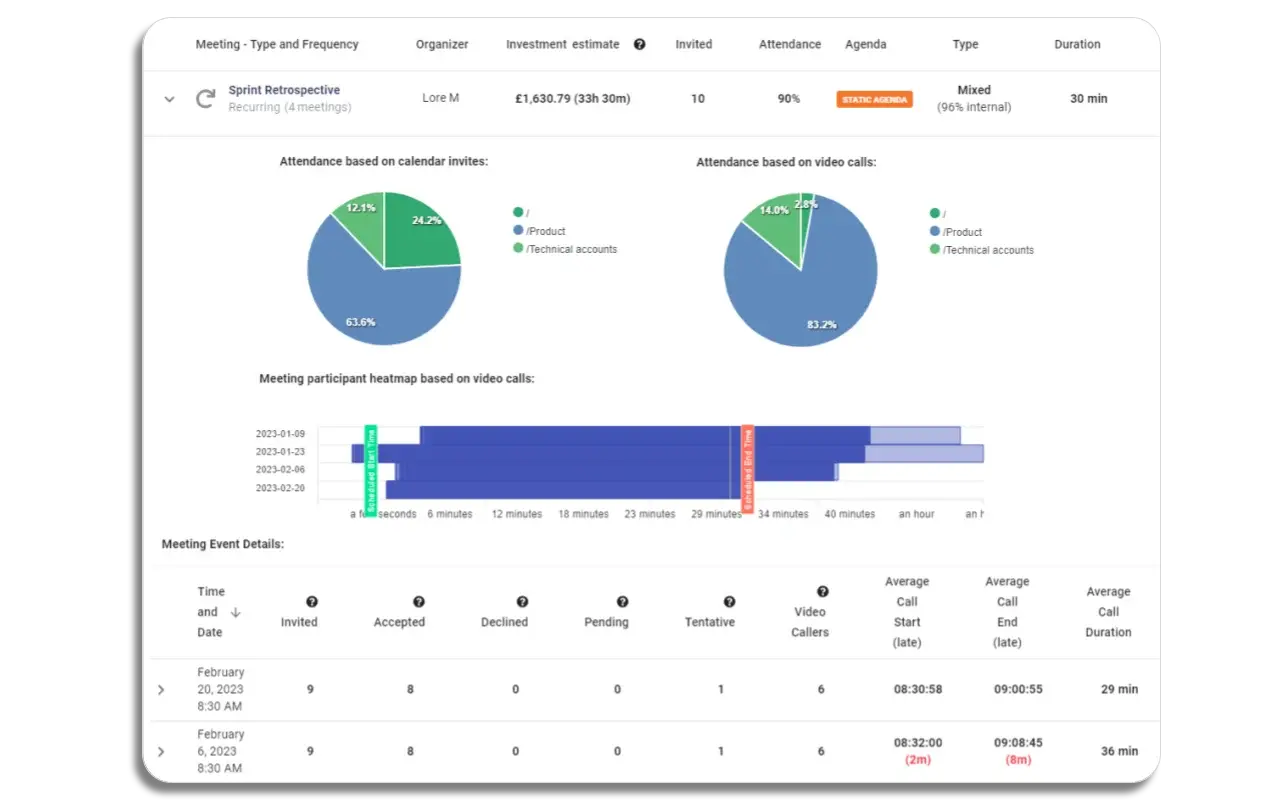
Meeting cost is useful because it makes an invisible tradeoff visible. The goal is not to shame organizers. The goal is to ask whether the meeting's value justifies the time it consumes.
For each recurring meeting, estimate:
You can do this manually for a small team. For larger organizations, meeting cost analytics or a meeting cost calculator can make the review faster.
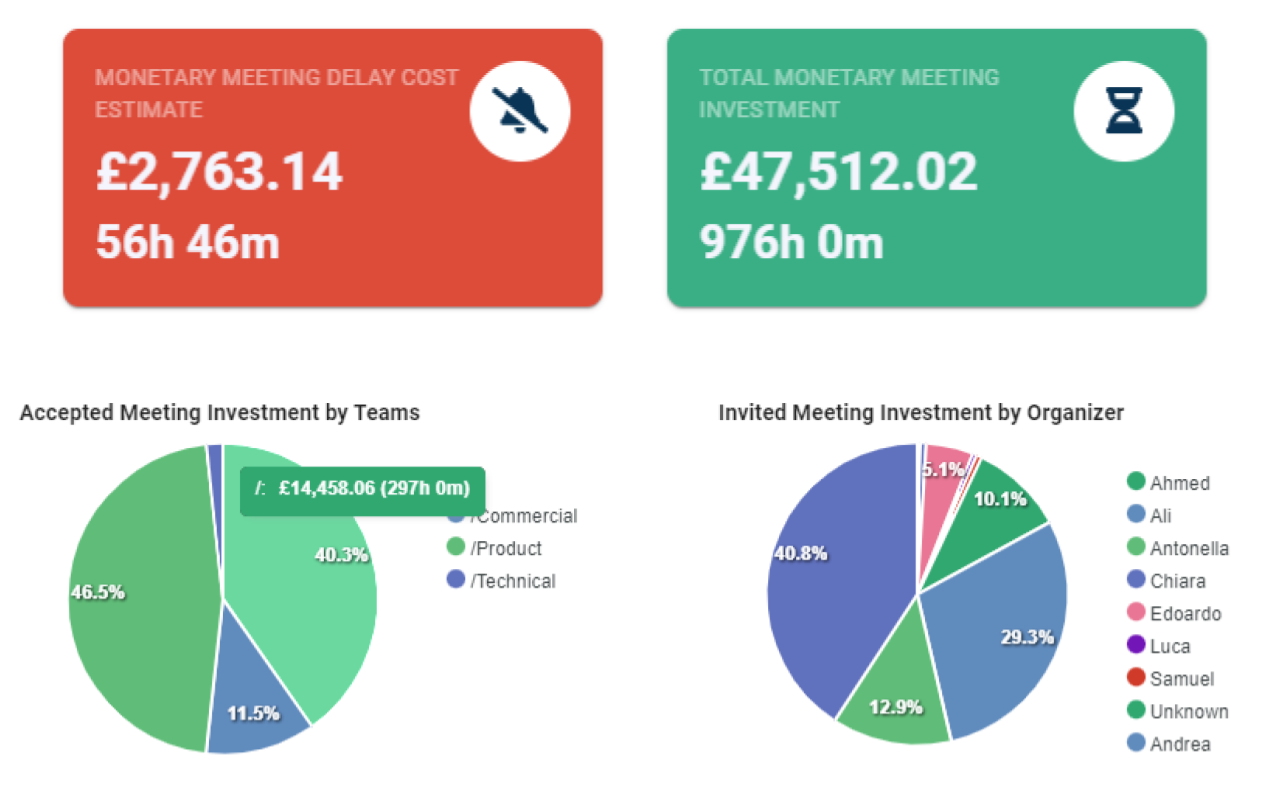
Flowtrace's calendar extensions recorded more than 2.1 million meeting-related calendar analyses per month in H1 2026 across Chrome, Edge, and Outlook. That proof of scale matters because meeting cost visibility works best when it appears where meeting behavior happens: inside the calendar, before the invite is sent.
A meeting that produces no decision, no action, no shared understanding, and no changed behavior is a weak candidate to keep.
Review the last three occurrences of each recurring meeting and ask:
If follow-up is the problem, the fix may not be fewer meetings. The fix may be better meeting notes, clearer ownership, or a decision log. Read meeting follow-up best practices if meetings are useful but outcomes disappear afterward.
Surveys and feedback sessions help explain how meetings feel. They are especially useful for questions analytics cannot answer directly:
Use meeting feedback to interpret the data, not replace it. A high-cost meeting may be worth keeping if employees say it is the one place decisions actually get made. A low-cost meeting may still be harmful if participants consistently say it lacks purpose, repeats information, or ends without clear ownership.
The audit is only useful if it changes the next invite.
After the review, create a small set of meeting rules:
This is where meeting governance and Outlook meeting rules become more useful than policy documents. Policies are easy to ignore when people are scheduling quickly. Calendar-side nudges and invite validation rules can reinforce better meeting quality at the point where meetings are created.
Use this checklist for each meeting or recurring series.
Score each area from 1 to 5.
| Area | Score | Notes | Next action |
|---|---|---|---|
| Purpose | 1-5 | Is the meeting still needed? | Remove, keep, or rewrite purpose |
| Agenda | 1-5 | Is the agenda useful before the meeting? | Add agenda rule |
| Attendees | 1-5 | Are the right people invited? | Reduce attendees |
| Recurrence | 1-5 | Is the cadence still justified? | Change cadence or review date |
| Length | 1-5 | Is time matched to the task? | Shorten or split |
| Cost | 1-5 | Is cost visible and justified? | Add cost review |
| Preparation | 1-5 | Can people arrive ready? | Add pre-read or async update |
| Decisions | 1-5 | Are outcomes clear? | Add decision log |
| Follow-up | 1-5 | Do actions happen? | Add owner and deadline |
| Governance | 1-5 | Are rules reinforced? | Add invite validation |
Add the scores together:
Do not end with a spreadsheet full of scores. Turn findings into a short operating plan.
This loop is where meeting audits become meeting culture change. The audit finds the pattern. Governance changes the behavior. Analytics shows whether the change held.
Flowtrace helps organizations move from manual meeting audit checklists to continuous meeting culture improvement.
It does this through:
That last point matters. A meeting audit should improve the system, not make employees feel watched. Flowtrace focuses on meeting metadata, ratings, and patterns so leaders can improve meeting culture without turning the audit into surveillance.
A meeting audit is a structured review of meeting habits, recurring meetings, attendance, agendas, outcomes, meeting cost, and follow-up. The goal is to decide which meetings to remove, shorten, redesign, or govern.
A meeting audit checklist should include purpose, ownership, agenda quality, attendee fit, preparation, participation, meeting length, recurrence, meeting cost, decisions, follow-up, feedback, and governance rules.
Most teams should review recurring meetings quarterly and run a broader meeting culture audit at least once or twice a year. If meeting overload is already showing up in employee feedback or leadership cost reviews, start with a focused recurring-meeting audit now.
Use both. Surveys explain how meetings feel. Analytics shows meeting patterns across the business: recurrence, duration, attendee count, agenda use, cost, and scheduling behavior. The combination is much stronger than either source alone.
A calendar audit reviews how time is allocated across a calendar. A meeting audit focuses specifically on meeting quality, purpose, cost, attendance, outcomes, and governance. If you need a broader calendar review, start with this guide to conducting a calendar audit.
The best meeting audit does not end with "run better meetings." That advice is too vague.
End with a behavior loop: measure the current state, decide which meetings to remove or redesign, reinforce better rules inside the calendar, then measure again. That is how meeting culture changes without relying on memory, goodwill, or another policy document nobody opens.
If your meeting problem is now too large to inspect manually, Flowtrace can help you turn the checklist into a continuous meeting analytics and governance process.
Learn how to manage meetings with policy, rules, analytics, and recurring meeting reviews that improve meeting culture.
Learn how many meetings are too many, assess meeting frequency by role and team, and reduce overload without losing alignment.
Use meeting analytics to help executives allocate leadership time, review recurring meetings, and improve decision speed.