Meetings
Calendar Analytics vs Meeting Analytics
Discover the key differences between calendar analytics and meeting analytics, and learn how to improve organizational efficiency and meeting...
Discover how enterprise meeting analytics transforms meeting culture by measuring productivity, decision-making, and costs, leading to improved collaboration.
Enterprise meeting analytics gives companies a measurable way to understand how meetings affect productivity, focus time, decision-making, and operating cost. This matters because meetings are not just calendar events. At enterprise scale, they become part of the company’s operating system: they determine how priorities move, how decisions are made, how managers spend their time, and how much uninterrupted work employees can protect.
The problem is that most organizations still manage meeting culture through opinion. Employees say there are too many meetings. Leaders introduce guidelines. Managers are asked to reduce meeting load. But without enterprise meeting analytics, it is difficult to know where the problem is actually happening, which teams are overloaded, which meetings are creating value, and whether meeting policies are changing behavior over time.
Flowtrace is built for this layer of visibility. It creates insights from company calendars and online meetings so leaders can measure meeting culture with management metrics, including meeting overload, productivity impact, decision quality, meeting cost, and team benchmarks. That makes meeting analytics less about individual calendar habits and more about how the organization collaborates as a whole.

Meeting problems become harder to see as companies grow. A single recurring meeting may look reasonable, but thousands of recurring meetings across teams can create a large and mostly hidden cost. A few oversized calls may seem harmless, but repeated across departments they can reduce participation, slow decisions, and make calendars harder to manage.
Microsoft found that employees using Microsoft 365 are interrupted every two minutes on average by a meeting, email, or notification. The same research found that 57% of meetings are ad hoc calls without a calendar invite, while one in ten scheduled meetings are booked at the last minute. For enterprise leaders, this points to a broader collaboration problem: work is not just busy, it is fragmented.
Atlassian’s research also shows the quality problem behind meeting overload. In a survey of 5,000 knowledge workers across four continents, meetings were identified as the main reason people struggle to get work done, and Atlassian found that meetings are ineffective 72% of the time. That is why enterprise meeting analytics should measure more than meeting volume. The issue is not only how many meetings exist, but whether those meetings are structured enough to support decisions, ownership, and progress.
Enterprise meeting analytics should give leaders a clear view of meeting behavior across the organization. Counting meetings is useful, but it is not enough.
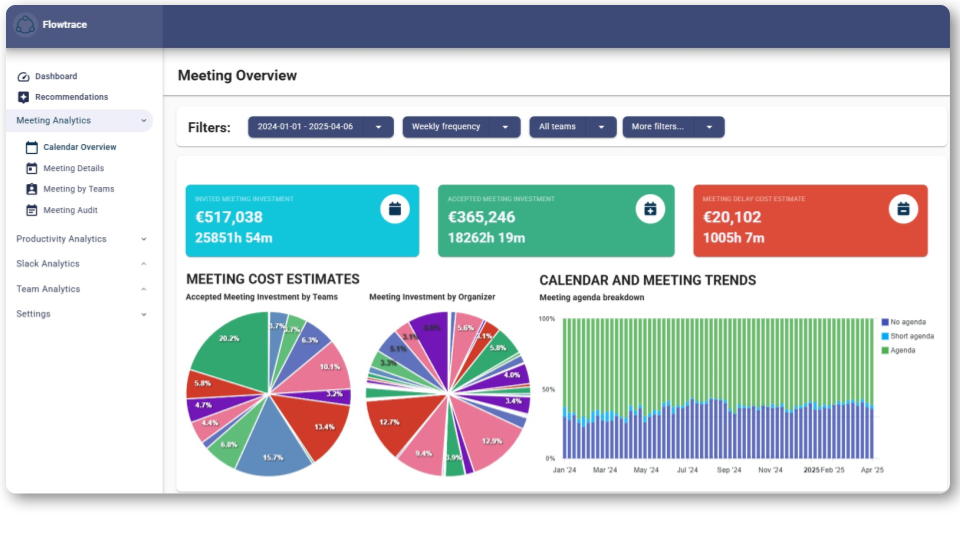
A company can have fewer meetings and still have poor meeting culture if the remaining meetings are badly prepared, too large, poorly timed, or disconnected from outcomes.
A stronger enterprise meeting analytics model should include:
Flowtrace meeting analytics reflects this and measures meeting costs by organizer and attending team, supports real-time calendar audits, reviews meeting start time, participation, and runtime, and helps companies follow meeting culture trends over time.
The cost of meetings is often discussed in general terms, but enterprise meeting analytics makes that cost more concrete. When meeting time is spread across many teams, calendars, and time zones, it becomes difficult for leaders to see how much capacity is being consumed by live collaboration.
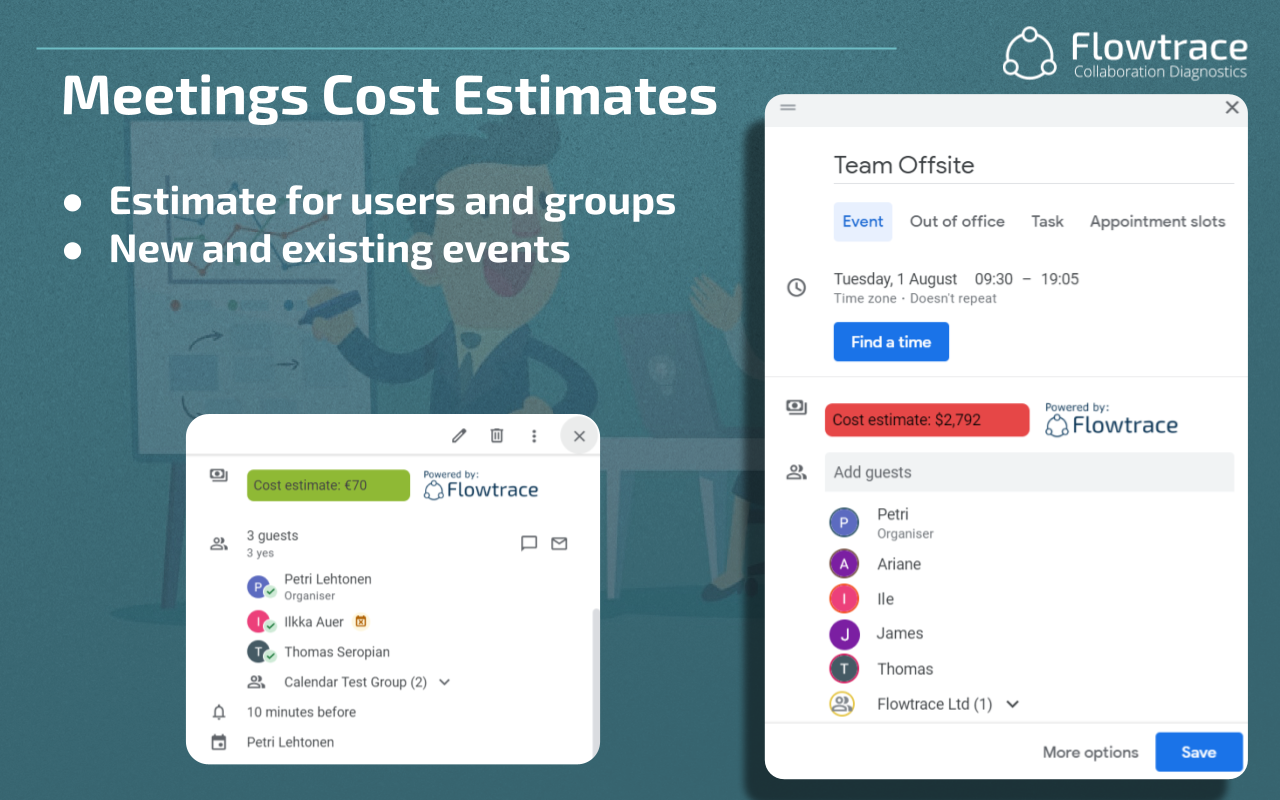
Flowtrace data shows why attendee discipline matters. Removing just two attendees from a 30-minute meeting saves the equivalent of one full-time employee day per 100 meetings. That is a useful enterprise metric because it turns meeting improvement into a concrete operating lever. A small change to meeting size may not feel significant in one meeting, but across hundreds or thousands of meetings it becomes a measurable recovery of working time.
This is where enterprise meeting analytics becomes more useful than general productivity advice. Leaders do not need another reminder that meetings should be smaller. They need visibility into which teams are running large meetings, which recurring meetings have grown over time, where passive attendance is common, and how much salary cost is attached to those patterns.
Flowtrace also found that companies using meeting analytics reduced average meeting size by 27% and reduced one-off meeting participants by 34%. That points to one of the clearest benefits of measuring meeting behavior: once companies can see where meeting bloat is happening, they can start changing it. The goal is not to cut people out of important conversations. It is to make attendance more intentional, so meetings are built around the people needed for decisions, contribution, and accountability.
For enterprise teams, this matters because meeting cost is rarely created by one obvious problem. It is created by many small habits that scale badly: inviting people for visibility, keeping recurring meetings alive without review, using live calls for updates, and defaulting to 30 or 60 minutes because the calendar makes it easy. Enterprise meeting analytics gives companies a way to see those habits clearly and manage them before they become a permanent cost of doing business.
Meeting volume is only one part of the problem. Enterprise meeting analytics also needs to show how meetings function. A shorter meeting is not automatically better if it lacks preparation. A smaller meeting is not automatically useful if the wrong people attend. A recurring meeting is not necessarily wasteful if it creates a valuable operating rhythm.
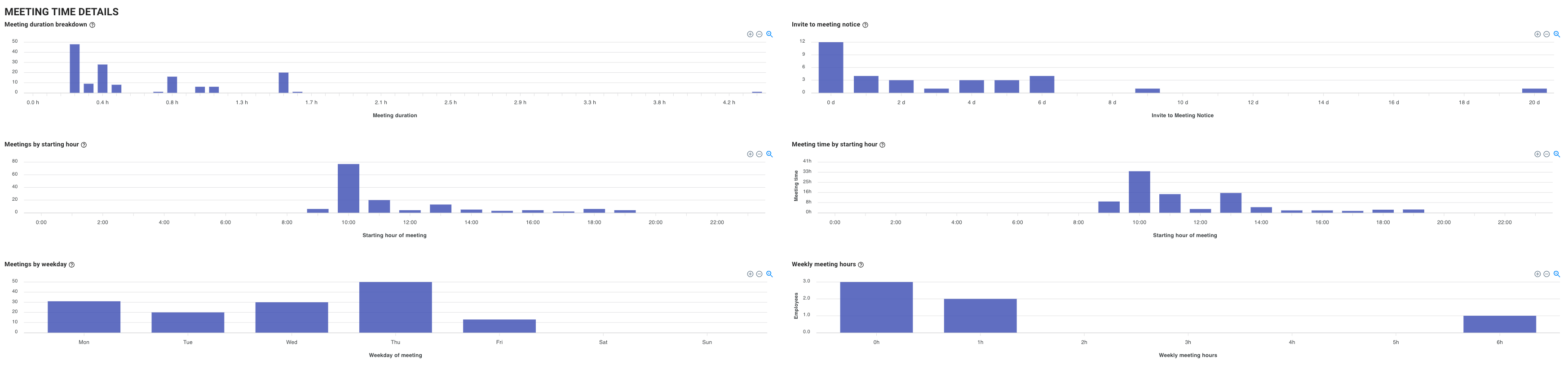
This is where meeting analytics needs to go deeper than calendar analytics. Meeting analytics should be a way to examine how meetings actually function, including agenda usage, punctuality, attendance consistency, participation levels, and invite bloat. That distinction is important because it moves the conversation away from “how many meetings do we have?” and toward “are our meetings designed well enough to justify the time?”
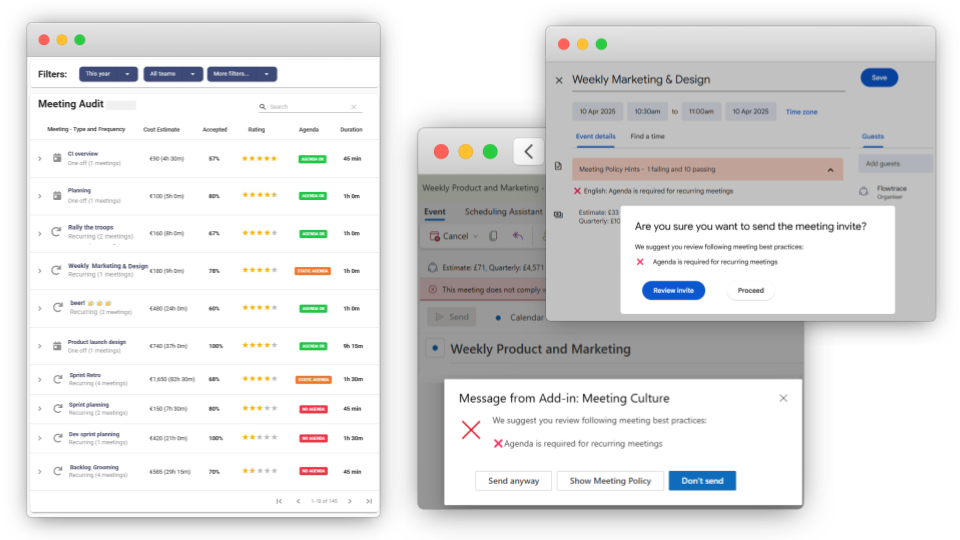
Flowtrace data also shows how meeting preparation can be measured. Across its dataset, meeting agendas totaled 2.47 million characters in 2025, with an average agenda length of around 380 characters and agenda variance reduced by 24%. That is useful for enterprise meeting analytics because it gives leaders a way to track whether agenda practices are becoming more standardized, not just whether teams are being told to use agendas.
The purpose of enterprise meeting analytics is not to create another reporting dashboard. The purpose is to give leadership, HR, operations, and managers a practical way to govern meeting culture. Once companies can see meeting behavior clearly, they can make better decisions about which meetings should stay, which should change, and which should be replaced with asynchronous updates.
For enterprise teams, that usually means using meeting analytics to support decisions such as:
Flowtrace supports this governance layer by combining meeting analytics with meeting audits, meeting reviews, trend tracking, and calendar-based insights. It also integrates with the collaboration tools enterprise teams already use, including Microsoft Outlook, Google Calendar, Zoom, Microsoft Teams, and Google Meet.
Enterprise meeting analytics is most valuable when it changes behavior. Reporting that meeting load is high does not solve the problem. Leaders need to understand why it is high, where it is concentrated, and which interventions will make the biggest difference.
Our data shows that companies using meeting analytics can make meaningful changes to meeting design. Companies cut average meeting size by 27% and one-off meeting participants by 34%, which signals a deliberate move toward leaner and more focused collaboration. This is the practical value of enterprise meeting analytics: it gives organizations the evidence needed to adjust meeting behavior at scale.
That shift matters because enterprise meeting culture does not improve through advice alone. It improves when teams can see the cost of meetings, understand the quality of those meetings, and track whether better meeting habits are becoming part of the operating rhythm.
Enterprise meeting analytics gives companies the visibility needed to manage meetings as an operating system. It helps leaders move beyond complaints about meeting overload and start measuring the specific behaviors that shape meeting culture: meeting cost, meeting load, agenda discipline, attendance patterns, recurring meeting habits, and focus-time impact.
Flowtrace is positioned for this work because it does not treat meetings as isolated calendar events. It connects meeting data across calendars and collaboration tools, turns that data into management metrics, and helps organizations improve meeting culture with evidence rather than assumptions.
For enterprises, that is the real value of meeting analytics. It makes collaboration measurable, and once collaboration is measurable, it can be managed with far more discipline.
Discover the key differences between calendar analytics and meeting analytics, and learn how to improve organizational efficiency and meeting...
Discover how an executive meeting dashboard optimizes time, improves meeting culture, and reduces costs by transforming calendar data into actionable...
Discover how Flowtrace integrates calendar analytics, meeting analytics, and video call analytics to revolutionize time management and collaboration...