Meetings
How to Organize a Meeting
Learn how to organize a meeting and respect everyone's time with these 10 practical steps, ensuring each meeting drives real progress and minimizes...
Learn how to create effective meeting agendas that drive outcomes, reduce unnecessary meetings, and enhance productivity with these best practices.
A meeting agenda is often treated like admin. Something you add five minutes before the call so the invite looks “complete.” That mindset is exactly why agendas fail to do their real job.
A good agenda is a design tool. It decides what outcome the meeting should produce, what work must happen live, who needs to be there to do that work, and how much time it should take. When the agenda is weak or missing, teams compensate in predictable ways: they invite too many people, they schedule too much time, and they spend the meeting figuring out what the meeting is for.
That compensation is common. Atlassian’s survey of 5,000 knowledge workers found that 62% often attend meetings that don’t even state a goal in the invite, and 79% say an agenda leads to more productive meetings.
Those two numbers describe the problem and the opportunity in the same breath: many meetings start without clarity, and most people already know what would improve them.

Agendas are not primarily about “staying on track.” They are about preventing the wrong meeting from happening in the first place, and preventing the right meeting from being overbuilt.
When you write a meeting agenda properly, you do three things at once. You define the outcome, you bound the scope, and you make participation purposeful. This is why agendas reduce meeting sprawl without requiring cultural heroics, because the agenda forces decisions before the calendar invite becomes reality.
It also helps to be honest about the baseline we are working from. Our meeting stats report shows that meetings are ineffective 72% of the time, and that meetings are the number one reported barrier to productivity in their research. In that environment, “better meetings” is not a soft skill. It is a capacity problem.
At the same time, an agenda is not magic. HBR research has found “little to no relationship” between simply having an agenda and how attendees evaluate meeting quality, because what matters is what is on the agenda and how it is facilitated. The best practice is not “always have an agenda,” but “use the agenda to force relevance and to make the meeting easier to run well.”
Without an agenda, the meeting becomes a container for uncertainty. People join because they are not sure what will be decided, who will be asked for input, or what context will matter. “Just in case” becomes the attendance strategy.
That is why missing agendas tend to inflate invite lists. If the meeting purpose is unclear, the safest option is to include everyone who might be affected, even if their presence doesn’t help produce the outcome. This creates large meetings where most people are present but not required.
Large meetings also tend to run long. Our statistics for meetings found that when more than 10 people attended, 64% of meetings took longer than 60 minutes, compared to 15% when only two people met. Size is not just a social cost; it is a duration driver.
Time inflation matters because meetings don’t only consume time, they displace it. A HBR report on meeting overload notes research suggesting about 70% of meetings keep employees from working and completing tasks, which is a direct description of “meeting time crowding out execution time.” When meetings expand without clear outputs, teams end up with more coordination and less progress, which then creates the conditions for even more meetings.
Finally, agenda-less meetings create participation confusion. People do not know why they are present, which makes it harder to contribute, and easier to disengage. The meeting turns into status narration, open-ended debate, or a decision that gets deferred because the right person was not prepared to decide.
The best agenda starts with a clear outcome statement, not a list of topics. This matters because a topic tells people what you want to talk about, while an outcome tells people what you want to achieve.
Outcome language forces a different kind of preparation. “Discuss Q2 priorities” invites opinions; “Decide Q2 priorities and owners” forces tradeoffs, a decision-maker, and an output. If you can’t write the outcome, you usually aren’t ready to schedule the meeting.
A practical way to implement this is to make the first line of every agenda: “By the end of this meeting, we will…” If you can’t finish that sentence, you either need more async context first, or you don’t need a meeting yet.
This also aligns with Atlassian’s finding that many meetings don’t even state a goal in the invite. Making the outcome explicit is low effort, high leverage, and it reduces the “why am I here” dynamic immediately.
A meeting agenda is also a participant filter. Every agenda item implies specific knowledge, authority, or accountability, and the invite list should be derived from those requirements rather than from org charts or convenience.

The simplest best practice is to map people to agenda items. If someone cannot point to an agenda item where they are required to contribute, decide, or unblock, then they should not be a required attendee. They can receive notes, or join optionally, without being pulled into the full meeting cost.
This is not about exclusion; it is about precision. When meetings are unclear, teams over-invite to manage risk. When agendas are clear, you can confidently keep the room small while keeping visibility high.
McKinsey makes a similar point from the decision-making side, noting that for decision-making meetings, a participant “sweet spot” is five to seven, and that more than seven can lead to unwieldy discussion. A well-written agenda supports that constraint because it clarifies exactly who is needed to decide, and who simply needs the decision afterward.
The default 30 or 60 minutes is often a scheduling habit, not a reflection of the work. A good agenda turns duration into a deliberate choice.
The practical best practice is to timebox agenda items. You allocate minutes to each item based on complexity and priority, then you confirm whether the meeting still fits the slot. If it doesn’t fit, the right move is usually to reduce scope, split the meeting, or move updates async, rather than simply expanding the meeting length.
This also prevents a common failure mode: the agenda that is longer than the time available. When the agenda is overloaded, teams either rush the most important items at the end, or defer decisions and create follow-up meetings. Both outcomes increase total meeting load.
Our data is a reminder that duration is sensitive to the conditions you create. More attendees correlates with longer meetings, and longer meetings become easier to justify when the agenda isn’t doing its bounding job. Writing the agenda with time in mind is how you avoid building 60-minute meetings that only needed 20 minutes of real discussion.
The fastest way to improve an agenda is to change the verbs. “Review,” “decide,” “align,” “resolve,” and “plan” tell people what kind of work is expected, while “Update,” “overview,” and “check-in” often signal a meeting that could be handled asynchronously.
Action-oriented agenda items also reduce circular discussion. When an item is framed as “decide,” you are forced to define who decides, what inputs are needed, and what tradeoffs are on the table. When it is framed as “discuss,” the group can talk indefinitely without producing a clear output.
This best practice aligns the HBR report before; to think beyond agendas as a “laundry list of topics” and to pay attention to the relevance and importance of what is on the agenda. The agenda should be structured around work that matters, not around everything that might be mentioned.
Agenda sequencing is not cosmetic. It shapes the energy and quality of decisions.
A useful sequencing pattern is: context first, then discussion, then decisions. If you start with the hardest decision before people share the necessary context, you create confusion and deferral. If you leave critical decisions to the end, you create rushed outcomes or no outcomes.
A practical best practice is to place the most consequential item early, when attention is highest, and to push pure updates to the top as pre-reads rather than meeting time. This reduces decision fatigue and protects the part of the meeting where real collaboration is needed.
Sequencing also helps you contain drift. When people know the decision is coming at minute 20, they are less likely to use minute 5 for unrelated debate. The agenda becomes a behavioral constraint, not just a plan.
Agenda quality tends to decline when “the group” owns it. Shared ownership usually means no ownership, and no ownership means the agenda becomes generic.
Best practice is to assign an agenda owner who is responsible for three things: relevance, scope, and outputs. They are not responsible for doing all the work alone, but they are responsible for ensuring the agenda reflects the outcome, the correct participants, and a realistic time plan.
This also makes meetings easier to evaluate. If a meeting repeatedly fails to produce outcomes, an owner can redesign it, split it, or cancel it without requiring a consensus process. Over time, that ownership prevents “agenda-less meetings” from becoming part of the culture.
A meeting agenda that arrives two minutes before the call is often functionally the same as no agenda. People cannot prepare, and the meeting becomes the place where preparation happens live.
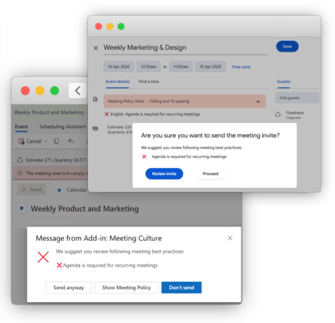
Sharing the agenda in advance changes attendance decisions and preparation behavior. People can see whether they are needed, what they should read, and what inputs are expected. This reduces the “join just in case” reflex and improves the quality of discussion.
Atlassian’s research from before explains why this matters, showing many workers attend meetings that lack a stated goal, and that agendas are widely associated with better productivity in respondents’ experience. When the agenda is early, clarity is early, and the meeting starts closer to the work instead of spending time finding it.
A good operational rule is simple: if the agenda is not available at least 24 hours before a recurring meeting, the meeting should be shortened or converted into async updates unless an urgent decision is required.
Meeting culture is not only shaped by how people behave in meetings, but by what the organization treats as acceptable meeting design. Agendas are one of the few levers that influence design before the meeting happens.
When agendas are consistently outcome-driven, invite lists naturally shrink, because attendance becomes tied to contribution rather than visibility. When agendas are timeboxed and sequenced, meeting lengths become intentional rather than habitual. When agendas are shared early, preparation moves out of the meeting, which increases the probability that the meeting produces an output.
These changes also reduce follow-up meetings. Meetings often fail to deliver desired outcomes, and meetings can become a generator of more meetings. Strong agendas counteract that tendency by making “what must be resolved now” explicit, which reduces the number of discussions that end in “let’s schedule another call.”
Finally, agenda best practices make meeting costs visible. When an agenda forces you to decide who must be present and how long each item should take, it becomes harder to justify a large, long meeting for work that could be handled asynchronously. Over time, meeting culture improves not because people become more disciplined, but because the system makes discipline easier.
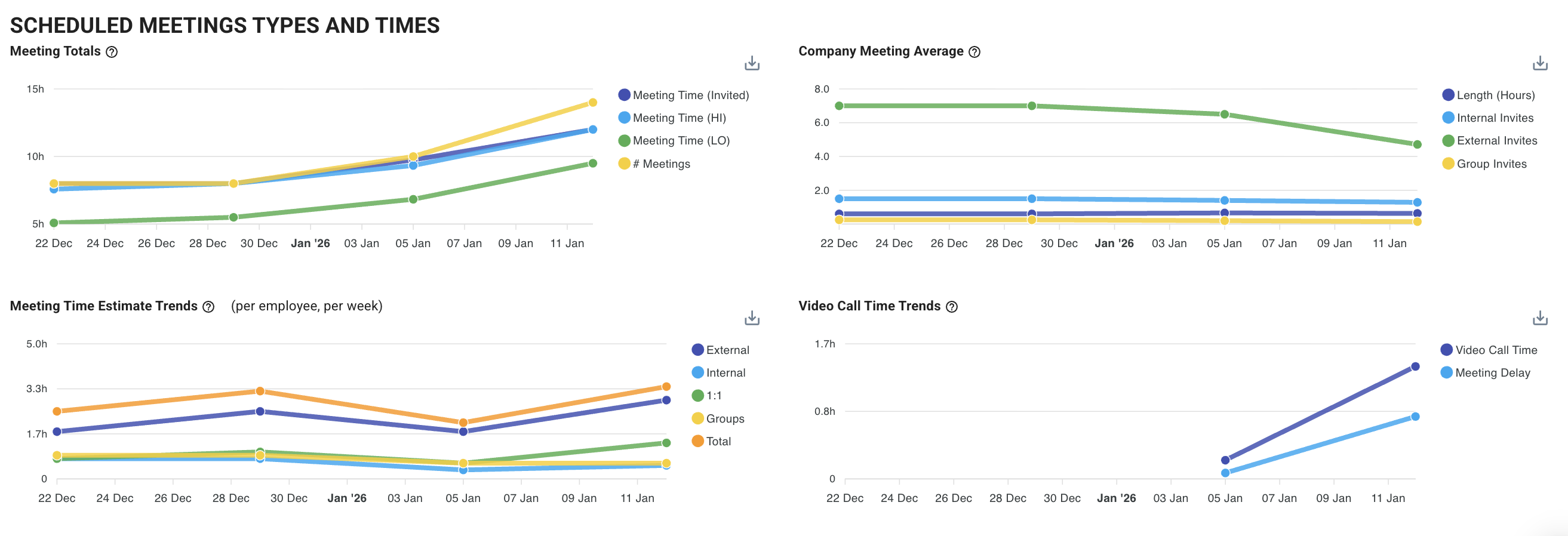
If you want to make this measurable, meeting analytics helps you spot where agendas are not doing their job. Metrics like attendee count growth, high-frequency long meetings, and meeting series with large invite lists are often signals of low agenda clarity. Tools like Flowtrace’s meeting analytics can make those patterns visible, which makes it easier to improve meeting design without relying on anecdote.
Meeting agenda best practices are not about formatting. They are about using the agenda as a tool that shapes the meeting before it exists.
When the agenda defines the outcome, the right participants, and the right time allocation, meetings become smaller, shorter, and more decisive. When agendas are shared early and owned clearly, people understand why they are present, and the meeting stops being a container for uncertainty.
Better agendas do not just create better meetings. They create a culture where meetings earn their place on the calendar, and where synchronous time is reserved for work that genuinely benefits from being done together.
Learn how to organize a meeting and respect everyone's time with these 10 practical steps, ensuring each meeting drives real progress and minimizes...
Optimize meetings with 20 essential meeting rules for leaders to boost productivity, cut costs, and drive results.
Optimize manufacturing meetings with structured practices and analytics to enhance productivity, safety, and operational efficiency. Learn practical...