Meetings
Meeting FOMO: How to Break the Cycle
Combat meeting FOMO by establishing clear decision systems, enforcing agenda rules, and promoting async updates to enhance productivity and reduce...
Discover how to cut company meeting time by redesigning workflows, implementing async updates, and ensuring meetings are purposeful and outcome-driven.
Meeting overload rarely shows up as a deliberate decision. It usually starts as a reasonable workaround for uncertainty, then repeats until it becomes the default: if something feels unclear, schedule time together, if something feels risky, pull more people in, if something feels stuck, add a recurring check-in so it stops slipping.
Before long, the calendar becomes the company’s operating system, and “doing the work” becomes the thing everyone tries to squeeze into the gaps.
This is why cutting meeting time is not really about running tighter calls, it’s about redesigning how work moves through the organization so that meetings are not the only reliable way to share context, coordinate dependencies, and make decisions.
That matters because the cost is not just minutes on a calendar, it’s fragmentation of attention, delayed execution, and the quiet erosion of ownership when everything becomes a group discussion.
Harvard Business Review captured the scale of this problem when it reported that executives spend nearly 23 hours per week in meetings, which is the kind of number that makes focus feel like a luxury rather than a basic requirement for doing good work.
If you’re looking at your own company’s calendar and thinking “this cannot be normal,” you’re noticing a systemic issue.

The fastest way to reduce meeting time is to stop using meetings as a general-purpose container for unresolved thinking. A meeting should exist for a narrow reason: to decide, to unblock, or to solve something that genuinely benefits from real-time collaboration.
When meetings become the place where people discover context, exchange updates, or circle around issues that were never framed, they start multiplying because the meeting itself becomes the workaround for missing process.
A simple way to spot the difference is to ask what kind of collaboration you are actually doing. Most work falls into three buckets: sharing information, coordinating moving parts, or making decisions. Meetings can be useful for the last two when the problem is complex, the tradeoffs are real, and the people in the room have the authority to commit.
Meetings are usually a poor tool for information sharing, especially when “alignment” is really just one person talking while everyone else tries to multitask. If the goal is for people to know something, the best format is almost always written, searchable, and reusable, because it does not require a live slot and it does not disappear the moment the call ends.
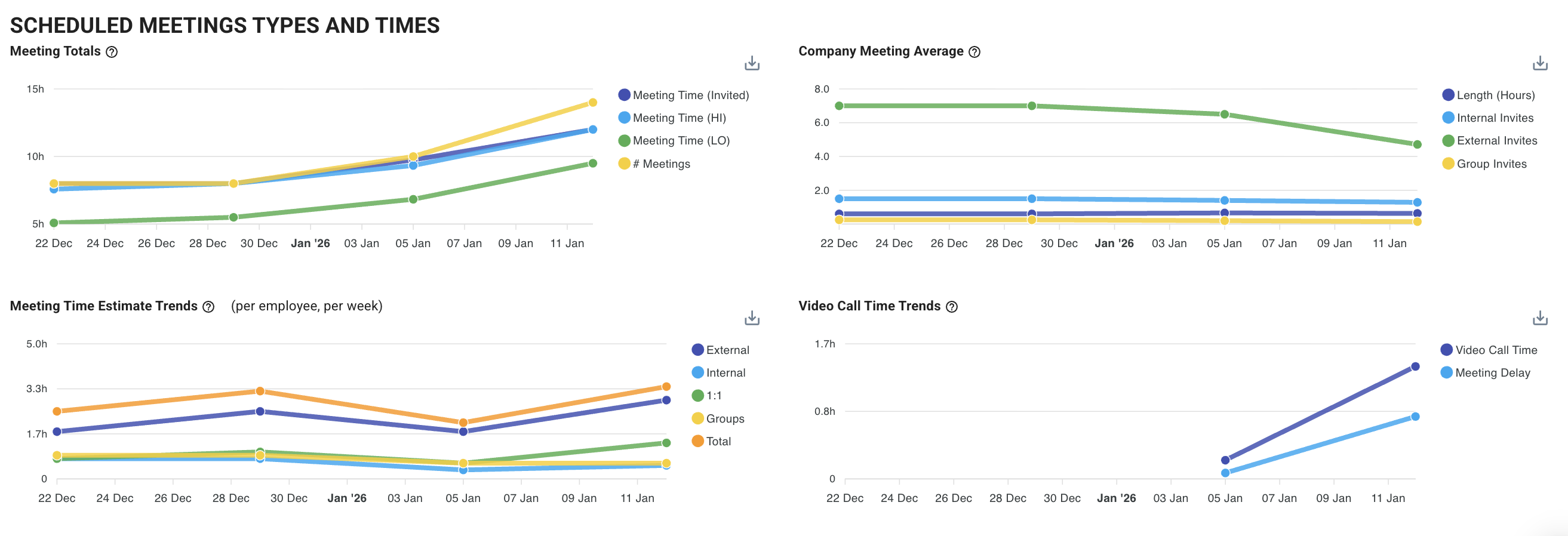
Cutting meeting time without visibility turns into opinion wars, because everyone feels the pain but nobody can point to the levers. The calendar already contains the evidence you need; you just have to read it like a system map instead of a list of appointments. You’re not looking for perfection, you’re looking for patterns that repeat.
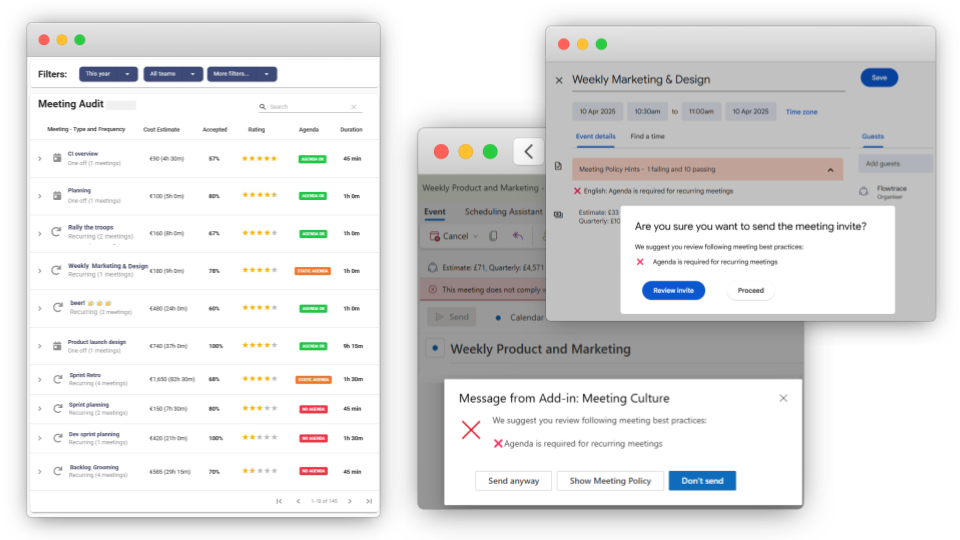
Start with a short calendar audit window, typically two to four weeks, and pull out the most obvious signals. You do not need a hundred metrics to learn something useful; you need a few that reveal where the time actually goes and what kinds of meetings dominate the week.
Here are the patterns that almost always show the biggest opportunities, without turning the audit into a complicated exercise:
Once you can name the top three meeting types that are consuming the most hours, you can redesign those meeting types instead of arguing about individual invites. This is the shift that makes the change feel fair, because it is about improving the system rather than blaming people.
Most meeting overload comes from one habit: scheduling time together is easier than thinking through whether time together is required. So the fix is to make “should this be a meeting?” just as easy as sending the invite.
The goal of the gate is not bureaucracy, it’s clarity. If the organizer cannot explain what will be different at the end of the meeting, the meeting usually should not exist yet. It either needs framing, written context, or a decision owner who can make a call without convening a room.
A simple gate can be phrased as a short set of prompts that the organizer answers in the invite or agenda:
You’ll notice what this gate does immediately. It discourages meetings that are really just “let’s talk about it,” and it forces meetings that remain to become outcome-driven.
It also creates social permission for people to decline meetings where they do not have a role, because the role is now explicit rather than implied.
Recurring meetings usually began with a real need, often during a period of change, uncertainty, or rapid growth, and then they became a ritual that stayed long after the original problem shifted. If you want sustainable meeting reduction, you have to replace the underlying purpose, not just cancel the calendar entry and hope the need disappears.
Start by asking what the recurring meeting is doing in practice, not what it claims to do in the title. A “weekly sync” might be a status update, a dependency review, a decision forum, or a social glue moment that the team relies on more than anyone admits. Each of those needs a different redesign.
This is one place where a small amount of structure pays off fast. For each recurring meeting, define the purpose in one sentence, define what “success” looks like, and set an expiration date so it has to be renewed intentionally instead of living forever by default.
A clean “renewal rule” can be as simple as this: if there’s no agenda and no clear outcome, the meeting gets canceled, and if the meeting does not produce decisions or actions for a month, it gets redesigned or removed. It sounds strict, but it is actually respectful, because it treats everyone’s time as a shared resource.
Some meetings are worth having. Cutting meeting time does not mean eliminating collaboration, it means protecting collaboration by making it purposeful and by removing the meetings that exist only to compensate for missing clarity elsewhere.
The simplest design move is to start with an outcome, not a topic. “Project update” is a topic that expands to fill time. “Choose the next milestone and commit owners” is an outcome that invites preparation. Outcomes also make it easier to keep meetings short, because you can stop when the outcome is achieved instead of talking until the clock runs out.
Preparation is the hidden driver of meeting length. When people show up without shared context, the meeting stretches into live reading, live catching up, and live rehashing, which is why so many calls begin with presentations and end with “we should take this offline.” When context is shared ahead of time, the live time can be spent where it adds real value: surfacing tradeoffs, resolving tension, and making the final call.
Attendance discipline matters too, because every extra person in the room increases coordination cost and lowers the chance of a crisp decision. A useful rule is that you invite people who will decide, execute, or unblock, and you inform everyone else through notes and a decision log.
Meeting overload is not only about the number of meetings, it’s also about what meetings do to attention. Even a “reasonable” calendar becomes destructive if meetings are scattered in a way that breaks the day into unusable fragments.

The fix is not simply fewer meetings, it is fewer interruptions, which is why asynchronous communication becomes the infrastructure that makes meeting reduction stick.
When teams have a reliable async rhythm, meetings stop being the only place where work feels coordinated. Updates can live in a consistent format, questions can be handled in-thread, and decisions can be reviewed without forcing everyone into the same time slot.
The side effect is that meetings become less frequent because the system is doing more of the coordination work that meetings were previously forced to do.
This is not a theoretical win. McKinsey reported on a Netflix effort where the company reduced the number of meetings by more than 65% after tightening how meetings were used and pushing one-way information sharing into other formats.
The point is not to copy Netflix, the point is that meeting volume is a design choice, and it can change dramatically when the underlying collaboration defaults change.
The obvious advice is to have an agenda, invite fewer people, cancel the meetings that do not matter. The reason meeting overload persists is not a lack of tips, it’s a lack of visibility and follow-through. Without clear data, teams argue from feelings. Without measurement, improvements fade. Without accountability, the calendar quietly snaps back to its old shape.
.png?width=960&height=540&name=Marketing%20Images%20(11).png)
Flowtrace helps by making meeting behavior visible in a way that is practical, not performative. Instead of guessing where time is going, you can see which meetings are expanding, where recurring time is stacking up, which groups carry the heaviest load, and how meeting patterns shift after you introduce new norms.
That matters because meeting culture does not change from one announcement, it changes from hundreds of small daily choices, and small choices are easier when the impact is measurable.
It also helps turn meeting reduction into a business conversation rather than a philosophical one. When leaders can connect meeting time to cost and opportunity, it becomes much easier to prioritize changes, to protect focus time without losing alignment, and to keep the organization honest about whether meetings are actually producing decisions and progress.
If your calendar feels unmanageable, the fix is not heroic personal productivity. It is redesigning the system that keeps generating meetings in the first place, so that meetings are no longer the default answer to uncertainty.
Start by auditing what is actually happening, introduce a simple gate that forces clarity before invites go out, and then redesign recurring meetings by replacing their purpose with better async flows and sharper decision mechanics.
The goal is not silence, it is clarity and momentum. When information moves cleanly, decisions are captured, and teams know exactly why they are meeting, the calendar becomes lighter almost as a side effect. And the work that actually matters finally has room to happen.
Combat meeting FOMO by establishing clear decision systems, enforcing agenda rules, and promoting async updates to enhance productivity and reduce...
Learn effective strategies to prevent meetings from becoming too large by defining outcomes, refining agendas, and ensuring the right attendees are...
Discover the key differences between calendar analytics and meeting analytics, and learn how to improve organizational efficiency and meeting...