Meetings
How to Cut Company Meeting Time
Discover how to cut company meeting time by redesigning workflows, implementing async updates, and ensuring meetings are purposeful and...
Combat meeting FOMO by establishing clear decision systems, enforcing agenda rules, and promoting async updates to enhance productivity and reduce unnecessary meeting attendance.
Meeting FOMO is now a defining feature of knowledge work. People join sessions not because they contribute, but because they worry decisions will happen without them, context will disappear, or visibility will slip. The fear is rational: when information is uneven, and decisions aren’t documented, the safest move is to be in the room, even if the room is the worst place for their time.
The consequence is a meeting culture shaped by insecurity rather than intent. Calendars fill with spectators, decision work slows, and days fragment into short blocks of availability instead of long blocks of progress. Most teams aren’t trying to waste time; they’re compensating for unclear ownership and weak communication systems. The rest of this article explains how to fix that.

Meeting FOMO is attending 'just in case.' You default-accept invites, sit in for awareness, and treat presence as protection against being left out. The pattern produces padded invites, vague agendas, and rooms full of spectators.
In practice, meeting FOMO looks like:
It’s a predictable response to uncertain decision ownership and weak documentation. When attendance is the only reliable path to information parity, people over-attach to meetings.
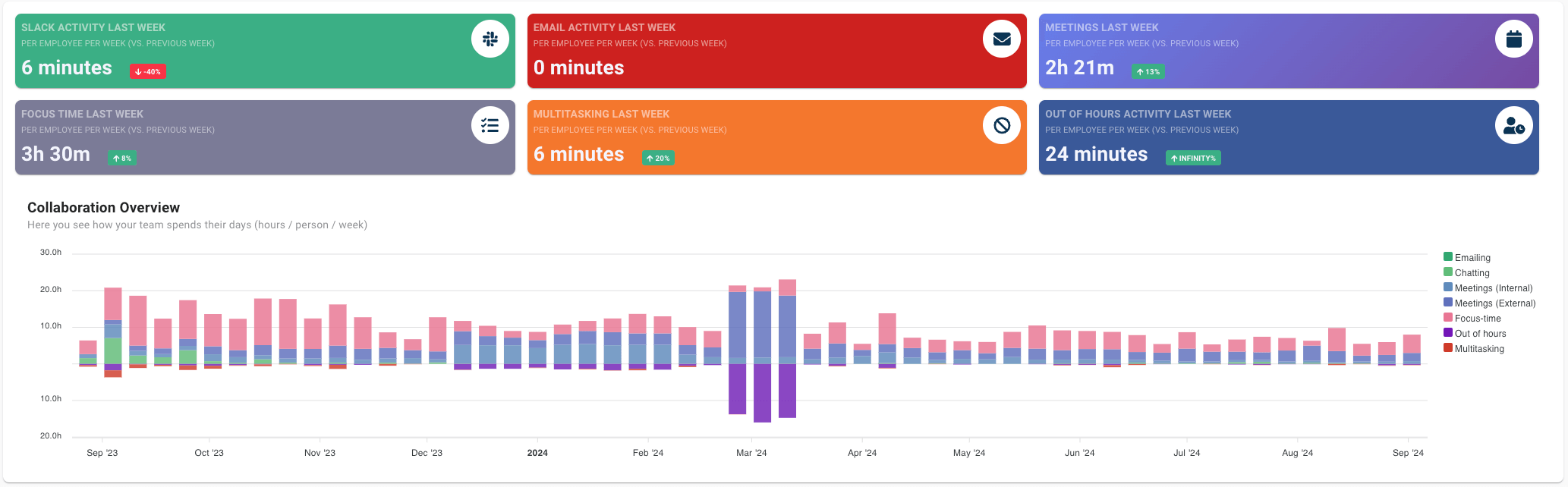
Meeting FOMO' bloats calendars, slows decisions, and pushes work into evenings. One report shows meetings after 8 p.m. are up 16% year over year, a clear signal of spillover and fragmented attention. This isn’t a calendar hygiene issue; it’s an operating model issue. Fixing it requires clear decision rights, tighter rooms, reliable summaries, and strong norms for async updates.
FOMO is rational wherever the safest way to stay informed is to be 'in the room.' If leadership rewards presence over outcomes and documentation is unreliable, attendance becomes insurance. The aim isn’t 'fewer meetings at all costs'; it’s fewer, clearer, shorter meetings that lead to decisions.
FOMO thrives where decision rights are vague, summaries are inconsistent, and optics matter more than outcomes. Hybrid convenience accelerates the problem; it’s easy to add attendees and schedule another 30 minutes, so meetings multiply and expand.
Primary drivers you can fix:
These are operational problems. Solve them and FOMO recedes without blunt cuts.
Time is wasted, decisions slow down, and attention fragments. Another report shows that about 43% of meetings could be eliminated with no negative consequences, showing how often attendance substitutes for process. At scale, the cost is slower execution, a higher coordination tax, and rising burnout signals.
Where the cost lands:
The roots are operational: weak decision frameworks, agenda poverty, recurrence without expiry, information parity by presence, and incentives that reward theatre over outcomes. Each is addressable with policy, workflow, and measurement.
Breakdown:
Replace presence-based context with a decision system. Declare meeting types and deciders up front, default non-contributors to optional, enforce a 24-hour agenda/input rule, move status to async, add cadence guardrails, and require a post-meeting summary every time.
State Type (Inform/Decide/Do), name one decider, list contributors (people whose input is required), and tag informed-not-attending stakeholders who’ll receive the summary. If you can’t name a decider, you don’t have a meeting.
Normalize 'decline with context': 'Not a contributor to the decision; please send the summary.' Leaders must model this so teams feel safe opting out.
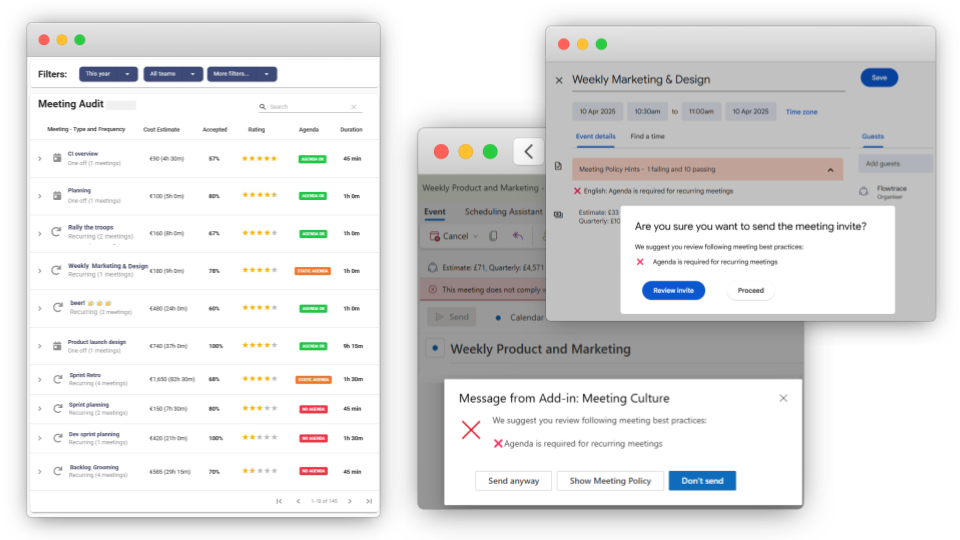
No agenda, no meeting. The agenda states the decision or outcome, links inputs (pre-reads, data), and names the decider. Distribute ≥24 hours before go-time. If pre-work isn’t done, reschedule instead of carrying prep debt into live time.
Status, updates, and broadcasts move to written or short video updates. Live time is for decisions and work that benefits from debate. Slack’s data and guidance back this shift; teams report large portions of meetings are removable with no downside.
Every meeting produces a one-page summary: context, options, decision & rationale, owner & deadline, risks/next steps. Store summaries in a shared workspace with consistent naming. Notify the informed-not-attending list automatically. Trustworthy summaries are the antidote to FOMO.
Use live sessions for decision convergence, cross-functional alignment when threads stall, and time-sensitive incidents with clear roles. Even then: agenda, inputs, decider, summary, no exceptions.
Treat this as an operational change with a six-week pilot. Combine descriptive metrics (load, hygiene) with behavioral indicators (declines with context, summary completion) and outcome signals (decision velocity, after-hours drop). Convert time into cost to make the readout board-ready. Flowtrace handles the instrumentation by analyzing metadata from calendars and collaboration tools, no message content required.
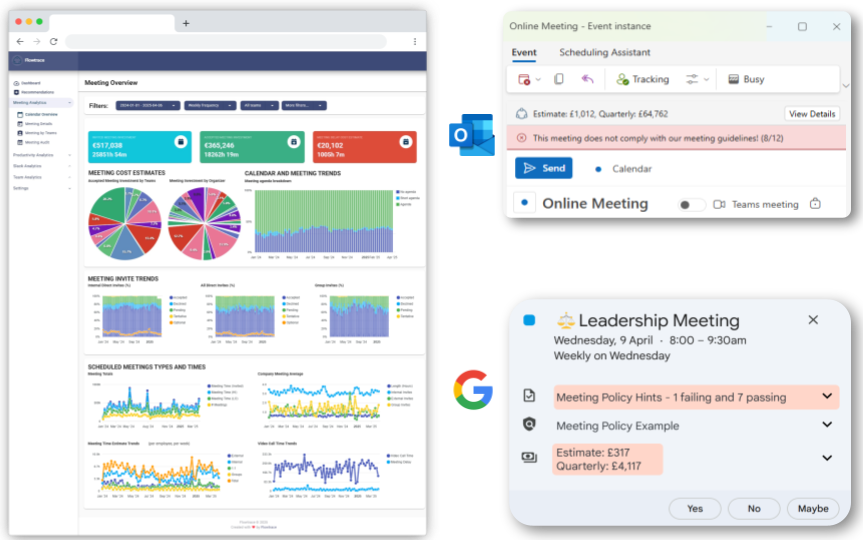
Before changing anything, capture where you are. You need a baseline to show a real delta. Track meetings per person, optional-to-required ratio, invite lead-time distribution, agenda compliance, and recurrence expiry rate. This tells you whether your meeting hygiene is functioning at all. It also surfaces quick wins (for example, recurring meetings without an end date). Flowtrace establishes these metrics automatically across Google Workspace, Outlook, Teams, Slack, and Zoom using metadata only.
Translate synchronous time into a simple financial lens using a blended rate. Focus on decision meetings (where attendance inflation hurts most). Track total decision-meeting hours × blended rate by function, the top decile of heavy attendees (by hours), and meeting length distribution (watch for 60-minute defaults). Use your finance partner’s rate assumptions and keep them constant across the pilot for apples-to-apples comparison.
This is where you implement the system: enforce the 24-hour agenda/input rule, move status to async, and default non-contributors to optional. Don’t measure success by the number of canceled meetings; measure it by the quality of the remaining ones. Expect initial friction as teams learn to prepare inputs and rely on summaries. Keep coaching 'decline with context', leaders should post examples to normalize the behavior.
Right-size decision meetings to decider + contributors. Push the summary standard until it’s habit. Use Flowtrace’s hygiene signals to target specific fixes (e.g., 'Team A: low invite lead time; Team B: recurring series without expiry'). As summaries become consistent, people realize they don’t need to sit in 'for safety,' and decline rates with context will increase.
Decision speed is the quality metric that leadership cares about. Track cycle time from proposal → decision and the decision-to-meeting ratio (how many decisions per hour of synchronous time). When rooms are smaller and inputs are ready, both improve. Use specific examples in your readout: 'Pricing change X went from proposal to decision in 5 days vs. 13 days pre-pilot.'
Monitor after-hours meetings (≥20:00 local) as a proxy for spillover. Your goal is to beat the broader trend of rising late-evening meetings. Use the +16% YoY figure as the external benchmark; show your team’s curve bending the other way. This is easy for executives to grasp and links directly to well-being.
Close the pilot with a crisp before/after:
Wrap with one or two concrete stories (e.g., a retired weekly status shifted to async saved 8 hours/week; a cross-functional decision now closes in one meeting because inputs are prepared).
Flowtrace turns calendar and collaboration metadata into a full meeting analytics view. You see meeting hours by team and role, invite counts per organizer, average attendees per meeting, recurrence load, and after-hours vs in-hours patterns.
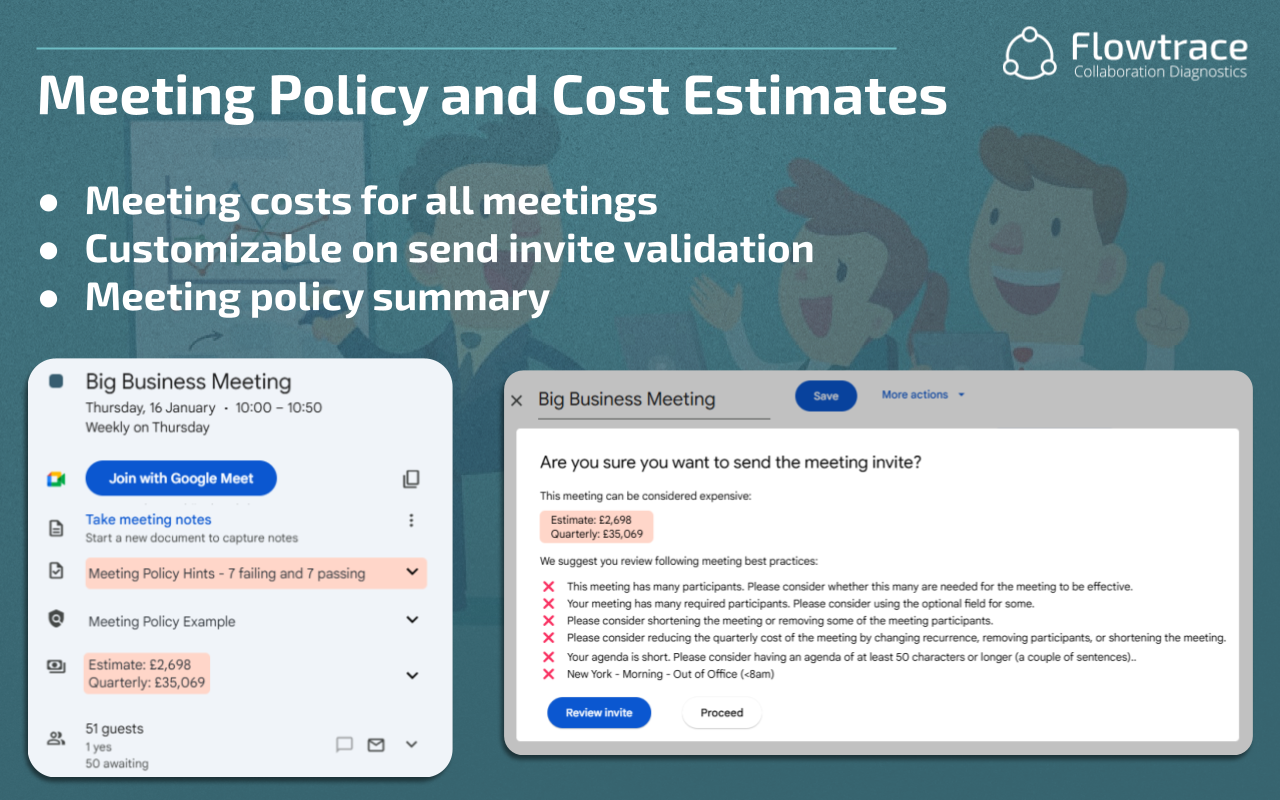
See time and cost associated with those meetings, highlights heavy meeting organizers and “meeting-rich” teams, and surfaces hygiene issues such as bloated invite lists, long back-to-back chains, and recurring series that never end.
Leaders get a trusted view of how meetings consume time and budget, how invite behaviour changes during a FOMO clean-up, and where to intervene next to protect focus time and improve decision flow.
Calendars breathe, rooms are smaller, summaries replace presence, velocity improves, and after-hours meetings decline. The system becomes self-reinforcing because leaders see results and model the behavior.
Signals to expect:
Keep norms tight: agenda-or-cancel, inputs ≥24 hours, summary every time, optional-by-default for non-contributors. Once these are habit, FOMO fades.
Use this to set guardrails that actually change behavior. If a meeting violates the checklist without a clear reason, it doesn’t happen.
Review a weekly snapshot across teams, optional/required ratio, agenda compliance, decision-to-meeting ratio, to prevent backsliding.
Meeting FOMO isn’t a calendar problem; it’s a decision-system problem. Define deciders, default non-contributors to optional, enforce the 24-hour agenda/input rule, move status to async, and publish summaries that deliver information parity without attendance.
If you want to make this stick and prove impact, Flowtrace helps to quantify meeting load, cost, and decision velocity, then surfaces the fixes that reclaim time and speed up decisions.
Discover how to cut company meeting time by redesigning workflows, implementing async updates, and ensuring meetings are purposeful and...
Learn effective strategies to prevent meetings from becoming too large by defining outcomes, refining agendas, and ensuring the right attendees are...
Meeting statistics for 2026 based on proprietary data from millions of meetings. Understand the impact of meetings on productivity and efficiency.