Meetings
Building a Meeting Culture With Analytics
Transform your meeting culture with analytics to boost productivity and efficiency. Learn how data-driven practices can optimize meetings and align...
Reset your meeting culture by redefining norms, improving efficiency, and ensuring meetings produce clear outcomes. Learn practical steps to transform your organization's meeting practices.
Resetting meeting culture is not the same thing as cancelling meetings. It is the work of changing the norms that decide when meetings happen, what people expect from them, and what good collaboration looks like inside your organization.
Most calendars are not messy because people are careless. They are messy because meetings become the safest default for uncertainty, visibility, and decision-making, even when a different tool would work better.
In this guide, we’ll break down why meeting culture drifts, what healthy meeting norms look like, and the practical steps teams can use to reset expectations around purpose, attendance, and outcomes. We’ll also cover how to reset recurring meetings as a cultural lever, and how to measure whether the change is actually sticking.

Meeting culture usually breaks down slowly, because the drivers are subtle and often well-intentioned. When priorities are unclear, ownership is fuzzy, or decisions feel risky, a meeting becomes a quick way to reduce discomfort and spread accountability across a group.
The problem is that meeting volume has shifted enough in recent years that it changes how work happens, not just how it is scheduled. Microsoft’s Work Trend Index reported that since February 2020, the average Teams user saw a 252% increase in weekly meeting time, and the number of weekly meetings increased 153%.
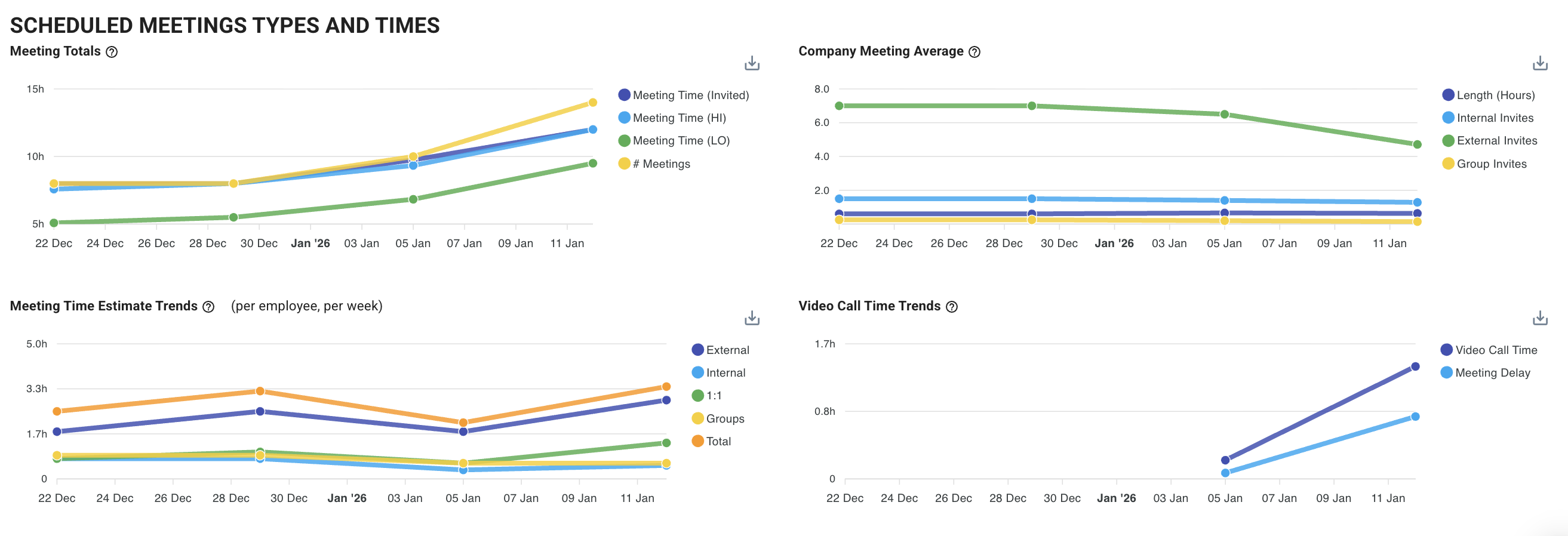
Once meeting load becomes the baseline, teams lose uninterrupted blocks that make deep work possible. Progress slows, and the organization responds by adding more coordination, because coordination feels like control when execution feels uncertain.
A second driver is that meetings persist long after the conditions that created them have changed. Recurring meetings become cultural infrastructure, because repetition looks like legitimacy even when outcomes are weak.
A third driver is effectiveness. Atlassian reports that meetings are ineffective 72% of the time in their research, describing meetings as the number one barrier to productivity in their survey. When teams experience meetings as costly and low-output, they do not automatically schedule fewer meetings; they often schedule more, because they still need alignment and decisions.
This is why meeting culture gets worse even when everyone agrees meetings are a problem. Harvard Business Review summarizes research showing that about 70% of meetings keep employees from working and completing tasks, and also notes that while meeting length decreased during the pandemic, the number of meetings attended rose. A culture can compress meetings and still remain meeting-heavy, because the underlying reflex is unchanged.
A healthy meeting culture is not defined by “having fewer meetings.” It is defined by shared judgment about when meetings are the right tool, and shared confidence that the organization can coordinate without defaulting to live calls.
In a strong meeting culture, meetings exist primarily for work that benefits from synchronous time: decisions, complex problem-solving, sensitive conversations, and fast resolution of blockers. Updates and routine information sharing are handled asynchronously, so meeting time is protected for interaction that actually needs it.
Healthy cultures also separate visibility from attendance. People do not join meetings to prove they are involved; they can stay informed through clear notes, reliable updates, and transparent decision logs.
Ownership is another marker. Someone is accountable for each meeting’s purpose, invite list, and outputs, and it is culturally normal to redesign or retire meetings when they stop earning their time.
Finally, there is safety around opting out. Declining a meeting is not treated as disengagement when a person is not required for the outcome, and optional attendance is a norm rather than a courtesy.
A culture reset is a behavior reset, which means you need explicit steps that people can follow consistently. The goal is not to create bureaucracy around meetings, but to replace vague norms with clear defaults that steer decisions in the right direction.
Start by making the “meeting decision” explicit. Instead of asking, “Should we meet?”, shift to, “What outcome requires synchronous time?”
This forces teams to separate work that needs debate, nuance, or quick resolution from work that is primarily informational. It also reduces meetings that exist because nobody wants to write the update, or because “we always do a sync.”
A simple rule that works is to require one sentence before a meeting is scheduled: This meeting exists to produce X outcome. If “X” is not clear, the right next step is usually a short written prompt, not a calendar invite.
Meeting culture often collapses into attendance culture. People join because it feels safer to be present than to miss context, and because attendance gets interpreted as commitment.
A reset changes the definition of participation. Participation becomes “contributing to the outcome,” not “being in the room.” That means it becomes normal to ask, “Am I needed to produce the outcome, or do I just need the notes?”
This step also benefits from role clarity. If teams normalize roles like decision owner, facilitator, contributor, and informed observer, meetings become easier to size correctly, and people can opt out without ambiguity.
Many organizations use meetings as a visibility system, because meetings are the easiest way to ensure everyone hears the same thing. The cultural shift is to build visibility outside meetings so attendance is no longer the primary visibility mechanism.
This is where simple, consistent written updates matter more than elaborate process. A weekly update format that covers priorities, progress, risks, and help needed often removes the pressure that creates status-heavy meetings.
When visibility is handled well, meeting agendas change naturally. They move away from narration and toward decisions, exceptions, and problem-solving, which is where synchronous time actually pays for itself.
A meeting culture reset requires clear ownership, because meetings without owners become immortal. If nobody owns the meeting, nobody is responsible for whether it still has a purpose, whether the attendee list is correct, or whether outcomes are being produced.
Make ownership explicit and lightweight. The owner’s job is to maintain the meeting’s purpose, confirm it is still needed, and ensure outputs are captured.
This is also where you stop meetings from becoming inherited rituals. If ownership is assigned, renewal becomes a decision rather than an accident.
Meeting culture follows leaders, because leaders define what is “safe” behavior. If leaders join every meeting, tolerate meetings without outcomes, and rarely decline invites, they teach the organization that meetings are the default risk-management tool.
A leadership reset looks like visible modeling. Leaders ask for outcomes before accepting meetings, decline meetings where their presence is not necessary, and cancel recurring series that no longer produce value.
This matters because it removes the fear that drives attendance. When leaders model intentional participation, teams gain permission to do the same.
A meeting culture reset stalls when people believe that questioning a meeting is political. If redesigning a meeting feels like criticism, the culture will keep its worst meetings indefinitely.
Make questioning normal and procedural. It helps to treat meeting redesign as maintenance, the same way you treat backlog grooming or quarterly planning.
Teams can adopt a simple habit: if a meeting does not produce an outcome for two or three cycles, it gets redesigned. That rule makes improvement a default rather than a confrontation.
Recurring meetings are not the whole culture, but they are one of the strongest cultural levers, because they encode assumptions. A weekly recurring meeting says, “We require constant synchronization to move forward,” and a large recurring meeting says, “Broad attendance is the safest form of alignment.”
Resetting recurring meetings is not primarily a calendar exercise. It is a cultural practice of reviewing and renewing coordination mechanisms intentionally.
A practical reset is to treat recurrence like a subscription. A meeting should have an explicit purpose, a named owner, and a renewal moment, because recurring meetings persist by default unless the culture actively prevents that.
It is also worth acknowledging what meeting size does to meeting behavior. Our meeting statistics found that when more than 10 people attended, 64% of meetings took longer than 60 minutes. If recurring meetings grow in attendance over time, they often grow in duration and drift in purpose, which increases the cultural cost even if the meeting feels “normal.”
A simple recurring reset pattern is to review cadence, size, and outputs. If the meeting is mostly updates, move updates to a pre-read and keep the meeting for exceptions and decisions. If the meeting exists “because we always meet,” add an expiry date and require renewal based on outcomes.
Meeting culture change is hard to sustain without visibility. If teams cannot see what is happening to meeting load, recurrence, attendance, and meeting outcomes, the reset becomes subjective, and subjective resets tend to fade.
Measurement is not about policing. It is about making drift visible, because drift is what breaks meeting culture in the first place.
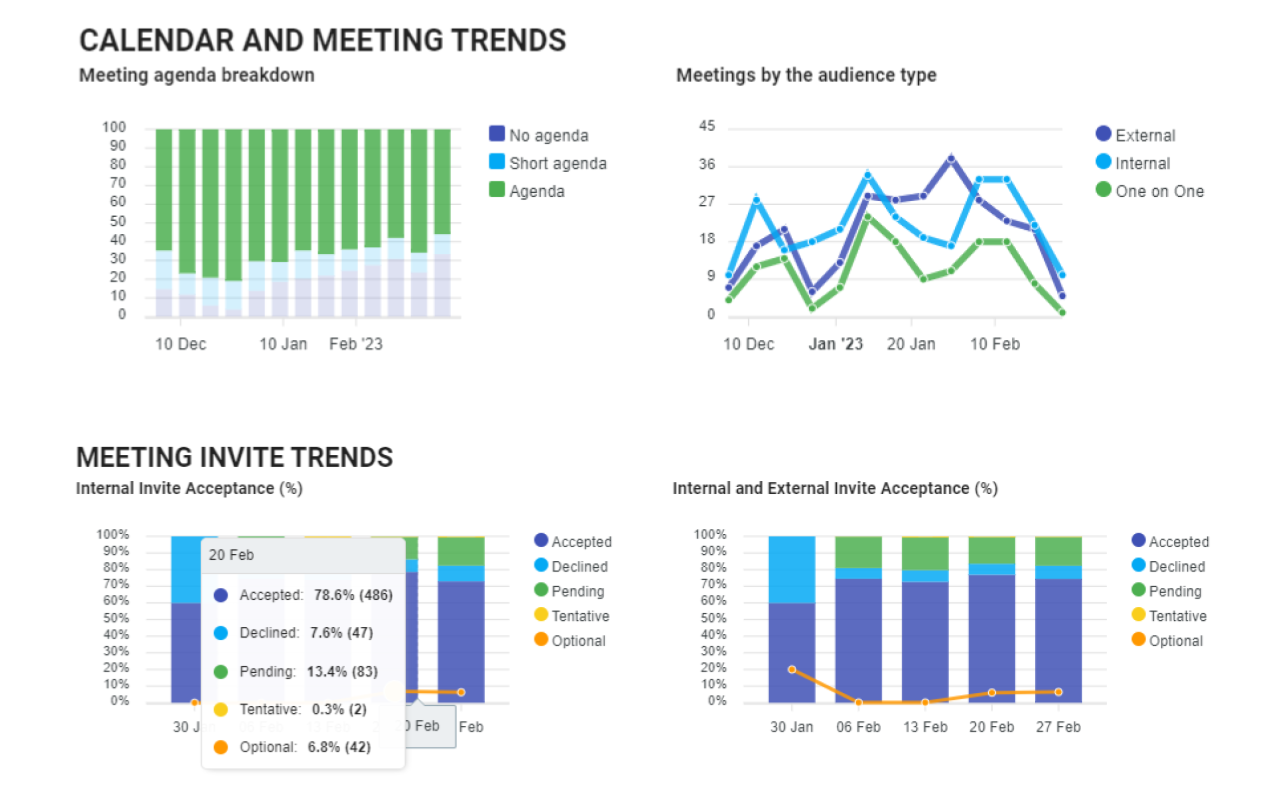
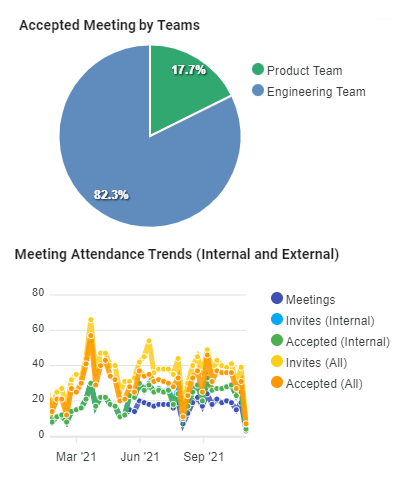
This is where meeting analytics becomes part of the culture reset, not as a dashboard for vanity metrics, but as a feedback system. Trends like recurring meeting growth, rising attendee counts, increasing meeting hours, and expanding cross-functional meeting load are early warnings that coordination is becoming the default again.
.png?width=960&height=540&name=Marketing%20Images%20(11).png)
Microsoft’s Work Trend Index data shows how quickly meeting patterns can shift at scale, which is exactly why measurement matters. When meeting time can rise 252% over a few years, the difference between a healthy culture and an overloaded one is often whether the organization notices the change early enough to correct it.
Meeting analytics supports cultural change when it is tied to norms, not targets. If the norm is “meetings should produce outcomes,” then measurement can look for signals that outcomes are weak, such as meetings that recur without decisions, meetings that continually grow in size, or meeting-heavy teams that report low progress.
This is also where Flowtrace fits naturally. A meeting culture reset improves when teams can quantify the current meeting environment, identify the specific patterns driving overload, and track whether changes are sticking over time, rather than relying on anecdotes.
The goal is simple: make the calendar reflect intent. When analytics shows that recurring meetings are shrinking, focus time is increasing, and meeting load is stabilizing while execution improves, you are not just changing meetings. You are changing culture.
A meeting culture reset is the work of changing defaults: when meetings are used, how participation is defined, how visibility is created, and how leaders model coordination. Calendars improve when culture improves, because meetings become a deliberate tool rather than a reflex.
If you reset the cultural drivers, recurring meetings become easier to maintain, ad hoc meetings become less necessary, and meeting time becomes more valuable. The organization gets back what meeting overload steals first: time, attention, and momentum.
Transform your meeting culture with analytics to boost productivity and efficiency. Learn how data-driven practices can optimize meetings and align...
Implementing a Meeting Analytics Dashboard is crucial for organizations to optimize productivity, time management, and cost efficiency. Learn how...
Optimize manufacturing meetings with structured practices and analytics to enhance productivity, safety, and operational efficiency. Learn practical...