An agenda can exist and still fail.
It can list three vague topics, arrive five minutes before the call, and leave everyone unsure what they need to prepare or decide. The meeting technically has an agenda. It does not have enough structure to improve the meeting.
That distinction is the reason agenda validation matters. An effective meeting agenda makes the purpose, preparation, participation, and expected outcome clear before people give up time. Validation checks whether the agenda does that job. It is a quality test, not a box-ticking exercise.
The research supports this distinction. In two studies involving 1,250 meeting observations, Leach, Rogelberg, Warr, and Burnfield found that agenda use was among the design characteristics associated with perceived meeting effectiveness. Their findings did not show that any agenda guarantees a good meeting. They showed that meeting design and attendee involvement matter together.
Flowtrace's own data shows why a quality test is needed. In Flowtrace's 2026 meeting statistics, based on more than 1.2 million scheduled meetings from 2025, 67.4% of meetings with agenda-length data had fewer than 100 agenda characters. That bucket includes both empty and very short agendas, so it is not a pure no-agenda rate. It is still a useful warning: agenda presence alone tells you very little about readiness.
Short answer: Meeting agendas are important because they move essential decisions before the meeting. They clarify why the meeting exists, who needs to attend, what people should prepare, and what outcome the group must produce. Agenda validation checks whether those decisions are visible before the invite becomes everyone else's commitment.
Key takeaways
- An agenda improves a meeting only when it changes preparation, participation, or the quality of the outcome.
- Agenda validation should test purpose, expected outcome, attendee fit, preparation, and follow-through.
- Character count and agenda presence are useful signals, but neither proves that the agenda is good.
- The best measurement combines calendar metadata with attendee feedback, decisions, and evidence that the outcome moved into the work.

Why meeting agendas are important
A meeting consumes time before anyone joins. Invitees read the title, search for context, decide whether to attend, and work out what they may be asked to contribute. A clear agenda reduces that uncertainty.
The value comes through four practical mechanisms.
The agenda makes the purpose testable
"Project update" is a topic. "Decide whether to delay the release after reviewing the open reliability risks" is a purpose with an outcome.
That difference matters because a specific purpose lets invitees challenge the meeting before it happens. If no decision, collaboration, or sensitive discussion requires people to meet, the work may belong in a document or an asynchronous update. Our separate guide answers whether a meeting needs an agenda at all; the important point here is that the agenda should also expose whether the meeting needs to exist.
The agenda improves preparation
People prepare better when they know what evidence, opinion, or authority the meeting requires. A budget owner may need cost assumptions. An engineering lead may need incident data. A customer lead may need the latest account context.
Microsoft Research studied 3,290 filtered survey responses and found that pre-meeting communication, including a meeting agenda, was among the factors correlated with perceived effectiveness, participation, inclusion, and comfort contributing. The study was conducted in a remote-collaboration setting and describes correlation, not a universal causal effect. It still supports a sensible operating principle: the agenda should help people contribute before the organizer asks for their time.
The agenda sets the participation boundary
Unclear purpose creates defensive attendance. People join because they might be needed, a decision might affect them, or nobody has explained whether their input is optional.
A useful agenda states which items need a decision owner, which need specialist input, and which are simply being shared. That makes attendee fit easier to judge. It also gives invitees a legitimate way to decline, delegate, or provide input in advance.
The agenda connects the meeting to follow-through
An agenda item should point toward an outcome: a decision, a resolved question, a tested proposal, or an agreed commitment. If it only names a subject, the meeting can spend an hour discussing the subject without completing any work.
Research by Král, Králová, and Šimáček found that sharing an agenda and doing pre-meeting work increased attendee involvement in their survey model. Incorporating meeting outcomes into subsequent work also had a large, significant positive relationship with perceived effectiveness. That is a useful reminder that agenda effectiveness does not end when the calendar slot ends. A good agenda creates an outcome that survives the meeting.
For the detailed process of recording decisions and commitments, use our meeting follow-up guide.
What agenda validation means
Agenda validation is a quality check applied before a meeting invite is sent or materially changed. It asks whether the agenda gives invitees enough context to prepare, participate, and understand the expected outcome.
The check can be manual. A manager can review important leadership meetings before they reach the calendar. It can also be built into meeting policy, with a reminder or rule appearing while the organizer creates the invite.
The crucial point is what the validation tests. A rule that only asks whether the description field contains text will accept "discuss project" as easily as a useful agenda. Stronger validation asks whether the invite answers five questions:
- Why does this meeting need to happen?
- What should be different when it ends?
- Who must contribute or decide?
- What should attendees review or prepare?
- How will the outcome be recorded and carried into the work?
If you need detailed guidance on writing and sequencing agenda items, use our meeting agenda best practices. If you need the exact calendar workflow, see calendar agenda validation. This article focuses on the quality standard and how to measure it.
A five-part meeting agenda effectiveness scorecard
Use this scorecard before important meetings or when reviewing a recurring meeting. Give each dimension 0, 1, or 2 points.
| Dimension |
0 points |
1 point |
2 points |
| Purpose clarity |
The topic is vague or absent |
The purpose can be inferred |
The invite states why the meeting is needed |
| Outcome clarity |
No outcome is named |
A likely outcome is implied |
The decision, answer, or commitment is explicit |
| Participation fit |
The invite gives no clue who is needed |
Roles are partly clear |
Contributors, decision owners, and optional attendees are distinguishable |
| Preparation readiness |
No pre-work or context is available |
Some context exists |
Required evidence, reading, or questions are clear and accessible |
| Follow-through design |
The meeting ends at discussion |
Notes or actions are expected |
The agenda says how decisions, commitments, and open questions will be recorded |
The total is a prompt for judgment, not a universal benchmark:
- 0 to 3: do not send the invite yet. The meeting may not be ready or necessary.
- 4 to 6: the purpose may be valid, but invitees will have to fill in important gaps.
- 7 to 8: the meeting is probably ready, with one or two points to clarify.
- 9 to 10: the agenda gives attendees a strong basis for preparation and follow-through.
A high score does not guarantee skilled facilitation, a sound decision, or useful debate. It tells you that the meeting has a fair chance because the essential design decisions have been made visible.
How to measure agenda effectiveness
Agenda effectiveness cannot be captured in one metric. Measure the meeting across three stages: before, during, and after.
Before the meeting: measure readiness
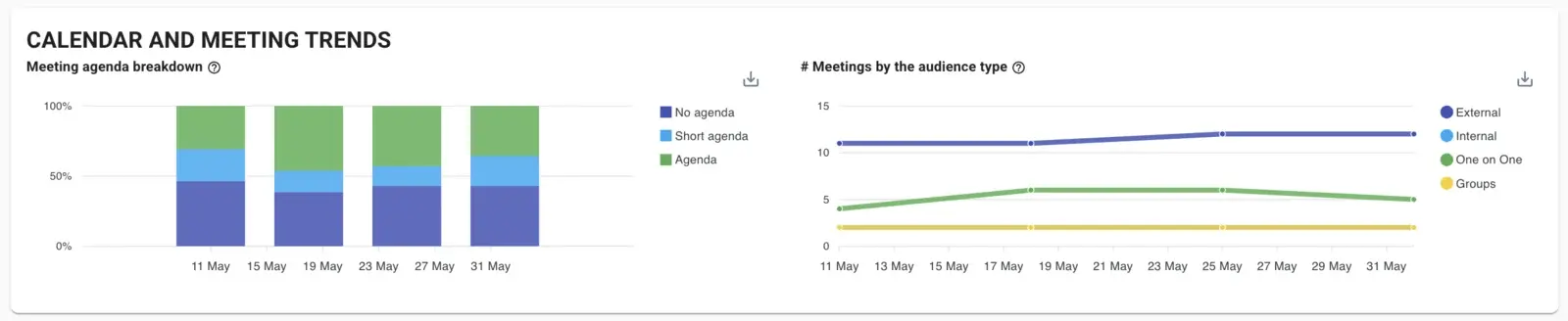
Calendar metadata can show whether agendas exist, how much detail they contain, and how patterns differ by meeting type, recurrence, team, duration, or attendee count. These signals help you find where to look.
They do not judge the quality of the argument or read what people intend to discuss. An agenda with 300 characters can still be useless. An agenda for a short decision meeting may be excellent with fewer words.
Useful readiness questions include:
- Was the purpose visible early enough for attendees to prepare or decline?
- Did the invite name an expected decision or outcome?
- Could attendees find the evidence or pre-work without chasing the organizer?
- Did the attendee list match the stated purpose?
During the meeting: measure whether the agenda helped
Do not turn facilitation into surveillance. Use a short observation or one targeted feedback question after selected meetings.
Ask whether the agenda made it easier to contribute, whether the right topics received attention, and whether the group reached the stated outcome. Targeted meeting feedback is more useful than a generic satisfaction score because it points to something the organizer can change.
After the meeting: measure whether the outcome moved into the work
Check whether the decision was recorded, commitments have owners, and open questions have a route back to a decision. The strongest signal is not a tidy set of minutes. It is whether the intended outcome appears in the systems and work that follow.
This is also what it means to maintain an agenda. Keep the purpose and expected outcome current when circumstances change. During the meeting, park unrelated issues rather than stretching the scope. Afterward, connect the agenda to the decision and follow-up record. The document should stay aligned with the work, not remain frozen as the version first attached to the invite.
How organizations improve agenda quality at scale
Telling every organizer to "write better agendas" rarely changes a company-wide pattern. The instruction is too broad, and it arrives far from the moment the behavior happens.
A practical improvement loop has four parts.
1. Establish the baseline
Use meeting analytics to compare agenda-related metadata by meeting type, team, recurrence, duration, and attendee pattern. Look for concentrations rather than ranking individual employees. A recurring leadership meeting and a short one-to-one should not be judged by identical wording or length.
2. Choose one validation rule
Start with the problem that appears most often. That might be a missing purpose, an absent expected outcome, or recurring meetings that never explain why the same group needs to keep meeting.
Avoid launching a long policy checklist. One clear rule gives organizers a fair chance to change and gives leaders something measurable to review.
3. Reinforce the rule in the calendar
Flowtrace can surface agenda rules while organizers create invites in Google Calendar and Microsoft Outlook. The prompt appears where the organizer can fix the problem, before the meeting has consumed anyone else's time.
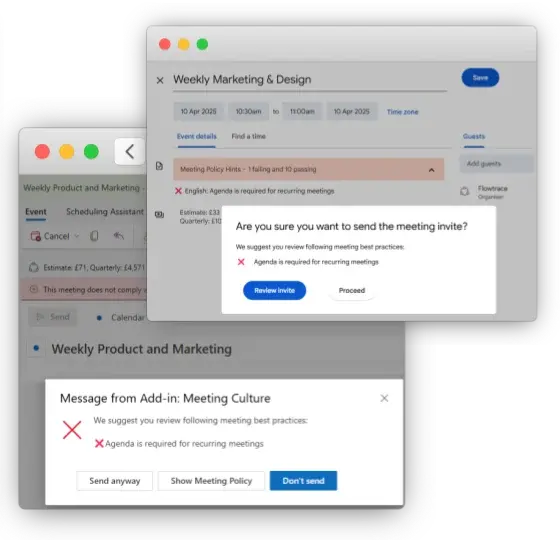
The aim is not to block every imperfect invite. It is to make the agreed meeting standard visible when it can still influence behavior.
4. Remeasure and adjust
Review the same pattern after the rule has had time to operate. Did more invites provide useful context? Did attendee feedback improve? Did the relevant meeting type produce clearer outcomes or fewer avoidable follow-ups?
If the metadata improved but outcomes did not, the rule may be too superficial. If organizers work around it with filler text, validate a more meaningful field. If one meeting type improves and another does not, split the standard rather than forcing one format across the company.
This loop connects agenda quality to meeting culture. The problem is treated as a system to improve, not a reason to blame the people who schedule meetings.
Where Flowtrace helps, and where it does not
Flowtrace helps organizations see agenda patterns across calendars, apply agenda rules at invite creation, and measure whether scheduling behavior changes over time. It uses metadata-first analytics. It does not need to record, transcribe, summarize, or interpret meeting conversations.
That boundary matters. Calendar data can show that an agenda is missing or very short. It can show which meeting types, teams, or recurring patterns deserve review. It cannot prove that a discussion was insightful, that a decision was correct, or that every participant felt heard.
Use analytics to locate the pattern. Use feedback, decision records, and operating results to judge the outcome. That combination is more honest and more useful than pretending one dashboard score can define a good meeting.
Frequently asked questions
Why is a meeting agenda important?
A meeting agenda makes the purpose, required preparation, discussion boundaries, and expected outcome visible before the meeting. It helps invitees decide how to contribute and gives the organizer a basis for keeping the meeting focused.
What makes a meeting agenda effective?
An effective agenda states why the meeting is needed, what outcome it should produce, who needs to participate, what preparation is required, and how decisions or commitments will be recorded. Length alone does not determine quality.
What is agenda validation?
Agenda validation is a quality check applied before a meeting invite is sent. It checks whether the agenda gives invitees enough context to prepare, participate, and understand the expected outcome. It can be a manual review or a calendar-side rule.
How do you measure agenda effectiveness?
Measure agenda effectiveness across preparation, participation, and outcomes. Combine calendar metadata such as agenda presence and length with targeted attendee feedback, decision records, and evidence that commitments moved into the work.
Make agenda quality part of the meeting system
Start with five questions: why the meeting exists, what outcome it should produce, who needs to contribute, what preparation is required, and how the outcome will be recorded. Apply the scorecard to one important recurring meeting this week.
If the same gaps appear across teams, the problem is larger than one organizer. Establish a baseline, choose one validation rule, reinforce it in the calendar, and measure whether the change improves preparation and follow-through. That is how a meeting agenda becomes an operating tool rather than text added to satisfy a policy.