A meeting policy is not a list of etiquette tips. It is an operating agreement for when meetings are worth using, how they should be designed, and how the organization will keep meeting habits from drifting back into overload.
Most companies do not need another lecture about better agendas. They need a way to stop bad meeting habits from becoming the default operating system.
That is why meeting policy and meeting governance belong together. The policy defines the standard. Governance makes it visible, practical, and durable.
One thing we hear from clients often: meeting guidelines exist somewhere, but almost nobody knows where. New employees may see them once during onboarding. Six months later, the calendar has taken over. Employees are surprised that meeting rules exist at all, managers are not sure whether the rules are current, and ownership is vague enough that nobody wants to rewrite them.
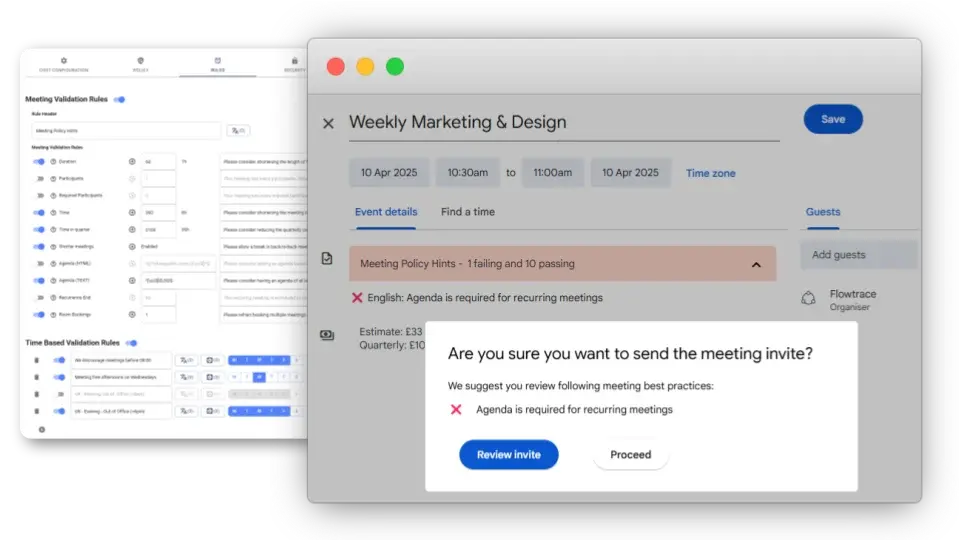
That is the practical reason calendar-side policy matters. If the policy only lives in onboarding material, it depends on memory. If the policy appears when someone drafts an invite, it can change behavior at the moment the behavior happens.
This guide is the parent resource for Flowtrace content about meeting policy, meeting rules, meeting governance, invite validation, calendar-side nudges, and meeting management. Use it when you need the whole system. For narrower workflows, use the meeting audit checklist, Google Calendar rules for productive meetings, Outlook meeting rules, or meeting invite rules.
In this guide
Meeting policy guide in a nutshell
A good meeting policy answers five questions:
- When is a meeting the right tool?
- What must be true before someone sends the invite?
- Who should attend, and who should not?
- How will recurring meetings be reviewed or retired?
- How will leaders know whether the policy is working?
The last question is the one most companies miss. They write the policy, announce it, and hope behavior changes. It usually does not.
Meeting policy works when it becomes a loop: measure current meeting behavior, define the standard, reinforce it at the moment meetings are created, review the data, and adjust the rules. Without that loop, the policy becomes a PDF in a shared drive.
Flowtrace has seen this problem at scale. In our 2026 meeting statistics work, based on more than 1.2 million scheduled meetings from 2025, 48.5% of meetings were recurring, 67.4% of meetings with agenda-length data had fewer than 100 agenda characters, and 36.3% of meetings with notice data were organized less than 24 hours before they started. Those are not just meeting hygiene facts. They are governance signals.
They show why meeting policy cannot live only in training material. The work happens in the calendar.
What is a meeting policy?
A meeting policy is a company-level agreement for how meetings should be created, attended, reviewed, and improved.
It should define:
- When a meeting is appropriate.
- What purpose, outcome, or agenda is required.
- How many people should be invited.
- When optional attendees are acceptable.
- Which meetings should be recurring.
- How much notice is expected.
- Which meetings should be replaced with async work.
- How meeting cost, meeting load, and focus time are reviewed.
- Who owns exceptions and enforcement.
The policy is not meant to make every meeting identical. A leadership decision meeting, one-to-one, incident response call, customer escalation, sprint planning session, and board preparation meeting do not need the same rules.
The point is to make the default behavior intentional.
That distinction matters for search intent as well. People searching for "meeting policy", "meeting rules", or "meeting management" are not usually asking for generic productivity advice. They are looking for a way to create standards that people will actually follow.
It also matches the direction of meeting research. A 2026 Annual Review article, Thirty Years of Meeting Science, describes meetings as more than calendar events. Meeting research now connects meetings with stress, communication technology, employee voice, inclusion, leadership, power, culture, and identity. A meeting policy should respect that complexity. It should improve the system without pretending every meeting can be judged by one rule.
Meeting policy vs meeting governance
Meeting policy and meeting governance are related, but they are not the same thing.
| Term |
What it means |
Example |
| Meeting policy |
The written standard for how meetings should be created and managed |
"Recurring meetings with more than seven attendees need an owner, agenda, and review date." |
| Meeting rules |
Specific requirements or nudges that support the policy |
"Warn the organizer if a recurring meeting has no agenda." |
| Meeting governance |
The system for measuring, reinforcing, reviewing, and improving the policy |
"Review recurring meeting load and policy exceptions monthly by department." |
| Meeting management |
The day-to-day operating practice of running better meetings |
"Managers review stale recurring meetings during quarterly planning." |
Policy is the rulebook. Governance is the operating system.
A company can have a meeting policy without governance. That is common. It is also why meeting policies often fade. People may agree with the policy, but their calendar tools, management rhythms, and incentives keep pulling them back toward old behavior.
Meeting governance closes that gap. It connects the policy to analytics, calendar workflows, leadership review, and practical behavior change.
For the broader analytics foundation, see the Meeting Analytics Guide. For a supporting article that explains the management angle, see Meeting Management: Policy, Rules, and Analytics.
Who owns meeting culture?
This is the awkward part. Meeting culture is everybody's problem, which often means it has no clear owner.
IT owns the collaboration stack. People or HR owns culture, manager enablement, and employee experience. Operations owns operating rhythm, process quality, and cross-functional coordination. Finance cares about meeting cost. Executives set the behavior everyone copies.
None of those groups can solve meeting culture alone.
| Function |
What they usually own |
What they cannot own alone |
| Senior leadership |
Role-modeling, decision cadence, strategic meeting rhythm |
Tool configuration, manager enablement, day-to-day calendar hygiene |
| People or HR |
Culture, manager training, onboarding, norms, employee experience |
Calendar enforcement, cost analytics, operational review cadence |
| IT |
Google Calendar, Outlook, collaboration tools, deployment, access controls |
The business rules for which meetings should exist |
| Operations or RevOps |
Operating cadence, process quality, cross-functional routines, governance rhythm |
Culture change without leadership and people-manager adoption |
| Finance |
Meeting cost visibility, opportunity cost, budget pressure |
Meeting quality, employee trust, collaboration design |
| Managers |
Team norms, recurring meeting hygiene, attendee discipline |
Company-wide consistency and tool-level reinforcement |
In practice, meeting governance works best when one function is accountable for the system and several functions own parts of it. The exact owner depends on the company. In a tool-led rollout, IT may lead deployment while People and Ops define the rules. In a culture-led rollout, People may own the policy while Operations owns the review rhythm. In a cost-led rollout, Finance may sponsor the business case while leaders decide what must change.
The important part is to name the owner. If nobody owns meeting culture, the calendar will.
McKinsey's article on making time management the organization's priority makes the same broader argument about time: companies should treat time as an organizational resource, not only as an individual productivity issue. Meeting policy belongs in that category. It is a management system, not a personal habit.
This ownership question deserves its own deeper article because different companies will answer it differently. For this guide, use the principle: meeting culture needs a named business owner, visible executive sponsorship, People/HR enablement, IT support, and operational review.
Why meeting policies fail
Meeting policies usually fail for one of five reasons.
1. The policy is written as advice, not as an operating rule
"Only have useful meetings" is not a policy. Neither is "keep meetings short."
Useful policies define observable behavior. They say what needs to happen before an invite is sent, what should trigger review, who owns exceptions, and how the organization will inspect whether the policy works.
2. Leaders create exceptions faster than teams can follow rules
Meeting culture flows from leadership behavior. If executives add recurring meetings without purpose, accept crowded invites, tolerate missing agendas, or book short-notice internal meetings as the normal way to get decisions made, the policy becomes theater.
This is not about blaming leaders. It is about making the operating system visible. Leaders create many meetings because they are trying to reduce uncertainty. Without governance, the total effect can be more uncertainty for everyone else.
3. The policy ignores recurring meetings
Recurring meetings are where meeting debt accumulates.
In Flowtrace's 2026 meeting statistics work, recurring meetings represented 48.5% of scheduled meetings. The share was 47.0% in the prior report, based on complete 2024 data. The important lesson is not that every recurring meeting is bad. The lesson is that nearly half the meeting system can become semi-permanent unless someone owns the review cycle.
A serious meeting policy needs rules for recurring meeting purpose, ownership, attendee count, review dates, and retirement.
4. The policy is not reinforced in the calendar
People do not create meetings while reading the company handbook. They create meetings in Google Calendar, Outlook, or a scheduling workflow.
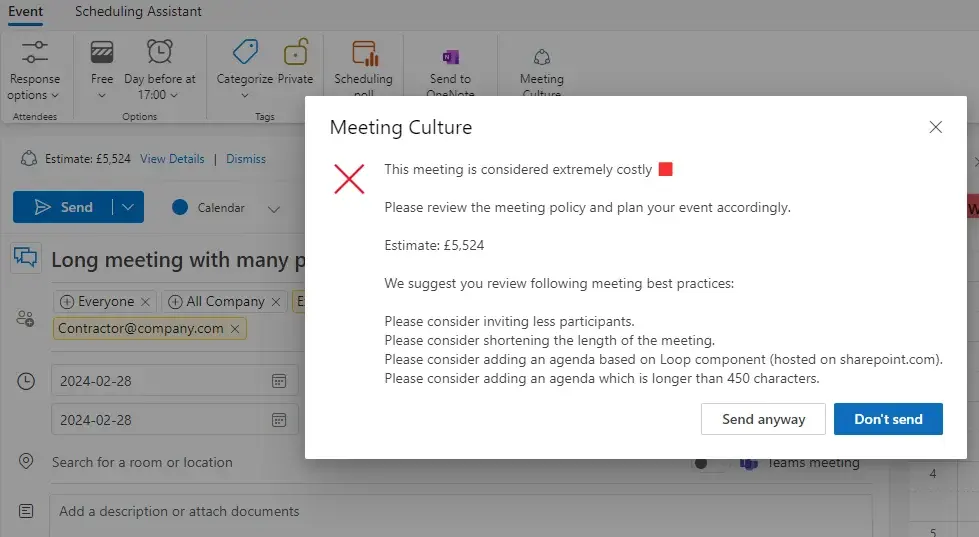
That is where policy needs to appear. If a meeting is missing an agenda, inviting too many people, creating a high-cost recurring commitment, or scheduled with little notice, the best moment to intervene is before the invite is sent.
This is why Flowtrace treats Google Calendar and Outlook as behavior-change surfaces, not just calendar platforms.
This is also why onboarding-only guidance is weak. A new employee might read the policy once. A manager creating a recurring meeting needs the policy at the point of scheduling, when the attendee list, cost, agenda, and recurrence are still editable.
5. The policy has no measurement
If nobody measures the policy, nobody knows whether it worked.
The meeting problem is not static. New projects appear, leaders change roles, hiring adds coordination load, customers create urgency, and quarterly planning creates new rituals. A policy that works in January may be stale by June.
Measurement does not need to be invasive. A metadata-first approach can show meeting load, recurring meeting share, attendee count, agenda discipline, notice time, cost, and calendar fragmentation without reading what people say in meetings.
The meeting governance loop
A strong meeting policy should sit inside a repeatable governance loop.
1. Measure the baseline
Start with the current meeting system. Do not begin with opinions.
Measure meeting load, recurring meeting share, large recurring meetings, invitee count, agenda discipline, notice time, meeting cost, focus fragmentation, and department-level patterns. A meeting audit is the best first step because it turns vague frustration into a concrete baseline.
2. Define the policy
Choose a small number of rules that match the real problem.
If the issue is recurring meeting debt, start there. If the issue is last-minute scheduling, create notice-time rules. If the issue is low-quality meetings, require purpose and agenda. If the issue is too many large decision forums, define attendee and decision-role rules.
Avoid creating 25 rules at once. A policy nobody can remember will not change behavior.
3. Encode the rules into calendar behavior
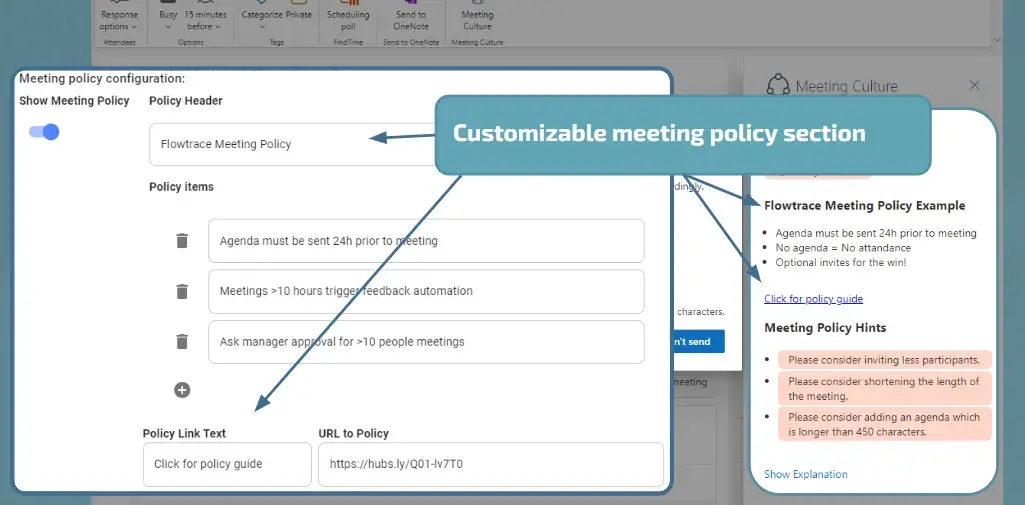
The policy should be visible when employees create meetings.
That might mean warning organizers when a meeting lacks an agenda, showing cost before a large recurring meeting is sent, requiring a purpose for meetings above a certain attendee threshold, or nudging the organizer to mark optional attendees properly.
This is the difference between a policy and a workflow. The policy says what good looks like. The workflow helps people do it.
4. Review exceptions and trends
Every policy needs exceptions. Incident calls, customer escalations, board meetings, hiring panels, and urgent delivery work do not fit neat meeting rules.
The question is not whether exceptions exist. The question is whether they are becoming the normal operating model.
Review exceptions by trend, not one by one. If short-notice meetings spike in one department, inspect planning cadence. If large recurring meetings keep growing, inspect ownership and decision rights. If missing-agenda warnings are ignored, inspect whether the agenda rule is too vague or poorly timed.
5. Improve the policy
Meeting governance is iterative. The first version of the policy will be imperfect.
The useful question is: did the rule change behavior without creating a worse workaround?
Microsoft WorkLab's 2025 Work Trend Index special report describes an "infinite workday" shaped by interruptions, messages, meetings, and ad hoc work. Its methodology also points to high interruption volume and substantial ad hoc meeting activity among high-volume users. The practical lesson for governance is simple: if the meeting policy only reduces scheduled meetings but pushes the same coordination into chat, the organization has not solved the system.
What to include in a meeting policy
1. Meeting purpose rules
Every meeting should have a reason to exist.
A useful policy separates meeting purposes into categories:
- Decision meeting.
- Problem-solving meeting.
- Planning meeting.
- Review meeting.
- One-to-one.
- Customer or external meeting.
- Incident or escalation meeting.
- Information-sharing meeting.
The rule should be practical: if the meeting is not making a decision, solving a problem, creating alignment, or handling a sensitive discussion, ask whether async work is better.
For tactical agenda guidance, use Meeting Agenda Effectiveness: Why Validation Matters.
2. Agenda and outcome rules
Agenda rules are not about ceremony. They are about reducing uncertainty before people spend time together.
Flowtrace's 2026 meeting statistics work found that 67.4% of meetings with agenda-length data had fewer than 100 agenda characters. That bucket includes empty and very short agendas, so it should not be presented as a pure no-agenda count. Still, it is a strong governance signal: many meetings are created with very little written context.
Good policy language:
Internal meetings need a clear purpose or agenda before the invite is sent. Decision meetings should name the decision owner and the expected outcome.
Bad policy language:
Please try to have better agendas.
The second version sounds nice. The first version can be governed.
3. Attendee rules
Attendee rules decide who should be in the meeting and who should receive the output.
Common attendee roles:
- Decision owner.
- Required contributor.
- Subject-matter expert.
- Accountable leader.
- Optional observer.
- Informed later by notes or async summary.
The policy should make it acceptable not to attend when the person does not have a clear role. This is where meeting FOMO becomes a management issue, not a personality flaw. For a deeper supporting article, see Meeting FOMO: How to Break the Cycle.
4. Recurring meeting rules
Recurring meetings need the strongest governance because they create durable cost.
A recurring meeting policy should define:
- Owner.
- Purpose.
- Attendee logic.
- Review date.
- Retirement condition.
- Expected output.
- Cost or attendee threshold for leadership review.
In Flowtrace's latest report, 33.0% of recurring meetings with invite-size data had seven or more invitees, up from 28.9% in the prior report. That does not mean large recurring meetings are always wasteful. It means they deserve explicit ownership.
5. Notice-time rules
Short-notice meetings are sometimes necessary. They can also reveal reactive management.
In Flowtrace's 2026 meeting statistics work, 36.3% of meetings with notice data were organized less than 24 hours before they started. Some of that is legitimate. But when short-notice meetings become normal, teams lose planning discipline and focus time becomes fragile.
Policy example:
Internal meetings should normally be scheduled at least 24 hours in advance. Short-notice meetings are acceptable for customer escalation, incident response, urgent delivery risk, or time-sensitive decisions.
This leaves room for reality without letting urgency become the default.
6. Meeting cost rules
Meeting cost should not make every conversation feel like a finance exercise. It should make tradeoffs visible.
Cost rules are most useful for:
- Large recurring meetings.
- Executive or leadership meetings.
- Cross-functional program meetings.
- Meetings with many senior attendees.
- Meetings scheduled without a clear decision.
Flowtrace's meeting costs for Google Calendar and meeting costs for Outlook pages explain the platform-specific cost visibility workflow.
7. Async replacement rules
Some meetings should become async updates, decision memos, dashboards, recorded walkthroughs, or written proposals.
The policy should not say "use async when possible", because that leaves all the hard judgment to the organizer. Better:
| Meeting pattern |
Better default |
| Status update with no discussion |
Async summary or dashboard |
| Broad awareness topic |
Written announcement |
| Pre-read discussion |
Written pre-read plus shorter decision meeting |
| Recurring meeting with frequent cancellations |
Retire or move to on-demand |
| Large meeting where few people speak |
Split decision makers from observers |
The goal is not async purity. The goal is to reserve meetings for work that benefits from being synchronous.
8. Focus-time rules
Meeting policy should protect the conditions for non-meeting work.
This can include:
- Meeting-free blocks for deep work.
- No-meeting mornings for certain teams.
- Protected engineering or product focus windows.
- Limits on fragmented calendars.
- Review of meeting load by team.
The warning is that no-meeting rules can backfire if the same work moves into chat. A policy should protect focus by redesigning coordination, not by hiding the calendar problem.
9. Platform rules for Google Calendar and Outlook
Calendar platforms are where meeting policy becomes practical.
For Google Calendar, policy can be reinforced through rules around agendas, meeting cost, attendee count, recurring meeting review, and scheduling warnings. See Google Calendar rules for productive meetings and implementing meeting policy rules in Google Calendar.
For Outlook, policy can be tied to meeting cost estimates, agenda validation, recurrence warnings, and organization-wide deployment. See Outlook meeting policy and Outlook meeting rules.
10. Privacy and trust rules
Meeting policy should make privacy clear.
Employees should know:
- What data is measured.
- What data is not measured.
- Who can see reports.
- Whether reports are individual, team-level, or aggregate.
- How the data will be used.
- How it will not be used.
Flowtrace's position is clear: meeting analytics should improve the meeting system, not inspect employees. Metadata-first analytics is enough for most meeting governance work. The organization can understand meeting load, recurrence, attendee patterns, agenda discipline, notice time, and cost without reading meeting content.
Meeting policy metrics
The right metrics depend on the policy, but most companies should start with this set.
| Policy area |
Metric |
What it tells you |
| Meeting load |
Meeting hours per person or team |
Whether the calendar leaves enough room for non-meeting work |
| Recurring meetings |
Recurring meeting share and review age |
Whether standing meetings are being governed |
| Attendees |
Invitee count and optional attendee use |
Whether meetings have clear participation logic |
| Agenda discipline |
Agenda presence or agenda-length signal |
Whether purpose is visible before the meeting |
| Notice time |
Meetings created less than 24 hours before start |
Whether planning cadence is reactive |
| Meeting cost |
Cost by meeting, series, or team |
Whether expensive meetings have enough value and ownership |
| Focus protection |
Fragmentation and meeting-free blocks |
Whether the calendar supports deep work |
| Policy behavior |
Warnings, exceptions, and ignored rules |
Whether the policy is changing invite behavior |
The metric should always connect to a decision. If a leader cannot act on the metric, it probably belongs in the background.
Harvard Business Review's "Stop the Meeting Madness" makes a similar point from a management angle: meeting overload is not only an individual time problem. It affects teams and organizations. The practical implication is that measurement should lead to group-level decisions, not personal blame.
A practical meeting policy template
Use this as a starting point, not as a document to copy blindly.
Purpose
We use meetings when synchronous discussion improves the quality, speed, or trust of the work. We do not use meetings as the default place for status updates, unclear ownership, or avoidable coordination.
Default rules
- Every internal meeting needs a visible purpose or agenda.
- Decision meetings should name the decision owner and expected outcome.
- Recurring meetings need an owner, review date, and retirement condition.
- Meetings with many attendees should separate required participants from optional observers.
- Short-notice meetings are reserved for urgent, customer, delivery, incident, or time-sensitive work.
- Expensive recurring meetings should be reviewed for purpose, attendance, and output.
- Status updates should move to async channels unless discussion is required.
- Focus-time blocks should be respected unless the work is urgent.
- Meeting rules apply to Google Calendar, Outlook, and any scheduling workflow used by the company.
- Meeting analytics is used to improve work design and meeting culture, not to score individual employees.
Owner responsibilities
Meeting owners are responsible for purpose, attendees, pre-work, facilitation, output, and recurring review.
People managers are responsible for reviewing meeting load and meeting quality with their teams.
Senior leaders are responsible for modeling the policy and reviewing organization-level trends.
Operations, People, or the meeting governance owner is responsible for reporting metrics, exceptions, and improvement opportunities.
Review rhythm
- Monthly: review policy exceptions and high-impact meeting patterns.
- Quarterly: review recurring meetings, cost, agenda discipline, and focus-time impact.
- Twice per year: review whether the meeting policy itself needs to change.
Exceptions
Exceptions are allowed when the business reason is clear. Examples include incident response, customer escalation, urgent hiring, legal or compliance deadlines, board work, delivery risk, and time-sensitive decisions.
Exceptions should not become the normal operating model.
How to roll out a meeting policy
Days 1 to 30: baseline and design
Start with a baseline, not a manifesto.
Run a meeting audit. Identify the largest issues: recurring meeting debt, missing agendas, too many attendees, high meeting cost, short-notice meetings, focus fragmentation, or unclear ownership. Review the data by team or department because averages hide the useful story.
Then choose the first three to five rules. A narrow policy that changes behavior is better than a beautiful policy nobody remembers.
Days 31 to 60: pilot and reinforce
Pilot the policy with a leadership team, department, or meeting-heavy function.
Do not rely on training alone. Reinforce the policy in calendar workflows. Show warnings when meetings miss important fields. Surface meeting cost when an invite becomes expensive. Nudge organizers when recurring meetings have no review date.
This is also where you test the language. If employees do not understand a rule, the rule will not survive rollout.
Days 61 to 90: review and expand
Review the trends:
- Did recurring meeting load change?
- Did large recurring meetings become smaller or better justified?
- Did agenda discipline improve?
- Did short-notice meetings reduce?
- Did meeting cost shift toward higher-value meetings?
- Did employees understand the policy as support rather than surveillance?
If the policy helped, expand it. If it created workarounds, fix the rule before expanding.
The best rollout is not dramatic. It feels practical. People can see the problem, understand the rule, and experience the nudge where the behavior happens.
Privacy and trust
Meeting governance depends on trust. If people believe the policy is a way to monitor them, they will resist it or route around it.
The privacy standard should be visible before rollout:
- Use aggregate reporting wherever possible.
- Keep the purpose focused on meeting culture and work design.
- Avoid individual productivity scoring.
- Explain what metadata is collected.
- Explain that meeting content, transcripts, or private conversation details are not needed for the policy.
- Limit access to sensitive reports.
- Give managers guidance on how to use the data responsibly.
The NIST Privacy Framework is a useful reference because it frames privacy as a risk-management and accountability system. Meeting governance needs the same discipline. The point is not simply to collect less data. The point is to know why data is used, who is accountable, and how individuals are protected.
Where Flowtrace fits
Flowtrace helps companies turn meeting policy into a measurable operating loop.
The Flowtrace meeting analytics platform shows meeting load, recurring meeting patterns, attendee behavior, meeting cost, agenda discipline, notice time, and calendar fragmentation. The platform helps leaders see where meeting culture needs attention and whether improvement work is moving the right metrics.
Flowtrace also supports behavior change where meetings are created. The Google Calendar and Outlook workflows can show meeting cost, validate meeting policy rules, and nudge organizers before the invite is sent.
That matters because meeting policy should not depend on everyone remembering the standard at the perfect moment. A good system helps people make better decisions inside the normal flow of work.
Flowtrace is not an AI note taker, a transcript summarizer, or an employee surveillance tool. It is built for organizations that want metadata-first meeting analytics, meeting cost visibility, and calendar-side governance.
Related meeting governance resources
Use these supporting articles when you need a narrower workflow:
For the measurement foundation, start with the Meeting Analytics Guide. For product-level implementation, see meeting analytics, Google Calendar, and Outlook.
FAQ
What is a meeting policy?
A meeting policy is a company agreement for when meetings should happen, how they should be designed, who should attend, what evidence is required, and how meeting habits are reviewed over time.
What should a meeting policy include?
A useful meeting policy should include rules for purpose, agendas, attendee selection, recurring meeting review, notice time, meeting cost, async alternatives, focus time, ownership, exceptions, and privacy.
How is meeting governance different from a meeting policy?
A meeting policy defines the rules. Meeting governance is the system that measures, reinforces, reviews, and improves those rules across teams and calendar platforms.
How do you roll out a meeting policy?
Start with a meeting audit and baseline metrics, choose a few high-impact rules, pilot them with clear owners, reinforce them in calendar workflows, and review trends after 30, 60, and 90 days.
Who owns meeting culture?
Meeting culture should have shared ownership. Senior leaders own behavior, People or HR owns culture and manager enablement, IT owns calendar and collaboration tools, and Operations often owns the operating rhythm and governance cadence. The exact owner can vary, but the accountable owner must be named.
Can meeting analytics help enforce meeting policy?
Yes. Meeting analytics can show recurring meeting load, attendee patterns, agenda discipline, notice time, meeting cost, and whether policy changes are improving meeting behavior. The best model is not heavy-handed enforcement. It is visibility, timely nudges, leadership review, and practical governance.
The bottom line
Meeting policy is not about making people like meetings. It is about making meetings earn their place in the operating system.
The companies that improve do not stop at advice. They measure the meeting system, set a small number of useful rules, reinforce those rules in the calendar, and review whether behavior changed.
That is meeting governance. It is how a meeting policy becomes more than a document.