MEETING ANALYTICS FOR LEADERS:
✔️ REDUCE MEETING OVERLOAD
✔️ INCREASE PRODUCTIVITY
✔️ MAKE BETTER DECISIONS
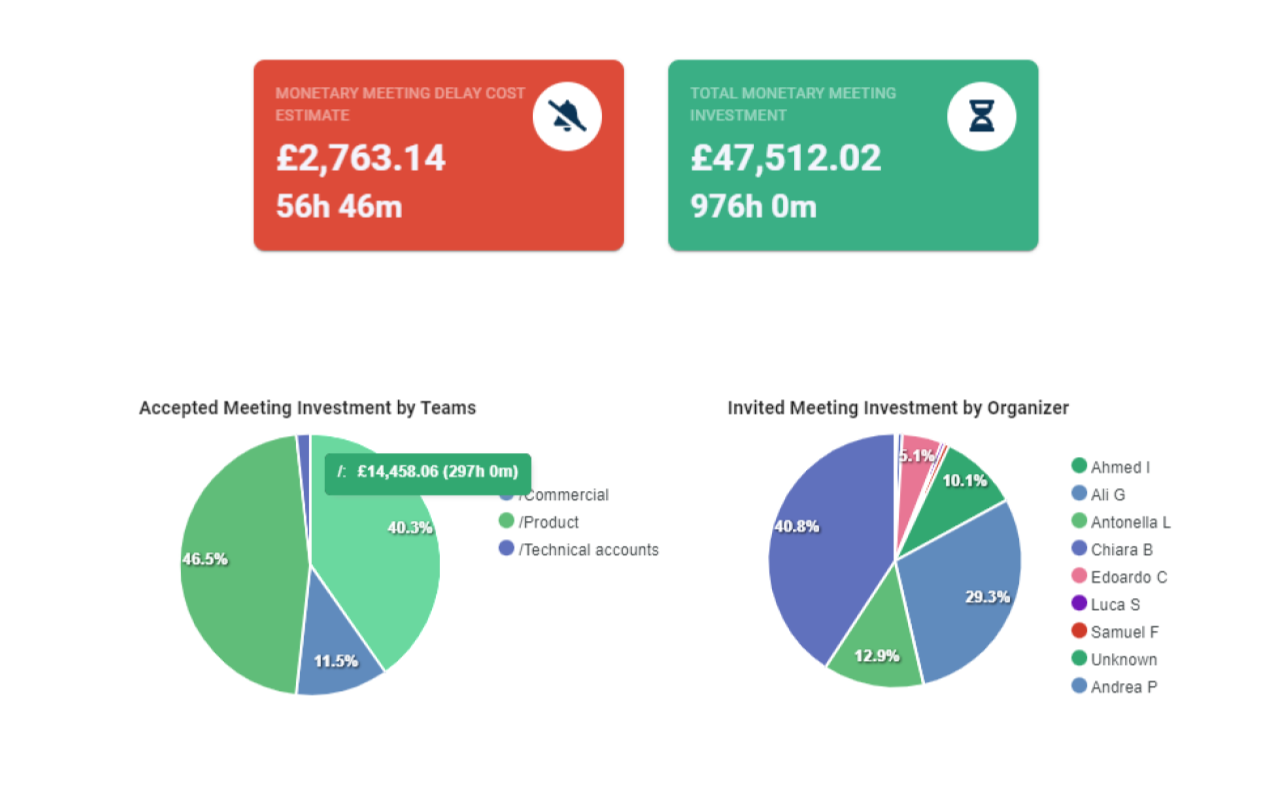
✔️ REVEAL MEETING COSTS
✔️ BENCHMARK TEAMS
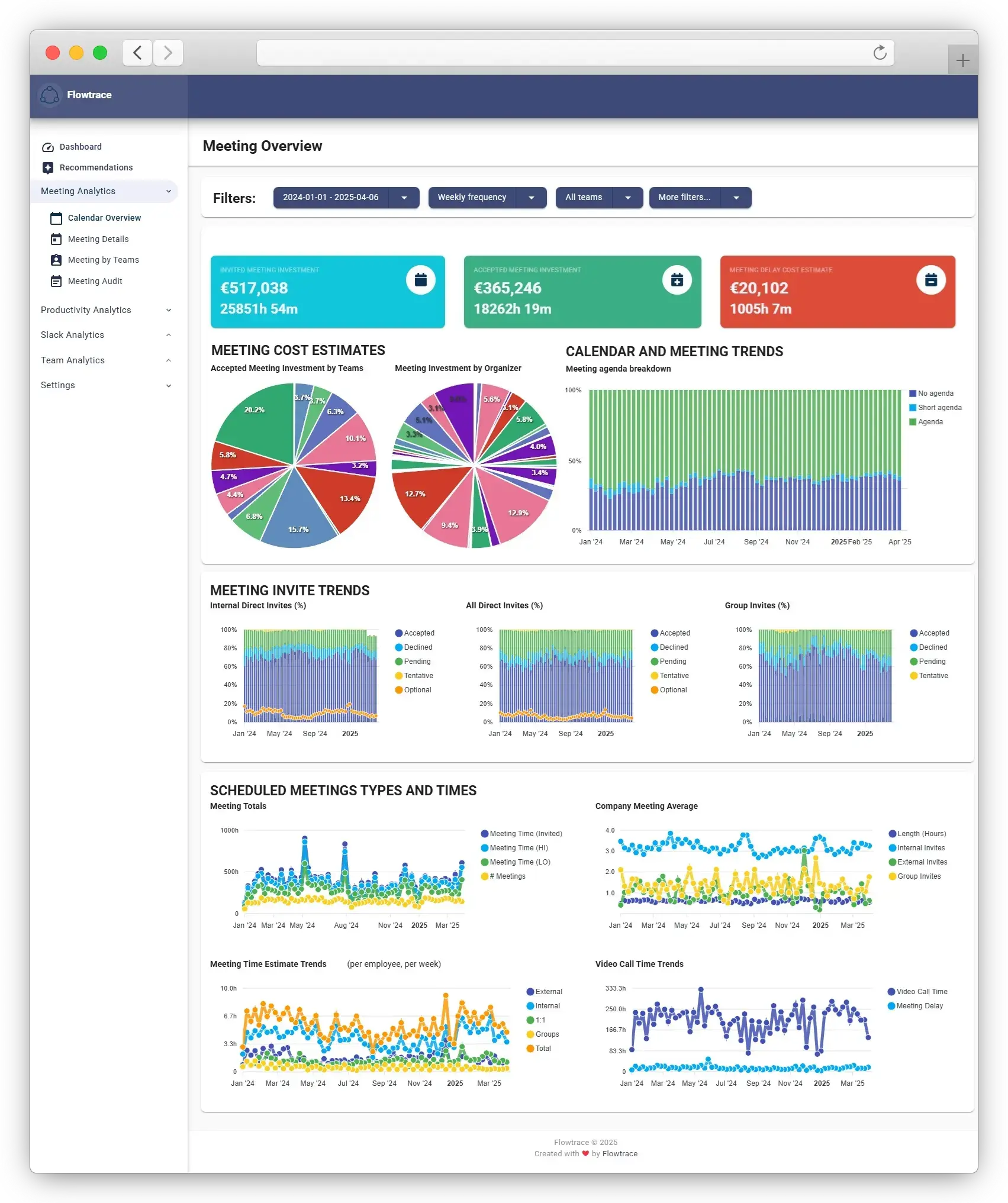
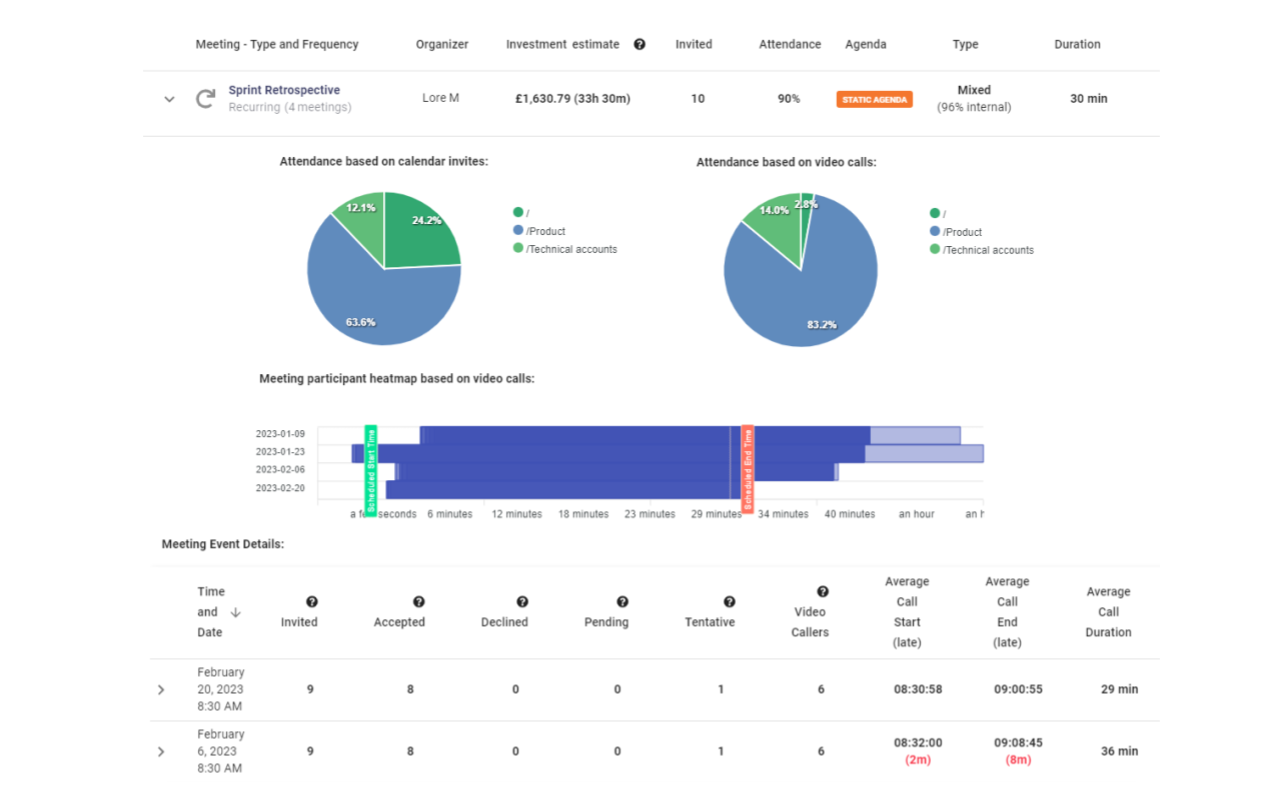
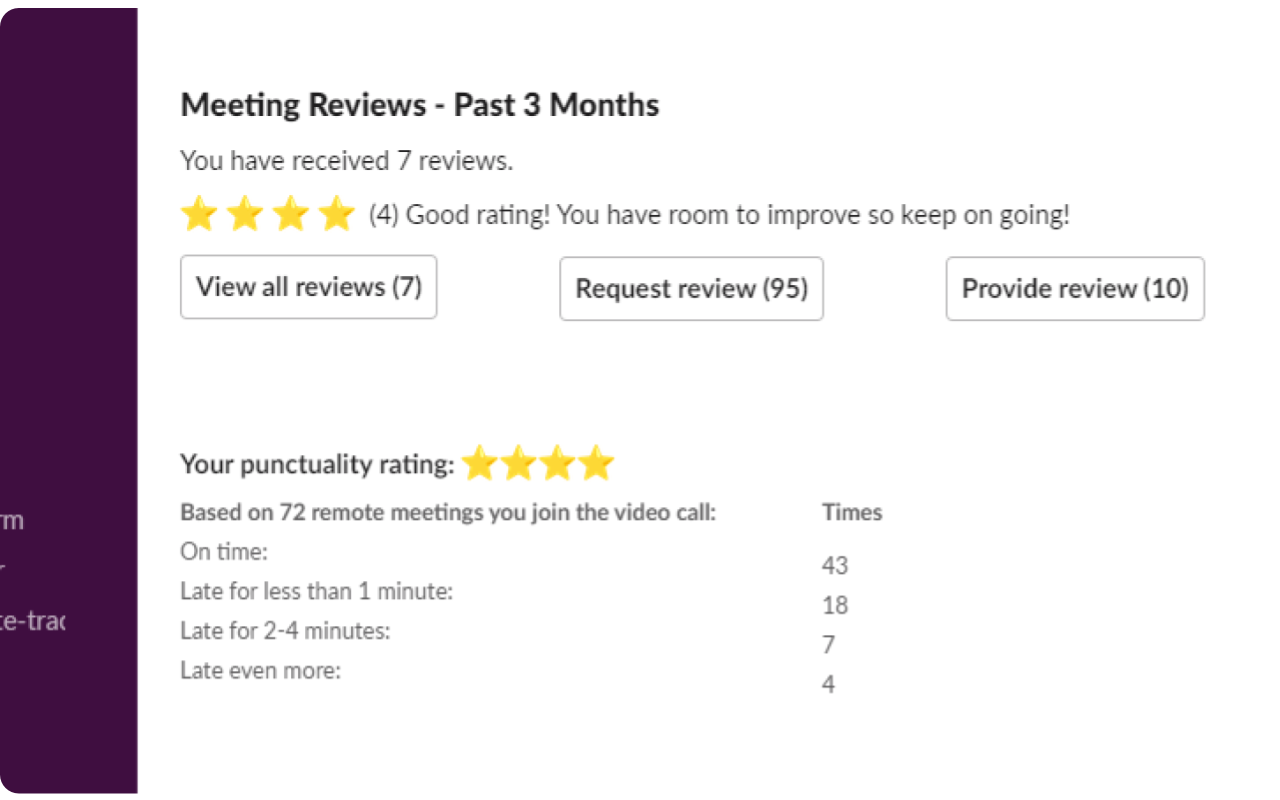
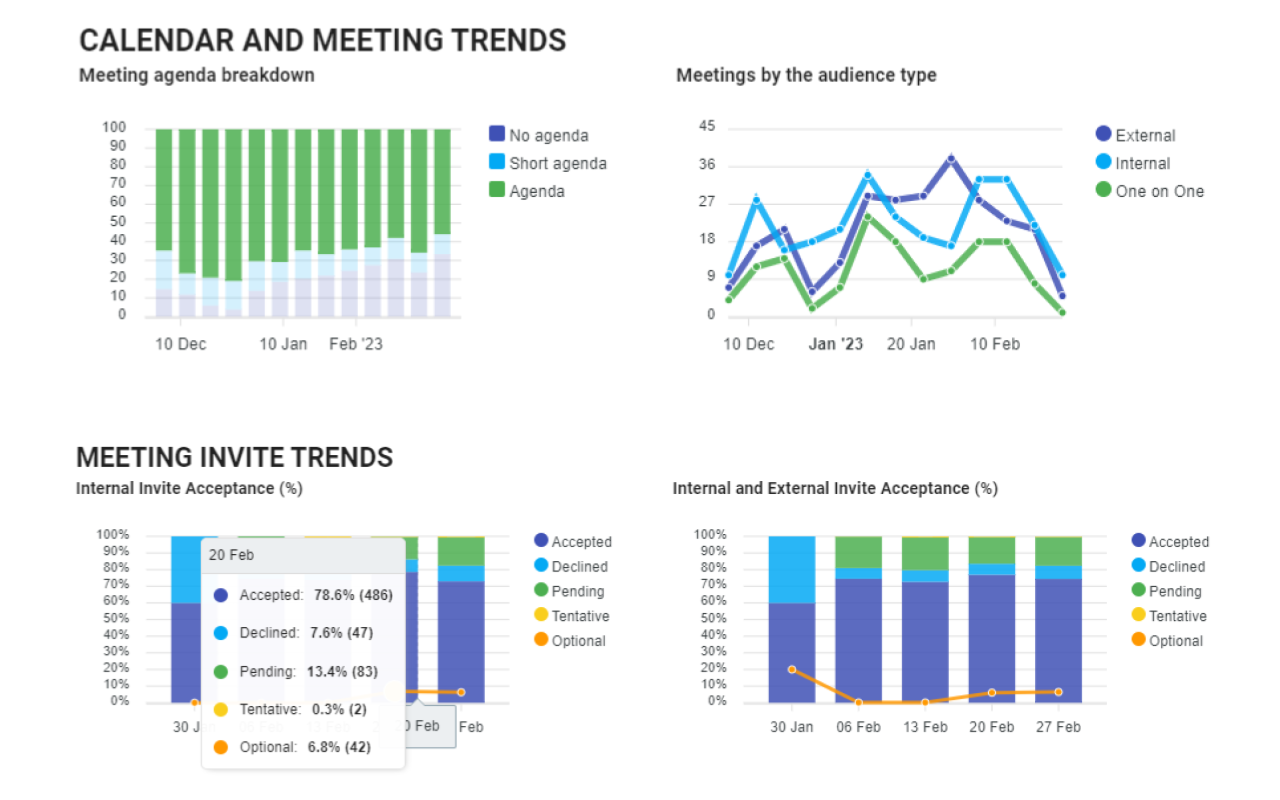
Flowtrace creates insights of company calendars and online meetings so you can steer your meeting culture with management metrics.

OVER TWO MILLION CALENDAR EVENTS ANALYZED EVERY MONTH
"Flowtrace is a very good product. We learned our lessons and focus on doing our homework, that is implementing a better meeting culture across the organization. Petri's individual support, diligence and guidance is just amazing!"

"Flowtrace helps us get work done faster, and our teams thrive in a more collaborative way of working."

"With Flowtrace, we gained a deeper understanding of our meeting culture, which we in turn used to train our staff better. It's been an important part of our quest for more deep work, more focus, and less meeting distraction."

"We knew we had a problem with meetings, but we couldn’t properly measure or change it. Flowtrace gave us visibility and control. The derived measurements far exceeded even our most optimistic expectations."

INTEGRATES WITH TOOLS OF HIGHLY EFFECTIVE TEAMS
We integrate with Microsoft Outlook, Google Calendar™, Zoom, Microsoft Teams, and Google Meets™.

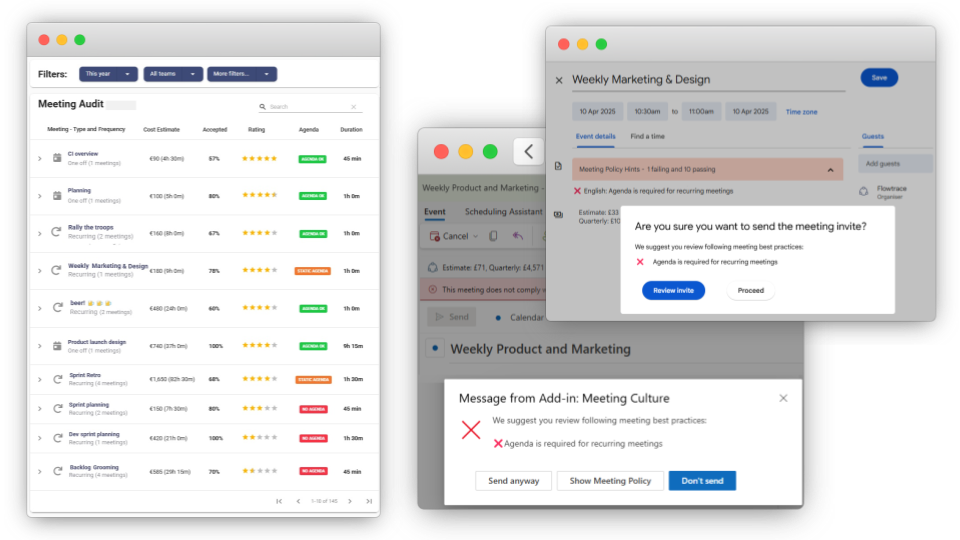
Directly Into Calendar
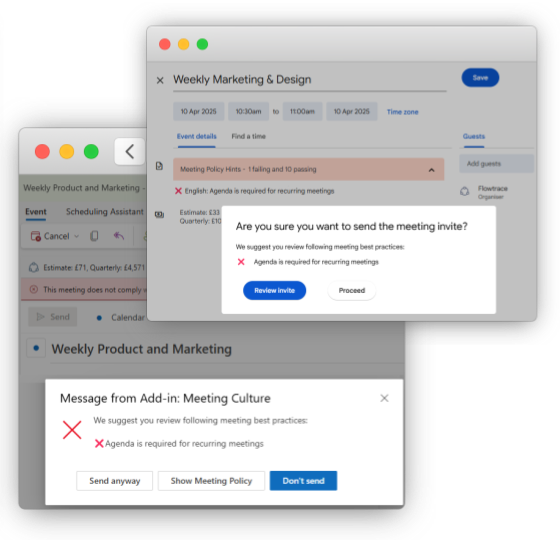
Increase the mindfulness of meeting costs. Available for Google Calendar and Microsoft Outlook.
✅ Reduce meetings without lifting a finger
✅ Secure company cost configuration
✅ Easy install across the team for enterprises
FREQUENTLY ASKED QUESTIONS
What is Meeting Analytics?
Meeting analytics is the systematic analysis of meeting data to understand how your organization spends time in meetings, identify inefficiencies, and improve collaboration patterns.
Flowtrace's meeting analytics platform captures meeting frequency, duration, costs, attendance patterns, and engagement metrics across Google Calendar, Outlook, Zoom, and Microsoft Teams to provide actionable insights for leaders and teams.
How does a Meeting Analytics Platform work?
A meeting analytics platform integrates with your existing calendar and video conferencing tools to automatically collect meeting metadata such as duration, participant count, recurring patterns, and cost calculations. Flowtrace's meeting analytics tool processes this data to generate dashboards showing meeting trends, cost analysis, productivity metrics, and team collaboration patterns without accessing sensitive meeting content.
What makes a good Meeting Analytics Tool?
The best meeting analytics tools combine comprehensive data collection, intuitive visualizations, and actionable insights. Key features include real-time cost calculations, trend analysis over time, team benchmarking capabilities, integration with popular calendar platforms, privacy-first data handling, and behavioral nudges to improve meeting culture at the point of invitation.
What ROI can I expect from Meeting Analytics?
Organizations typically see ROI within the first quarter through reduced meeting overhead, improved productivity, and better time allocation. Common benefits include 15-25% reduction in unnecessary meetings, 30% improvement in meeting preparation (through agenda requirements), and 2-3 hours per week recovered per employee for focused work time.
Can Meeting Analytics identify meeting overload?
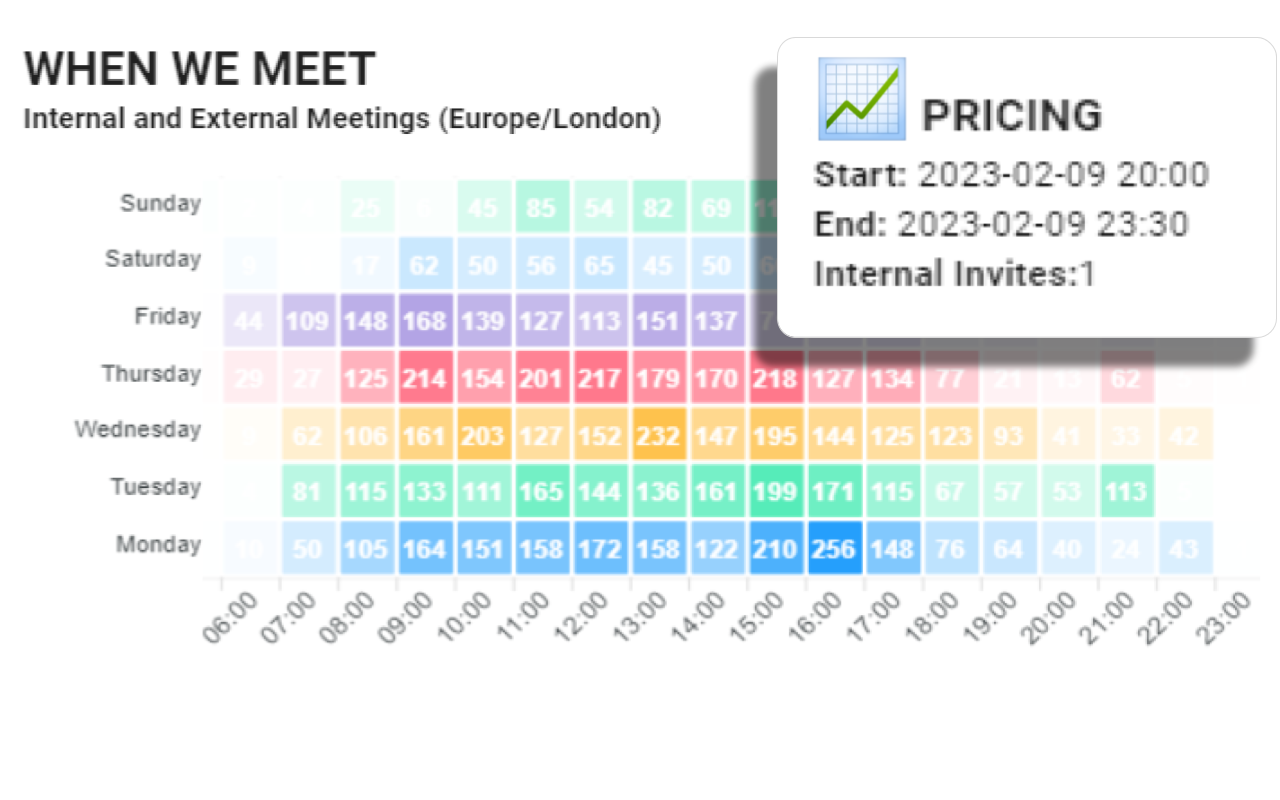
Absolutely. Our meeting analytics dashboard shows individual and team meeting loads, identifies people with back-to-back meeting patterns, and highlights when teams exceed healthy meeting thresholds. You can set custom alerts for meeting overload and track improvement over time as you implement meeting-free zones or policies.
How is Meeting Analytics different from time tracking?
Meeting analytics focus specifically on collaborative time and organizational meeting culture, while time tracking typically monitors individual productivity. Meeting analytics provide insights into team dynamics, meeting costs, and collaboration patterns that help improve organizational effectiveness, whereas time tracking focuses on individual task completion and billable hours.
How do enterprises use Meeting Analytics differently than small companies?
Enterprises typically use meeting analytics for policy compliance, organizational change management, and large-scale culture transformation initiatives. They focus on department-level benchmarking, executive dashboard reporting, and integration with other productivity and HR systems. Small companies often use meeting analytics for immediate cost savings and team optimization.
What's the first step to improve our meeting culture with Analytics?
Start by establishing baseline metrics: current meeting costs, average meeting duration, and time spent in meetings per person per week. Then implement meeting cost visibility through Flowtrace's calendar add-ons to create immediate awareness. Finally, set measurable goals for improvement and track progress through the analytics dashboard.
How long before we see meeting culture improvements?
You can start seeing meeting culture insights within days, while measurable business impact depends on the scale of rollout and the changes being introduced.
Flowtrace can quickly show what is happening across your meeting culture: meeting load, focus time, meeting costs, collaboration patterns, and where teams may be losing time. This means leadership and managers can identify quick wins early, often within the first weeks of use.
Some improvements can happen almost immediately once teams see the data and enable calendar-based interventions. For example, meeting cost reminders, validation rules, agenda requirements, attendee discipline, and better scheduling guidance can influence behaviour at the point meetings are created.
Longer-term performance improvement usually requires a structured change cycle. Meeting habits are part of company culture, so sustained improvements in focus time, collaboration, and alignment may take several months depending on the starting point of the organization.
For enterprise pilots, we typically recommend a 3-month structure: one month to establish a baseline, followed by two months of targeted interventions. This gives the organization enough time to compare “before and after” behaviour and measure whether meeting culture improvements are translating into better focus, lower meeting load, and stronger collaboration patterns.
Is my data safe with you?
Yes. Flowtrace is designed with privacy, security, and enterprise data protection as core principles.
Flowtrace uses a metadata-first approach wherever possible. We do not read email content, meeting content, private chat messages, or the contents of documents. Instead, Flowtrace analyses collaboration metadata, such as calendar events, meeting patterns, participation signals, and other intentional collaboration activity, to generate meeting culture and productivity insights. This reduces unnecessary data exposure while still allowing organizations to understand how work happens. Flowtrace’s public privacy guidance states that, wherever possible, it analyses metadata rather than work content and does not store the contents of private communication.
Flowtrace does not analyse what is being said in meetings. Unlike many meeting tools, Flowtrace does not need to record, transcribe, summarize, or interpret meeting conversations to generate insights.
Flowtrace also supports GDPR-aligned processing through a published Data Processing Agreement. The DPA confirms that the customer acts as Controller and Flowtrace acts as Processor, and that Flowtrace processes personal data only as necessary to provide the services and in accordance with the customer’s written instructions. It also covers UK GDPR, EU GDPR, DPA 2018, SCCs, and the UK Addendum for relevant international transfers.
From a security architecture perspective, Flowtrace production infrastructure is hosted in AWS in Ireland, with TLS 1.2+/1.3 encryption in transit and AES-256 encryption at rest. Access controls include SSO through Google, Microsoft, or Slack, MFA governed by the customer’s identity provider, quarterly access reviews, and least-privilege IAM roles.
Flowtrace also operates a documented security framework covering secure development, logging, monitoring, incident response, business continuity, and vendor management. This includes SAST and dependency scanning, centralized AWS CloudWatch logging, AWS Inspector, GuardDuty and Security Hub review, a four-stage incident response process, defined RPO/RTO targets, and published sub-processor controls.
Flowtrace’s controls map to ISO 27001:2022 Annex A and SOC 2 Security, Availability, and Confidentiality principles. Detailed security documentation, audit roadmap information, and supporting materials can be shared with customers under NDA where required.
You can read more about our commitment to data security from here.