After years of looking at company calendars, I no longer start with, "Which employees are running bad meetings?" It is the wrong question. It points at the person while ignoring the system that made the behavior normal.
If anybody can create a recurring meeting with twelve attendees, no purpose, no review date and a one-hour default, people will do exactly that. If managers use meetings as the only reliable way to get visibility, their teams will keep scheduling them. If the policy lives in an onboarding document and nowhere else, the calendar will win.
Meeting culture is the shared set of defaults and reinforced behaviors that determines why meetings are created, who attends, how they are run, what happens afterward and whether the organization learns from the pattern.
That makes meeting culture an operating-system problem. Employees work inside it, but they did not create every incentive, permission, management habit or calendar default around them. Improvement starts when the company can see that system, decide what should change, make the better behavior easier and check whether it stuck.
The short version
- Meeting overload is usually a system symptom, not an employee character flaw.
- Healthy culture does not mean the fewest possible meetings. It means purposeful, proportionate and reviewable use of meeting time.
- Employee feedback explains how meetings feel. Calendar metadata shows where the pattern lives. Companies need both.
- Rules and training help, but behavior changes more reliably when organizers get support as they create an invite.
- In Flowtrace client work, roughly 20% of staff often organize about 70% of meetings. Helping that group creates leverage across the company, although the exact distribution varies.
- Measure the result after every change. A cleaner policy document is not an outcome.
Use this Guide
What is meeting culture?
Meeting culture is how an organization repeatedly chooses to use meetings. It appears in formal rules, but also in default durations, manager expectations, invite habits, recurring series, accepted lateness, attendee behavior and what happens to decisions after the call ends.
Meeting etiquette is narrower. It tells an individual how to behave in one meeting. Meeting effectiveness asks whether a particular meeting achieved its purpose. Meeting culture explains why similar patterns keep appearing across teams, even when most employees agree they dislike them.
Meeting researchers use a related concept called organizational meeting orientation. In two exploratory studies, Mroz and colleagues connected employees' perceptions of organizational meeting policies and practices with meeting quality and satisfaction, work engagement and intentions to quit. The findings are associations rather than proof of causation, but they support an important point: meetings are part of the environment an organization creates. They are not isolated calendar events. Read the organizational meeting orientation research.
This changes the management question. Instead of asking employees to "be better at meetings," examine what the system rewards:
- Is a meeting the fastest way to get a manager's attention?
- Do recurring meetings need an owner and review date?
- Does anybody challenge a one-hour default?
- Can an organizer explain why each attendee is needed?
- Does the calendar warn the organizer when a rule is being broken?
- Can leadership see whether a policy changed the pattern?
If the answer is no, the company has a design problem before it has a discipline problem.
What does a healthy meeting culture look like?
A healthy meeting culture is not anti-meeting. Some work needs fast discussion, trust, disagreement and a decision made in the same room. The goal is to make synchronous time earn its place.
| Unhealthy pattern |
Healthier operating pattern |
| Meetings are the default response to uncertainty |
The team chooses between a meeting, written update, recorded explanation or direct decision |
| Invite lists grow "just in case" |
The organizer names the people needed to decide, advise or learn |
| Recurring meetings continue indefinitely |
Every recurring series has an owner, purpose and review point |
| One duration fits every discussion |
Duration follows the work rather than the calendar default |
| Agendas are optional decoration |
The invite gives attendees enough purpose and context to prepare |
| Managers rely on reminders and personal enforcement |
Shared rules are reinforced in the scheduling workflow |
| Success means fewer meeting hours |
Success means the intended work improved without shifting the burden elsewhere |
Research on 92 regular team meetings found that constructive problem solving and action planning related positively to meeting satisfaction, team productivity and later organizational success, while dysfunctional behaviors such as complaining and criticizing showed negative relationships. That does not mean every meeting needs a rigid script. It does show that the interaction patterns an organization tolerates have consequences. Read Kauffeld and Lehmann-Willenbrock's meeting research.
The reverse warning also matters. Research by Rogelberg and colleagues found that meeting demands do not affect everybody in the same way. Task interdependence and an employee's experience of meetings change the relationship with well-being. A product manager, recruiter and software engineer may need very different meeting patterns. This is why I am skeptical of universal targets such as "everyone should spend no more than 20% of the week in meetings." Context matters. Read the research on meeting demands and employee well-being.
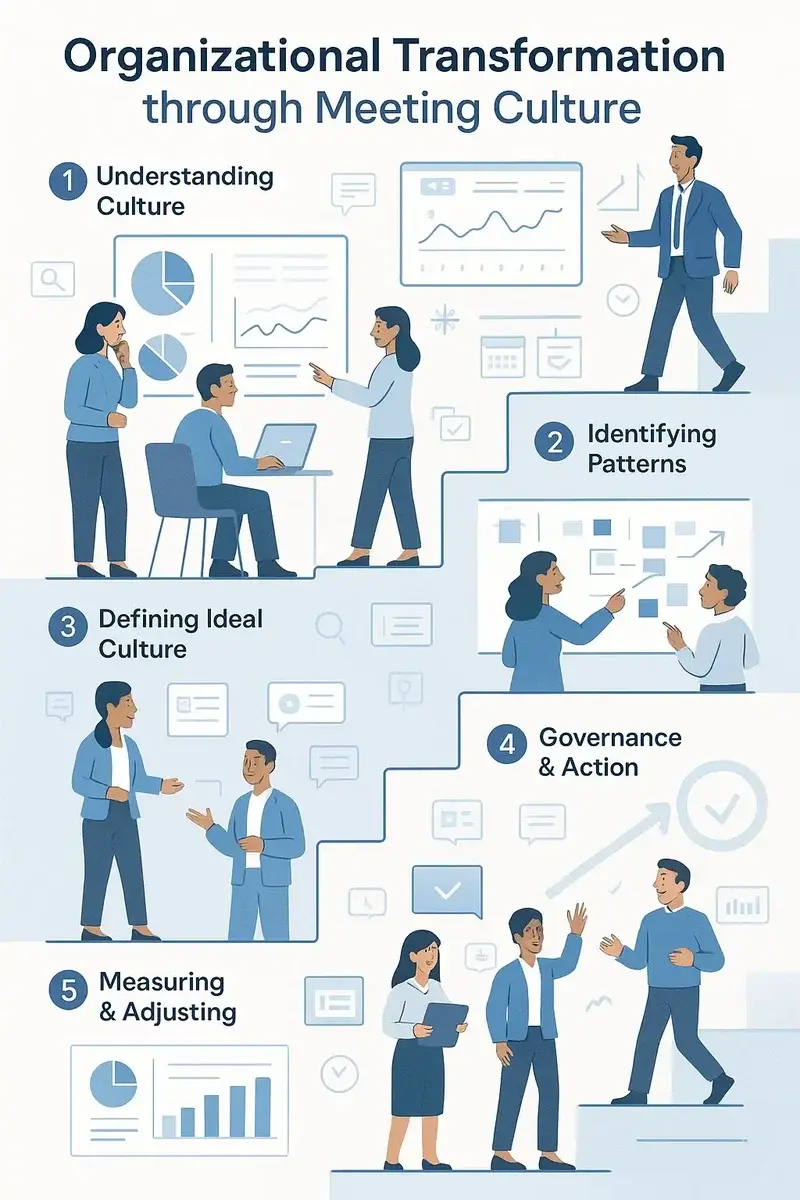
The five parts of the meeting culture system
A checklist of meeting tips can improve one meeting. Company culture needs a model that explains why the same problem keeps returning.
1. Purpose and necessity
Every meeting begins with a coordination choice. Does this work require people to interact at the same time, or would a written update, document review or direct decision work better? A culture becomes meeting-heavy when nobody has permission to choose the alternative.
2. Design defaults
Duration, attendee count, notice time, recurrence and agenda expectations shape the meeting before it starts. These details often look administrative, yet they decide how much company time the meeting consumes and whether people can prepare.
In Flowtrace's 2026 meeting statistics, based on more than 1.2 million scheduled meetings from 2025, 48.5% were recurring. Among meetings with agenda-length data, 67.4% had fewer than 100 agenda characters. Among meetings with notice data, 36.3% were scheduled less than 24 hours ahead. These are dataset patterns, not universal pass or fail thresholds. They are useful because they point to defaults worth investigating.
3. Interaction norms
Punctuality, facilitation, participation and decision behavior shape the experience inside the meeting. Allen and colleagues found that meeting lateness related negatively to satisfaction and perceived effectiveness, and their experimental work also found effects on group performance. A five-minute delay looks small. Repeated across teams, it becomes a norm about whose time matters. Read the meeting lateness study.
4. Follow-through
A meeting does not create value merely because the conversation felt useful. Decisions need owners, actions need deadlines and unresolved questions need a route that does not automatically become another meeting. The meeting feedback guide explains how to gather participant evidence without creating survey fatigue.
5. Reinforcement and learning
Leadership example, meeting rules, calendar prompts and regular review determine whether the other four parts survive. A rule that depends on every manager remembering to repeat it is fragile. A system can make the expectation visible when the invite is created and show whether the pattern changed afterward.
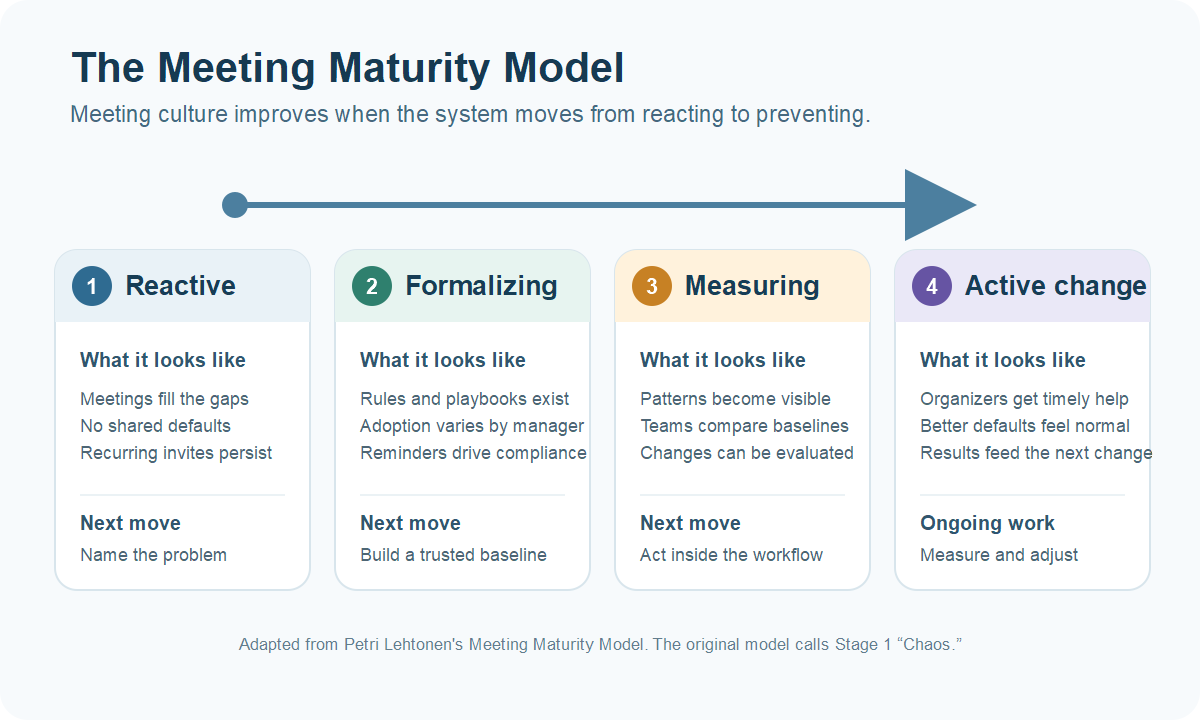
Use the Meeting Maturity Model to choose the next step
I originally built the Meeting Maturity Model because companies could have similar dashboards and completely different abilities to change what those dashboards showed. One treated the metric as a report. The other used it to steer behavior.
For this Guide, I use Reactive for the first stage. The original model calls it Chaos, which is accurate as a description but not always helpful language when working with clients. The stages are not a score of whether employees are good or bad. They describe how the organization manages the meeting system.
| Stage |
What the organization can do |
Practical next move |
| Reactive |
People can name the pain, but meeting load has no clear owner and calendars fill by default |
Agree on the problem and stop treating it as unavoidable |
| Formalizing |
Guidelines, agenda templates and recurring-meeting reviews exist, but adoption depends on managers |
Clarify ownership and establish a baseline people trust |
| Measuring |
Leaders can see load, recurrence, cost and hotspots, then compare before and after |
Select a behavior to change rather than collecting more metrics |
| Active change |
Organizers get timely guidance as they schedule, and the organization measures the effect |
Keep reviewing results and adjust rules as work changes |
Most meeting programs get stuck between Formalizing and Measuring. The company has advice, but no reliable view of adoption. Others get stuck between Measuring and Active change. The dashboard identifies waste, but the organizer receives no help when creating the next invite.
The next stage should solve the current limitation. Buying more analytics when nobody owns the response will not help. Launching strict rules before the company understands its own meeting patterns can create resistance and move the problem somewhere else.
How to assess meeting culture without blaming employees
Start with two kinds of evidence: employee experience and observable meeting patterns.
Employee feedback can reveal that people feel overloaded, cannot prepare, lose focus time or attend meetings where their role is unclear. Metadata can show where those experiences may be concentrated: meeting hours, recurrence, duration, invite size, notice time, organizer concentration, accepted load, agenda signals and changes over time.
Neither source is enough alone. A calendar cannot prove that a meeting was useful. A survey cannot tell you which recurring series or scheduling default created the complaint.
| What employees report |
Metadata signal to inspect |
Follow-up question |
| "There are too many meetings" |
Meeting hours, meeting count, recurrence and distribution by comparable role |
Is the load required by the work, or created by avoidable coordination? |
| "I cannot get focused work done" |
Usable focus blocks, back-to-back meetings and fragmentation |
Did the intervention create usable time or only move meetings? |
| "I am invited to everything" |
Invite size, optional attendance and recurring large meetings |
Who needs to decide, advise or receive the outcome? |
| "Meetings arrive with no context" |
Notice time and agenda-length signals |
What information would let attendees prepare or decline? |
| "Policies do not change anything" |
Rule adoption and before/after trends |
Was the expectation reinforced when the invite was created? |
A meeting culture audit can add qualitative review of purpose, preparation, facilitation, decisions and follow-through. Use the Meeting Analytics Guide for the measurement category and the Calendar Analytics Guide for calendar load, focus time and schedule fragmentation.
The privacy boundary should be explicit. Flowtrace uses metadata-first analytics. It does not need to record, transcribe, summarize or interpret what people say in meetings. Report patterns at the level needed to improve the system, limit access and avoid ranking individual employees as productive or unproductive.
Meeting organizers are the leverage point most companies miss
Across Flowtrace client work, we have learned that roughly 70% of meetings are organized by 20% of staff. The exact split varies by organization, so this is an operating observation rather than a universal benchmark. The pattern still changes how I think about rollout.
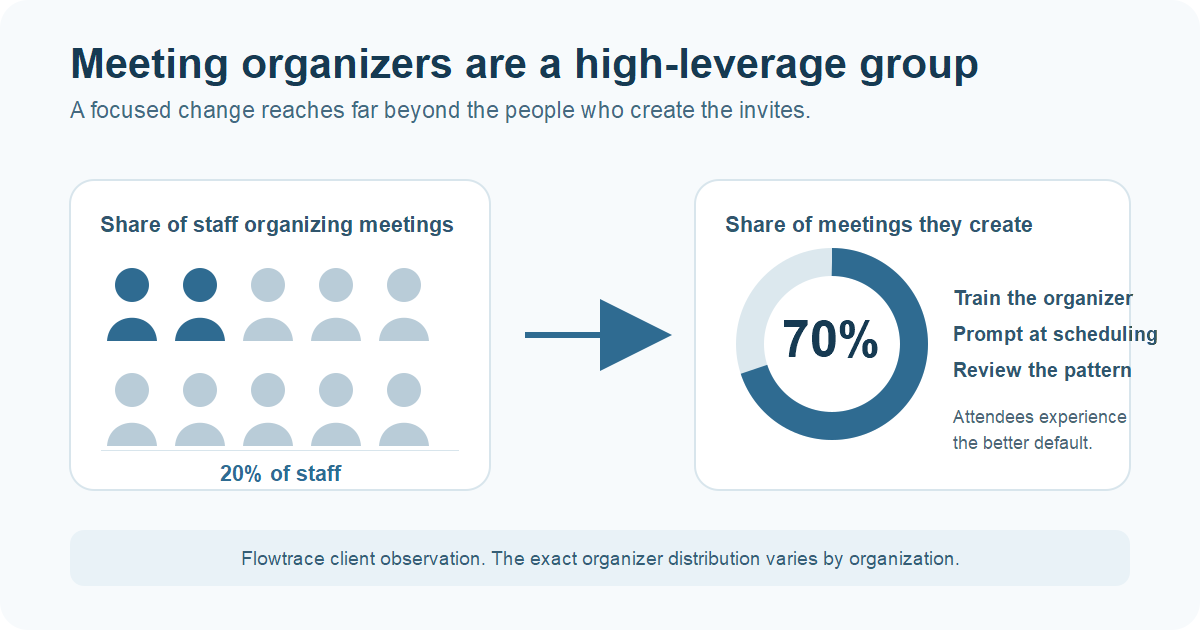
If a relatively small group creates most invites, organizer-focused change can reach a much larger population. One organizer who shortens a recurring meeting, removes three unnecessary attendees and adds a useful purpose changes the week for everybody invited. Those attendees also experience the new expectation and may reuse it when they organize their own meetings. The behavior propagates through normal work.
This does not mean sending the top organizer cohort to a training session and declaring victory. Training fades when the calendar still makes the old behavior easier. A stronger organizer program combines:
- A clear explanation of the problem and the desired behavior.
- Practical examples for common meeting types.
- Calendar prompts or meeting rules at the moment of scheduling.
- Feedback on patterns rather than judgment of the person.
- A review showing what changed for attendees and teams.
Company-wide communication remains important. Everyone needs permission to question an invite, choose asynchronous work and protect focus. The organizer cohort is the leverage point, not the only group with responsibility. Start by measuring your own organizer distribution, then decide how targeted the program should be. The meeting invite rules guide provides more detailed organizer practices.
The meeting culture improvement loop
Meeting culture does not improve through a one-time cleanup. Use a repeated loop:
Listen
Collect specific employee experiences. "Too many meetings" is a valid symptom, but ask which teams, roles, days, meeting types and consequences sit behind it.
See
Build a privacy-safe baseline. Segment comparable groups, keep metric definitions stable and investigate the meetings behind an unusual pattern before drawing a conclusion.
Choose
Select one or two behaviors to change. Remove, replace, shorten or improve meetings based on the diagnosed cause. Do not launch ten rules because the dashboard has ten metrics.
Reinforce
Give organizers clear expectations, useful examples and support where scheduling happens. Managers should model the rule, but the program should not rely on personal reminders forever.
Learn
Compare the new pattern with the baseline and employee experience. Keep the change, adjust it or stop it. Then choose the next constraint.
This loop connects meeting analytics with meeting policy and governance. Analytics reveals the pattern. Rules and calendar-side prompts change the behavior. Analytics then tests whether the change worked.
Choose an intervention that fits the problem
Popular meeting advice fails when a company starts with the intervention rather than the diagnosis.
| Diagnosed problem |
Intervention to test |
Evidence to review |
| Meetings are used for routine visibility |
Replace selected status meetings with a written update and an exception path |
Meeting count, manager visibility and delivery blockers |
| Recurring commitments have no owner |
Give each series an owner, purpose and review date |
Recurring hours, cancellations and employee feedback |
| Invite lists grow by default |
Define attendee roles and prompt organizers above a sensible threshold |
Invite-size distribution and decisions delayed by missing people |
| Default duration consumes unnecessary time |
Test shorter defaults for suitable meeting types |
Duration, overruns, follow-up meetings and outcome quality |
| People receive late or vague invites |
Require enough purpose and preparation context before sending |
Notice time, agenda signals, declines and feedback |
| Focus time is fragmented |
Protect specific blocks or trial a no-meeting period |
Usable focus blocks and whether meetings shift into denser days |
| Leaders cannot see the cost |
Add meeting cost visibility to selected scheduling and reporting views |
Meeting cost, attendee-weighted hours and organizer decisions |
No-meeting days can help when fragmentation is the real problem. They fail when the same meetings move to Tuesday and Thursday. Read the benefits and limits of no-meeting days before treating one policy as the company strategy.
Similarly, fewer meetings is not automatically the right result. The right amount of meetings depends on the work, role and coordination need. The better question is whether each pattern supports the work without creating avoidable load.
Why meeting culture initiatives fail
The same mistakes appear repeatedly:
- The company treats the symptom as the cause. "Too many meetings" becomes a reduction target without asking why people need them.
- One rule is applied to unlike teams. Recruiters, sales teams, engineers and executives do not have interchangeable calendars.
- The policy has no owner. Everybody supports it, which often means nobody reviews it.
- Training is separated from daily work. Organizers return to the same calendar defaults and management expectations.
- The dashboard becomes the finish line. Leaders can see the problem but cannot explain what happens next.
- One metric is optimized in isolation. Meeting hours fall while decision delays, follow-up meetings or fragmented days rise.
- Employees fear surveillance. The program never explains the metadata boundary, access controls or purpose of analysis.
The meeting overload guide goes deeper into the difference between visible overload and the coordination system behind it. If the symptoms already include exhaustion and withdrawal, review the signs of meeting burnout alongside calendar evidence.
Who owns meeting culture?
Meeting culture is shared, but shared responsibility still needs accountable ownership.
| Role |
Responsibility |
| Executive sponsor |
Connect the program to operating priorities, model the behavior and remove political barriers |
| People, Operations or Workplace owner |
Run the baseline, coordinate employee input, define the change and report progress |
| IT and calendar administrators |
Configure integrations, access, privacy controls and scheduling rules |
| Managers |
Translate company expectations into team context and stop rewarding unnecessary meetings |
| Meeting organizers |
Apply purpose, attendance, duration, recurrence and follow-through expectations when creating meetings |
| Employees |
Prepare, participate, decline when appropriate and give specific feedback about the system |
The owner does not need to approve every meeting. Their job is to keep the improvement loop alive and ensure local exceptions do not quietly become company defaults.
A practical 30/60/90-day starting plan
Days 0 to 30: listen and baseline
- Identify the executive sponsor and program owner.
- Review employee feedback and interview a small set of roles with different coordination needs.
- Establish stable definitions for meeting load, recurrence, invite size, duration, notice and organizer concentration.
- Document the privacy boundary and access model.
- Select one problem where the evidence and business consequence are clear.
Days 31 to 60: choose and reinforce
- Define one or two target behaviors and the meeting types they apply to.
- Work with high-volume organizers and managers to test the wording and examples.
- Configure a limited rule, prompt or recurring-review process.
- Communicate what is changing, why it is changing and what is not being monitored.
- Record the baseline and the conditions that would make you stop or alter the test.
Days 61 to 90: learn and expand carefully
- Compare the new pattern with the baseline.
- Ask whether attendees and organizers experienced a real improvement.
- Check for displacement, such as more follow-up meetings or denser meeting days.
- Keep, adjust or remove the change.
- Expand only when the mechanism is understood.
For a deeper implementation path, use the guide to implementing a data-driven meeting culture.
How Flowtrace supports measurable meeting culture change
Flowtrace combines organization-level meeting analytics with meeting cost visibility and calendar-side governance. The purpose is not to give leaders another dashboard. It is to connect diagnosis with action.
The operating path is straightforward:
- Use metadata-first analytics to understand meeting load, recurrence, cost, attendee patterns and scheduling behavior.
- Identify the teams, meeting types or organizer patterns that deserve investigation.
- Define the rule or better scheduling behavior with the people affected.
- Reinforce it in Google Calendar or Outlook before an avoidable pattern becomes another recurring series.
- Measure the trend and adjust.
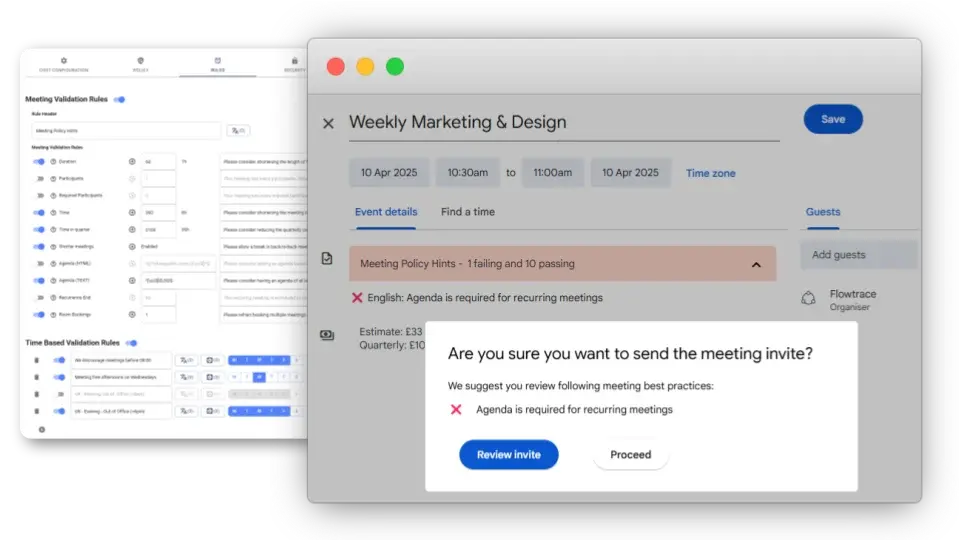
This is different from an AI notetaker or transcript tool. Flowtrace does not need to analyze what people say. It works with meeting and calendar metadata so companies can improve the environment around meetings without monitoring the conversation.
Explore the Flowtrace meeting culture transformation platform, see the wider meeting analytics platform, or review calendar-side controls for Google Calendar and Outlook.
Meeting culture resource hub
Use the specialist Guides and articles when you need more depth:
Frequently asked questions about meeting culture
What is meeting culture?
Meeting culture is the shared set of defaults and reinforced behaviors that determines why meetings are created, who attends, how meetings are run, what happens afterward and whether the organization learns from the pattern.
What makes a healthy meeting culture?
A healthy meeting culture uses meetings deliberately, matches the format and attendance to the work, protects focus time, records decisions and actions, reviews recurring commitments and changes rules when evidence shows a problem.
How do you assess meeting culture?
Combine employee feedback with privacy-safe calendar metadata. Compare sentiment with meeting load, recurrence, duration, attendee patterns, notice time, agendas and changes after a policy or scheduling experiment.
Who should own meeting culture?
Meeting culture needs an executive sponsor and a named program owner, usually in People, Operations or Workplace. IT and calendar administrators support the controls, while managers and meeting organizers apply the behavior in daily work.
Can meeting culture be measured without monitoring meeting content?
Yes. Metadata-first analysis can show patterns such as meeting load, recurrence, duration, invite size, notice time, agenda signals and cost without recording, transcribing or interpreting the conversation.
How long does it take to change meeting culture?
A company can establish a baseline and test one behavior within a quarter, but lasting culture change requires repeated measurement, reinforcement and adjustment. The goal is a working improvement loop, not a one-time campaign.
Change the system, then inspect the behavior
If employees keep creating the same meeting patterns, do not assume they ignored the advice. Inspect the environment around the decision. What did the manager need? What did the calendar make easy? What happened when the organizer tried to choose a different path?
Start with one behavior that matters, especially among the organizers who create most of the company's meetings. Make the better choice clear at the moment the invite is created. Then return to the data and employee experience.
That is how meeting culture changes: inspect, adapt, reinforce and inspect again.
