USE FLOWTRACE TO:
✔️ AUDIT COMPANY CALENDARS
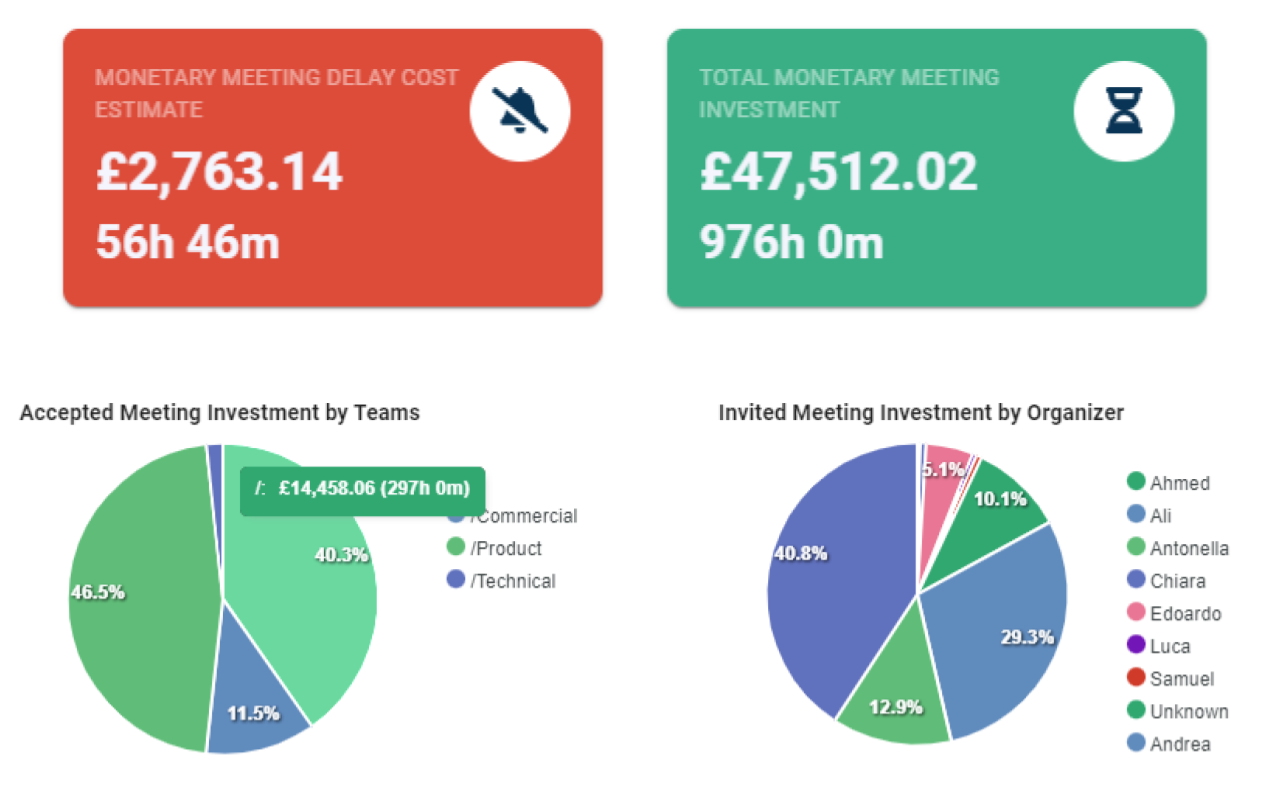
✔️ REVEAL TRUE MEETING COSTS
✔️ IMPROVE EFFECTIVENESS
✔️ REDUCE TIME WASTED
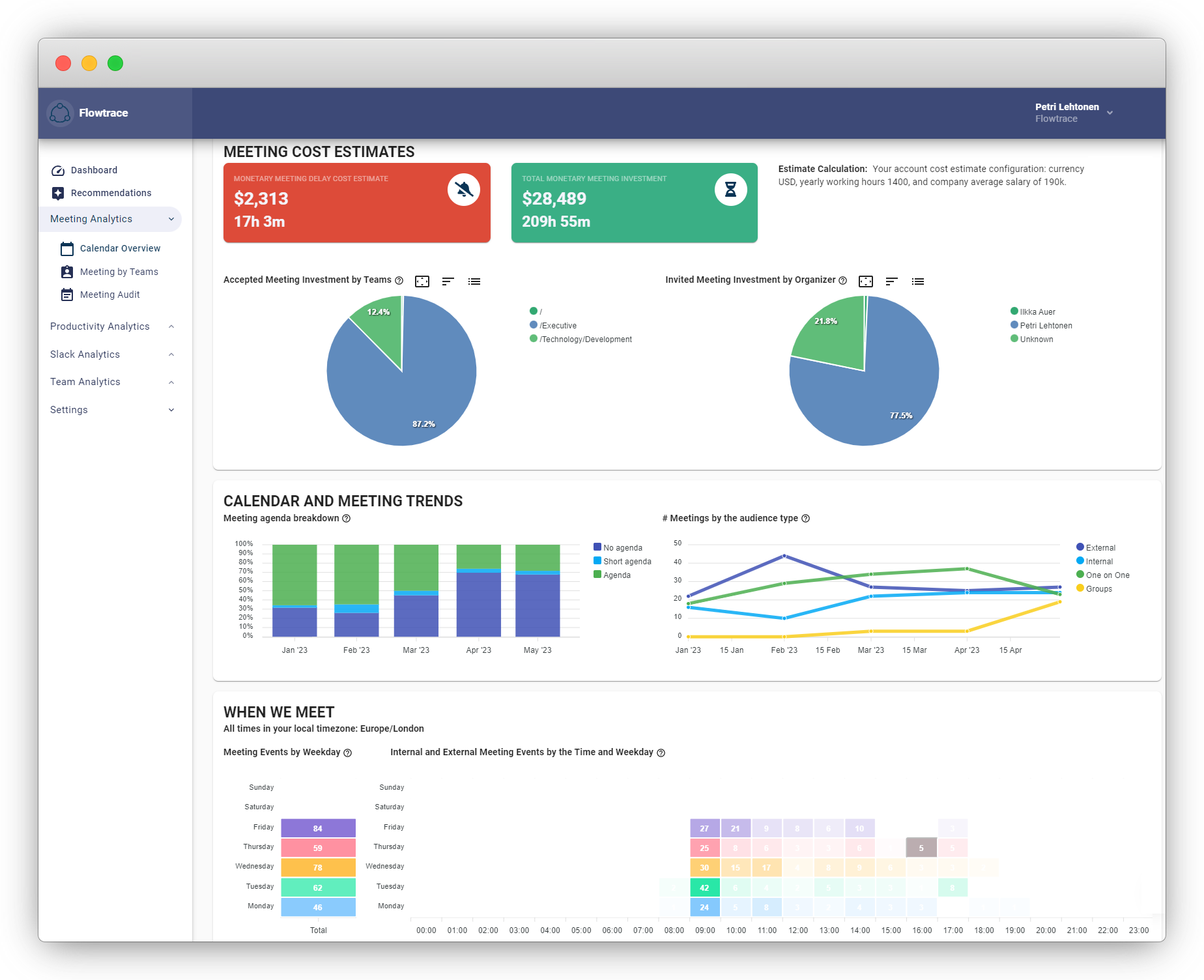
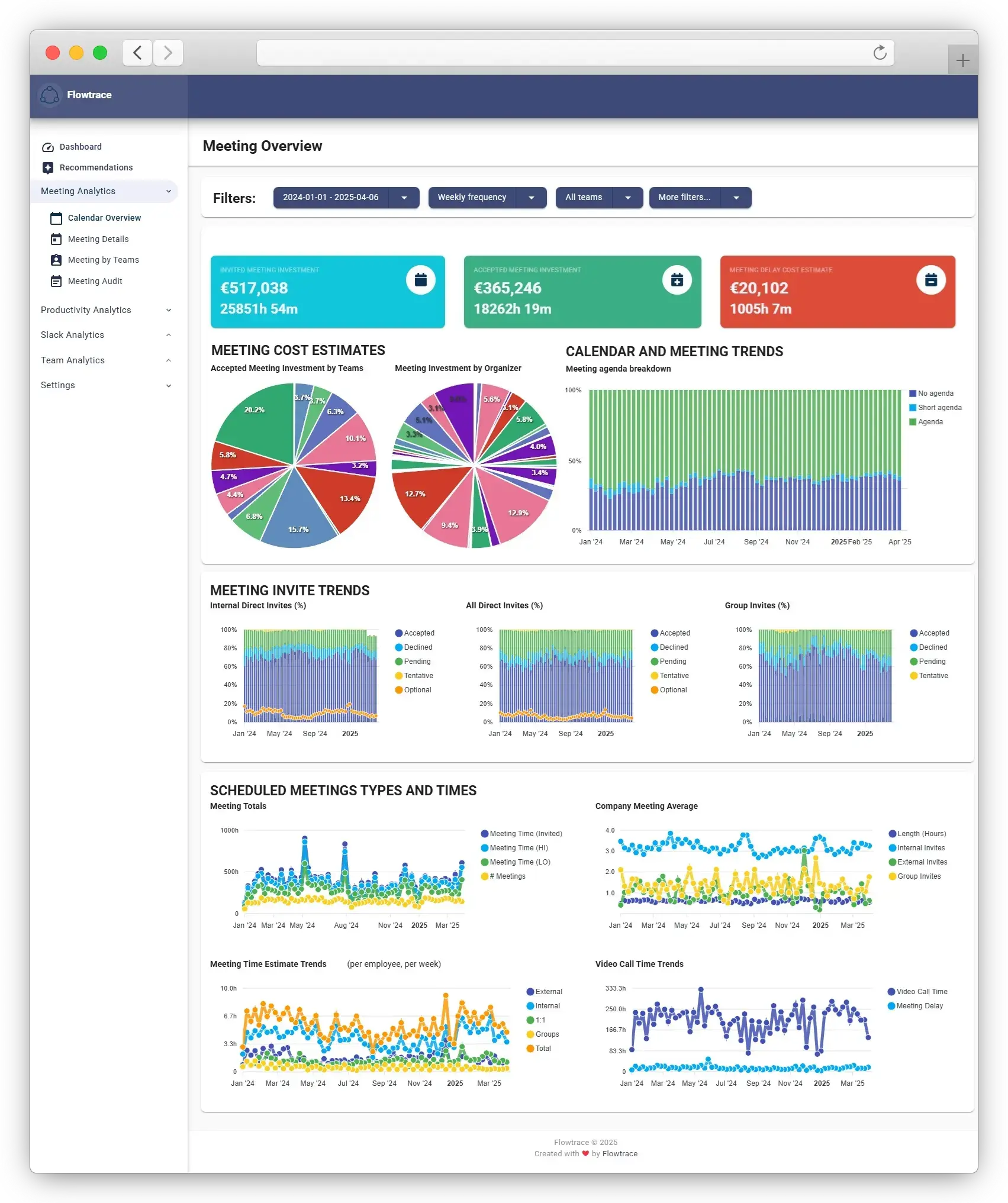
Understand calendar habits, reduce meeting costs, and transform meeting culture with Flowtrace’s calendar analytics platform.
Why Calendar Analytics is Critical Today
Modern teams are overwhelmed by unproductive meetings. Our analysis of over 1 million calendar events reveals the urgent need for smarter meeting habits.
- 62% of meetings lack an agenda, leading to wasted time and misalignment. [Meeting Statistics 2025]
- The average employee spends 392 hours per year in meetings, that’s a big part of working week. [State of Meetings 2025]
- 50% of meetings start over 75 seconds late, causing schedule drift and disrupting deep work. [Meeting Statistics 2025]
With Flowtrace, organizations cut their meeting time by up to 17% within 3 months, simply by bringing visibility and accountability to their calendars.

TRANSFORM YOUR MEETINGS WITH FLOWTRACE CALENDAR ANALYTICS PLATFORM
Meetings drive your team's decision making. Give your meeting organizers and attendees a complete toolset to make meetings better.
Our meeting cost analytics, invite validation rules, and gamified calendar insights drive ever lasting change to your myriad meeting practices.
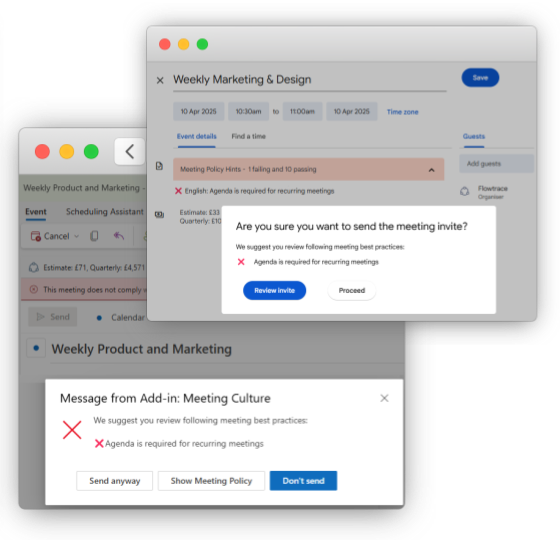
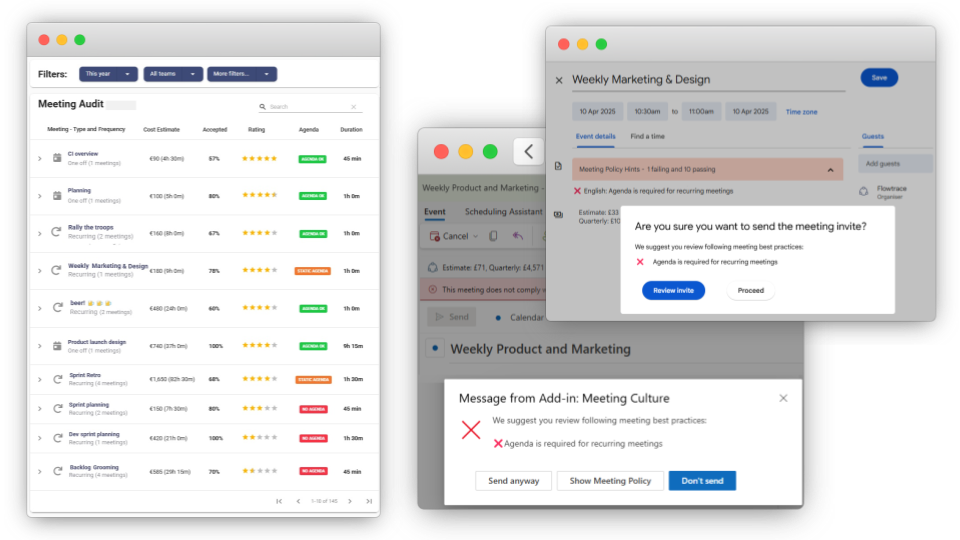
Gain deep insights into your meeting culture with Flowtrace’s Google Calendar Analytics and Outlook Calendar Analytics. By combining these insights with our built-in calendar add-ons, complete with behavioral nudges at the point of meeting invitation, you’ll drive real change in how your company meets and collaborates.
Install Meeting Costs for Outlook or Meeting Costs for Google Calendar now:
INTEGRATES WITH COMMON CALENDARS AND TOOLS OF HIGHLY PRODUCTIVE TEAMS
We integrate with Outlook Calendar, Google Calendar, Google Meets, Microsoft Teams, Zoom, and other SaaS tools and we are happy to include yours too.
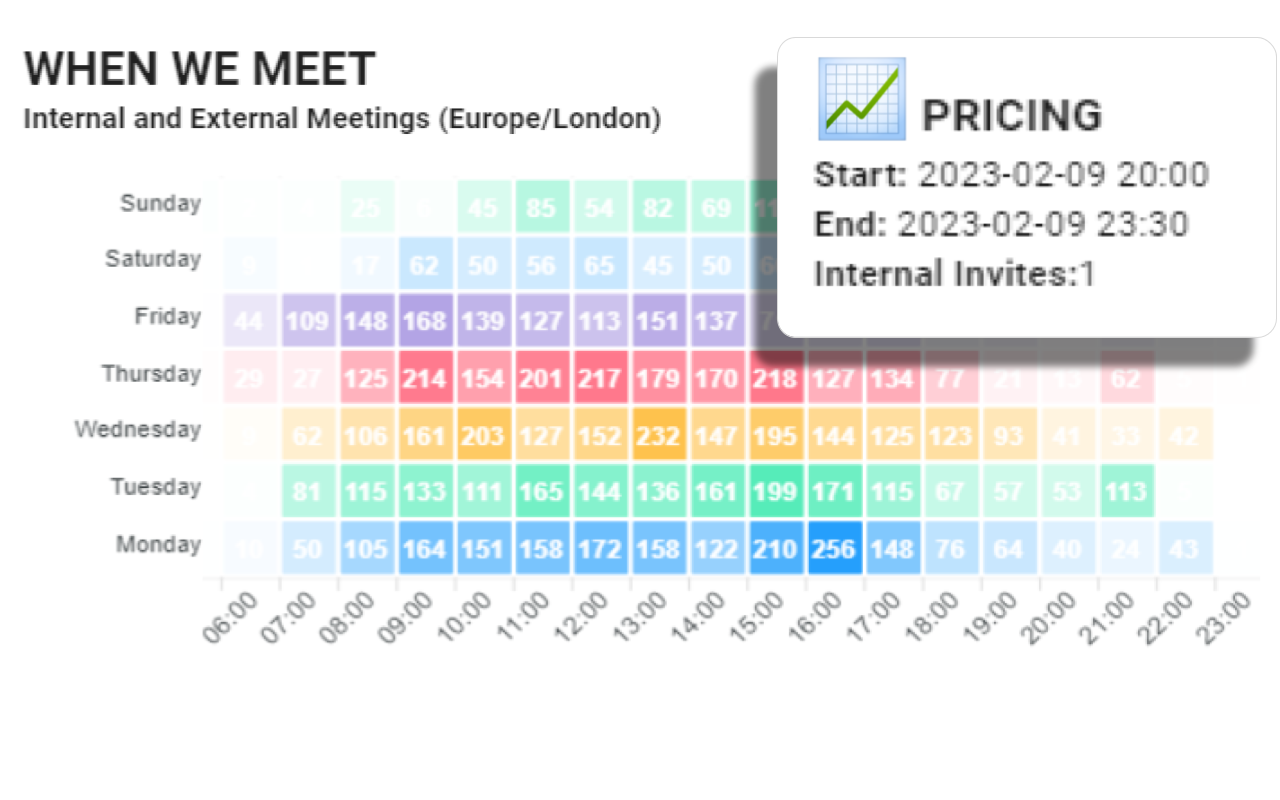
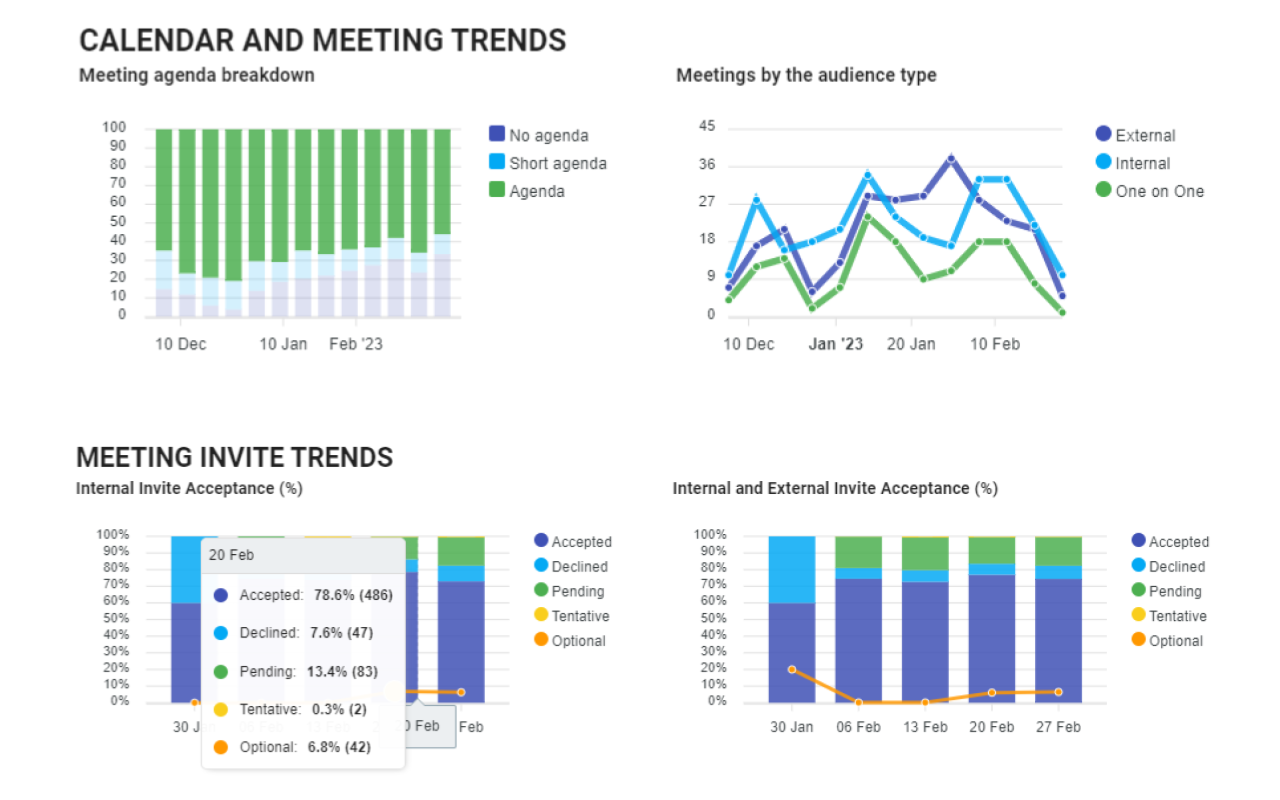
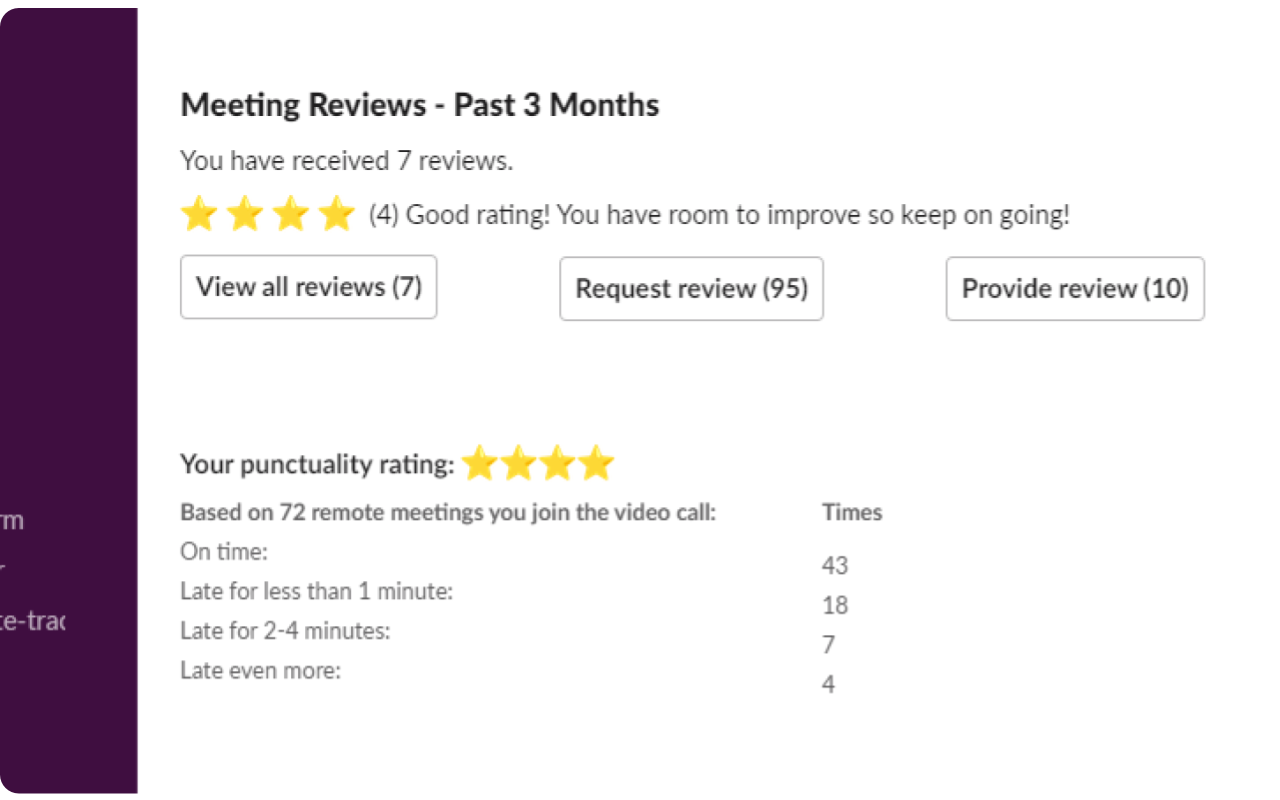
CALENDAR ANALYSIS TRENDS OVER TIME
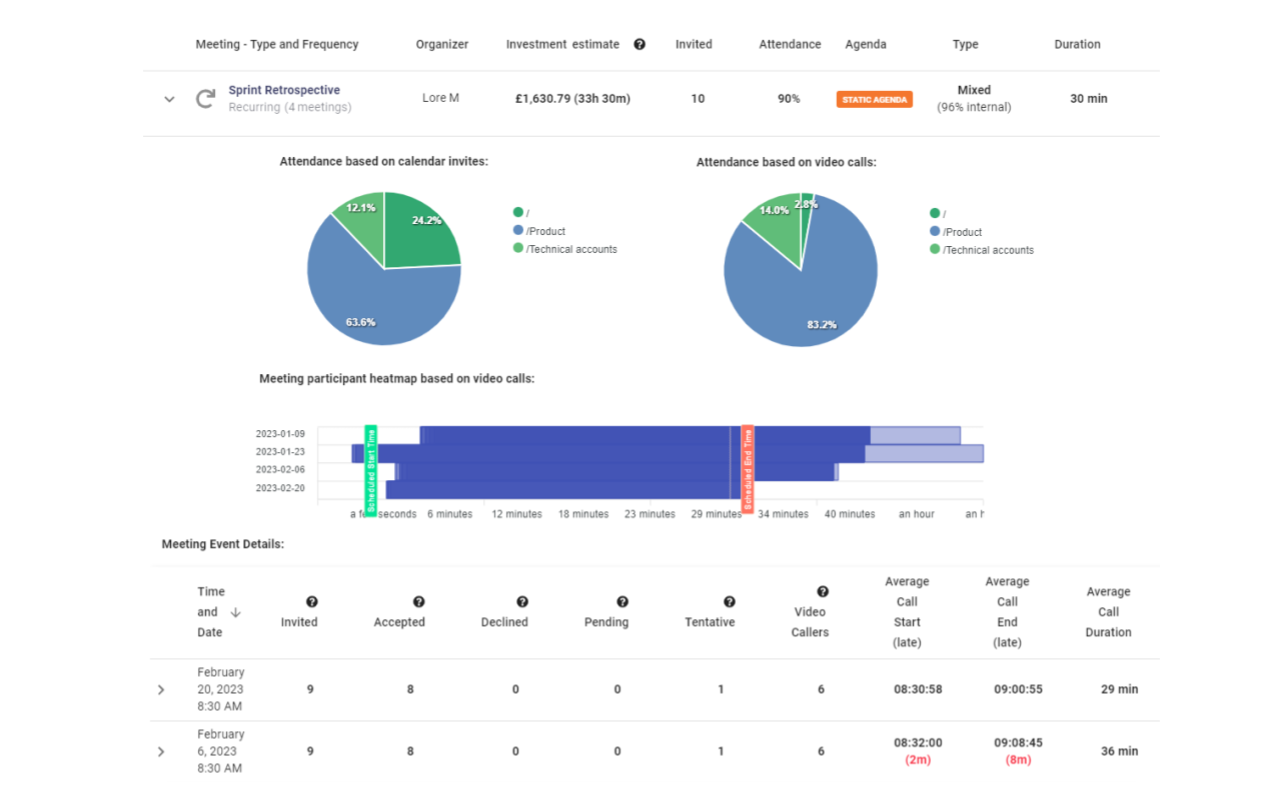
What part of your meeting culture is slipping? Surveys don't provide you tools to delve into real problems.
Maybe it's lack of agenda, too many meeting invites, or too long durtaion. Use our insights to improve decision making no matter the cause.
OVER TWO MILLION CALENDAR EVENTS ANALYZED EVERY MONTH
"Flowtrace is a very good product. We learned our lessons and focus on doing our homework, that is implementing a better meeting culture across the organization. Petri's individual support, diligence and guidance is just amazing!"

"Flowtrace helps us get work done faster, and our teams thrive in a more collaborative way of working."

"With Flowtrace, we gained a deeper understanding of our meeting culture, which we in turn used to train our staff better. It's been an important part of our quest for more deep work, more focus, and less meeting distraction."

"We knew we had a problem with meetings, but we couldn’t properly measure or change it. Flowtrace gave us visibility and control. The derived measurements far exceeded even our most optimistic expectations."

FREQUENTLY ASKED QUESTIONS
What is Calendar Analytics?
Calendar analytics refers to the process of analyzing calendar data, such as meeting frequency, duration, participants, and timing, to uncover patterns in how individuals and teams spend their time. These insights help organizations understand meeting culture, identify inefficiencies, and improve collaboration.
With Flowtrace’s calendar analytics, companies can:
- Measure time spent in meetings across teams and individuals
- Identify high-cost or low-value meetings
- Track recurring meetings without agendas or outcomes
- Visualize trends across Google Calendar and Outlook
- Surface opportunities for time recovery and culture change
Benefits of Calendar Analytics
Calendar analytics transforms how organizations understand and optimize their meeting culture by providing data-driven insights into time allocation and collaboration patterns. Here are the key benefits:
Cost Visibility & Control: Calendar analytics reveals the true financial impact of meetings by calculating time costs across participants and meeting types. This transparency helps organizations identify expensive, low-value meetings and make informed decisions about which meetings to eliminate or optimize.
Cultural Transformation: By tracking meeting habits like agenda frequency, duration trends, and participation patterns, teams can identify cultural issues and implement lasting behavioral changes. The data provides objective evidence to support meeting culture improvements rather than relying on subjective surveys.
Time Recovery: Analytics identify time drains such as recurring meetings without agendas, overlapping discussions, or meetings with too many participants. This visibility enables teams to reclaim valuable time for focused work and strategic initiatives.
Performance Optimization: Teams gain insights into their most productive meeting patterns, optimal meeting durations, and effective collaboration rhythms. This knowledge helps establish best practices that can be scaled across the organization.
Accountability & Engagement: When meeting costs and patterns are visible, meeting organizers become more thoughtful about invitations, preparation, and outcomes. This naturally drives better meeting hygiene and more purposeful collaboration.
Trend Monitoring: Long-term analytics reveal whether meeting culture improvements are sustainable or if negative patterns are creeping back, enabling proactive management of organizational productivity.
The combination of visibility, behavioral nudges, and actionable insights makes calendar analytics a powerful tool for building more effective, cost-conscious meeting cultures.
Calendar Analytics use cases
Calendar analytics serves multiple organizational needs across different roles and business objectives. Here are the primary use cases:
Meeting Cost Auditing: Organizations use calendar analytics to conduct comprehensive audits of their meeting expenses, calculating the true cost of recurring meetings, all-hands sessions, and cross-functional collaborations. This helps identify where meeting budgets are being spent and which meetings deliver the highest ROI.
Culture Assessment & Improvement: Leadership teams leverage calendar data to understand their organization's meeting culture objectively. They can identify patterns like meeting overload, lack of preparation (missing agendas), or inefficient scheduling practices, then implement targeted improvements with measurable outcomes.
Team Productivity Optimization: Managers use calendar insights to understand how their teams spend collaborative time, identify bottlenecks in decision-making processes, and optimize meeting schedules to preserve focus time for deep work.
Resource Planning: HR and operations teams analyze meeting patterns to understand collaboration loads, plan for meeting room resources, and make informed decisions about team size and structure based on actual collaboration needs.
Performance Benchmarking: Organizations compare meeting efficiency metrics across departments, teams, or time periods to identify high-performing collaboration patterns and scale best practices throughout the company.
Change Management: During organizational restructuring or process improvements, calendar analytics provides baseline measurements and tracks the effectiveness of new meeting policies or collaboration tools.
Executive Reporting: Leadership uses calendar analytics to demonstrate productivity improvements, justify meeting culture investments, and make data-driven decisions about company-wide collaboration policies.
Individual Development: Employees gain personal insights into their meeting habits, helping them become more intentional about meeting participation and time management.
These use cases enable organizations to transform meeting culture from intuition-based to data-driven, resulting in more productive collaboration and better business outcomes.
How do I start with Flowtrace?
Our self-service onboarding takes less than 5 minutes to complete and you will get your first insights right away.
You can add more sources of collaboration events at any time and these takes couple of minutes for common integration or more for complex tool integrations across the data sources.
How long it takes to see business performance?
You can start seeing meeting culture insights within days, while measurable business impact depends on the scale of rollout and the changes being introduced.
Flowtrace can quickly show what is happening across your calendars: meeting load, focus time, meeting costs, collaboration patterns, and where teams may be losing time. This means leadership and managers can identify quick wins early, often within the first weeks of use.
Some improvements can happen almost immediately once teams see the data and enable calendar-based interventions. For example, meeting cost reminders, validation rules, agenda requirements, attendee discipline, and better scheduling guidance can influence behaviour at the point meetings are created.
Longer-term performance improvement usually requires a structured change cycle. Meeting habits are part of company culture, so sustained improvements in focus time, collaboration, and alignment may take several months depending on the starting point of the organization.
For enterprise pilots, we typically recommend a 3-month structure: one month to establish a baseline, followed by two months of targeted interventions. This gives the organization enough time to compare “before and after” behaviour and measure whether meeting culture improvements are translating into better focus, lower meeting load, and stronger collaboration patterns.
Is my data safe with you?
Yes. Flowtrace is designed with privacy, security, and enterprise data protection as core principles.
Flowtrace uses a metadata-first approach wherever possible. We do not read email content, meeting content, private chat messages, or the contents of documents. Instead, Flowtrace analyses collaboration metadata, such as calendar events, meeting patterns, participation signals, and other intentional collaboration activity, to generate meeting culture and productivity insights. This reduces unnecessary data exposure while still allowing organizations to understand how work happens. Flowtrace’s public privacy guidance states that, wherever possible, it analyses metadata rather than work content and does not store the contents of private communication.
Flowtrace does not analyse what is being said in meetings. Unlike many meeting tools, Flowtrace does not need to record, transcribe, summarize, or interpret meeting conversations to generate insights.
Flowtrace also supports GDPR-aligned processing through a published Data Processing Agreement. The DPA confirms that the customer acts as Controller and Flowtrace acts as Processor, and that Flowtrace processes personal data only as necessary to provide the services and in accordance with the customer’s written instructions. It also covers UK GDPR, EU GDPR, DPA 2018, SCCs, and the UK Addendum for relevant international transfers.
From a security architecture perspective, Flowtrace production infrastructure is hosted in AWS in Ireland, with TLS 1.2+/1.3 encryption in transit and AES-256 encryption at rest. Access controls include SSO through Google, Microsoft, or Slack, MFA governed by the customer’s identity provider, quarterly access reviews, and least-privilege IAM roles.
Flowtrace also operates a documented security framework covering secure development, logging, monitoring, incident response, business continuity, and vendor management. This includes SAST and dependency scanning, centralized AWS CloudWatch logging, AWS Inspector, GuardDuty and Security Hub review, a four-stage incident response process, defined RPO/RTO targets, and published sub-processor controls.
Flowtrace’s controls map to ISO 27001:2022 Annex A and SOC 2 Security, Availability, and Confidentiality principles. Detailed security documentation, audit roadmap information, and supporting materials can be shared with customers under NDA where required.
You can read more about our commitment to data security from here.

CREATE FREE ACCOUNT NOW
Experience Flowtrace in action with powerful calendar and meeting tool integrations to super-charge your team productivity and effectiveness.
Enteprise-Grade Security
Flowtrace considers employee privacy, and data security as a paramount to your success. We never store, or ask data access which is not required to provide our services.
GDPR Compliant
Rigorous data protection and privacy standards in line with European regulations with extra privacy options for most stringent requirements.
Isolated Metadata Storages
Analytics is stored in separated databases from personally idenfiable data
End-to-End Encrypted
All your meeting data is protected in transit (SSL/TLS), and at rest (AES-256).
SSO by Default
You provision the account and user access to our platform through your account management procedures.
How Flowtrace Compares to Other Calendar Analytics Tools
There are many tools offering calendar insights, but few go beyond surface-level analytics. Flowtrace stands out by combining deep calendar metrics with in-calendar behavior nudges, meeting cost visibility, and a structured approach to meeting transformation. Here's how we compare to other popular solutions:
| Feature | Flowtrace | Microsoft Viva Insights | Time is Ltd | Clockwise |
|---|---|---|---|---|
| Calendar Analytics (Google & Outlook) | ✔️ | Outlook only | ✔️ | ✔️ |
| Meeting Cost Visibility in Calendar | ✔️ Real-time in Outlook & Google | |||
| Meeting Invite Validation Rules | ✔️ Company policies enforced | |||
| Team-Level Meeting Metrics | ✔️ With team benchmarking | Limited | ✔️ | |
| Behavior Nudges for Better Meetings | ✔️ In-calendar prompts | Focus time only | ||
| Meeting Culture Transformation | ✔️ Understand → Define → Transform | Data insights only | ||
| Granular Trial Setup (e.g. 3-user) | ✔️ Secure and flexible | Org-wide only |