Meetings
7 Best Calendar Analytics Tools in 2026
Discover the top calendar analytics tools of 2026 for real-time insights on meeting habits, focus time, and collaboration patterns to enhance...
Discover the key differences between calendar analytics and meeting analytics, and learn how to improve organizational efficiency and meeting effectiveness.
Calendar analytics vs meeting analytics is an important distinction because the two terms are often used as if they describe the same thing. They are connected, but they answer different operating questions. Calendar analytics shows how time is allocated across the organization. Meeting analytics shows whether the meetings occupying that time are structured, necessary, and effective.
This distinction matters because meeting problems rarely come from one visible cause. A team may not simply have too many meetings. It may have too much recurring meeting load, too little focus time, weak attendee discipline, poor agenda quality, or a calendar that has become too reactive to support planned work.
For leaders, separating calendar analytics from meeting analytics helps make the problem easier to diagnose. Calendar analytics explains what the schedule is doing to working capacity. Meeting analytics explains whether the meetings inside that schedule are earning their place.

Calendar analytics looks at the calendar as a time allocation system. It helps organizations understand how working time is distributed across meetings, focus time, recurring events, cross-team collaboration, and schedule fragmentation.
Meeting analytics looks at the meetings themselves. It helps organizations understand whether meetings have clear purpose, the right attendees, useful agendas, appropriate duration, consistent attendance, and a measurable role in decision-making.
The simplest distinction is this: calendar analytics shows how time is being used. Meeting analytics shows whether that meeting time is being used well.
| Area | Calendar Analytics | Meeting Analytics |
|---|---|---|
| Main question | How is time being allocated? | Are meetings effective and necessary? |
| Primary lens | Calendar patterns and working capacity | Meeting quality, cost, structure, and behavior |
| Typical metrics | Meeting load, focus time, recurring meetings, overlaps, calendar fragmentation, time distribution | Agenda quality, attendee count, meeting cost, duration, attendance, punctuality, recurring meeting governance |
| Best for | Understanding pressure on calendars and capacity | Improving meeting culture and decision-making |
| Leader action | Redesign schedules, protect focus time, reduce calendar sprawl | Improve agendas, attendee discipline, meeting ownership, and recurring reviews |
Both views are useful, but they should not be collapsed into one area. A focus time problem may require calendar-level changes. A poor decision-making problem may require meeting-level changes.
Calendar analytics is the analysis of calendar data to understand how people and teams spend their time. It looks at meeting frequency, duration, timing, participants, recurring patterns, overlaps, and the amount of usable focus time left in the week.
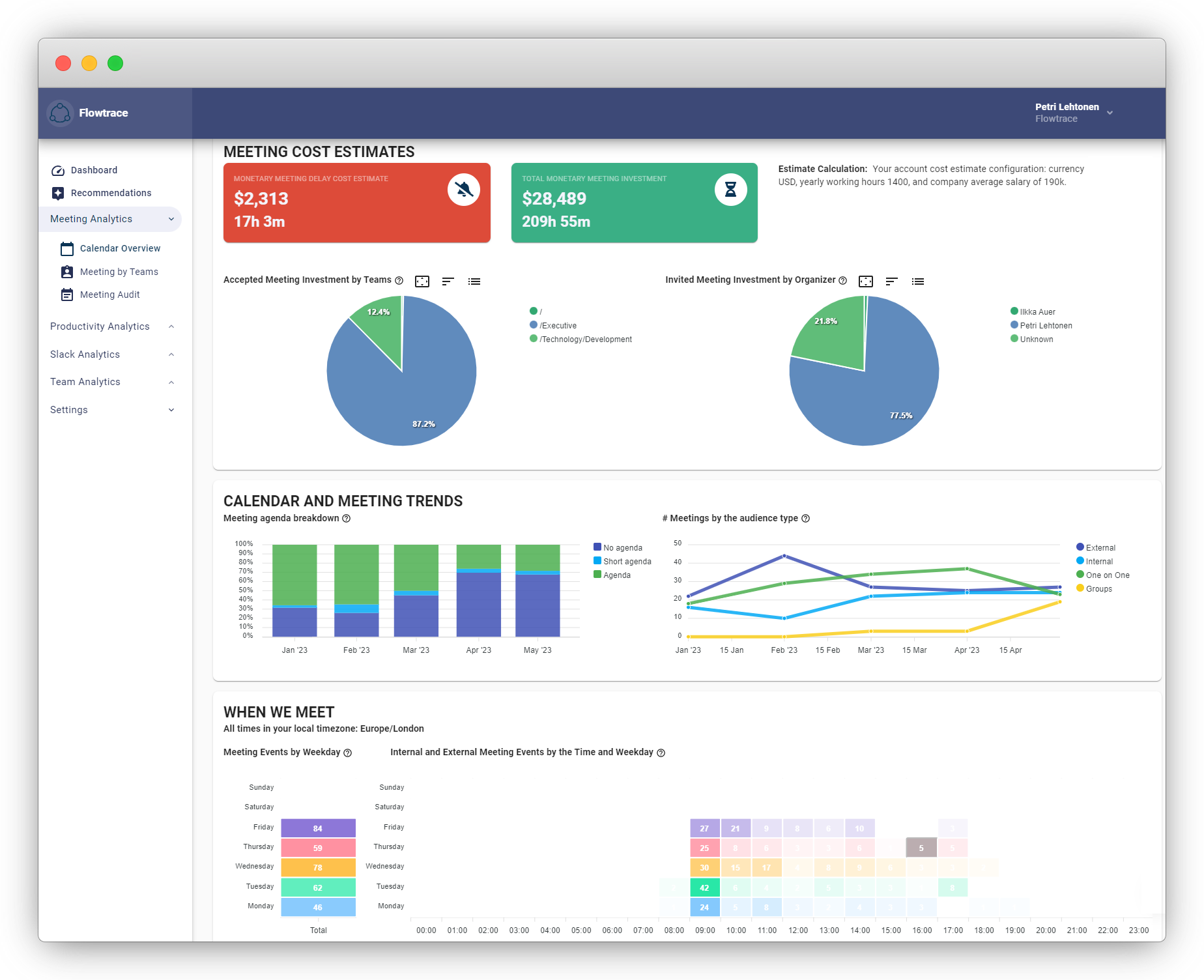
This matters because the calendar is not just a personal scheduling tool. At scale, it becomes a record of how an organization coordinates work. If recurring meetings are never reviewed, if focus time is repeatedly broken into small gaps, or if senior teams are carrying too much meeting load, those patterns become part of the operating rhythm.
Asana’s Anatomy of Work research reports that leaders lose 3.6 hours per week to unnecessary meetings, with collaboration overload becoming more problematic higher up the organization. The business implication is clear: calendar pressure is not evenly distributed, and the people most responsible for decisions are often among the most exposed to meeting overload.
Calendar analytics helps leaders replace anecdotal complaints with measurable visibility. Instead of asking whether teams feel busy, leaders can see which teams have the heaviest meeting load, where focus time is being lost, and how calendar behavior differs across departments.
Meeting analytics is the systematic analysis of meeting data to understand how meetings function across an organization. It measures meeting frequency, duration, cost, attendance patterns, participant behavior, agenda quality, punctuality, and recurring meeting structure.
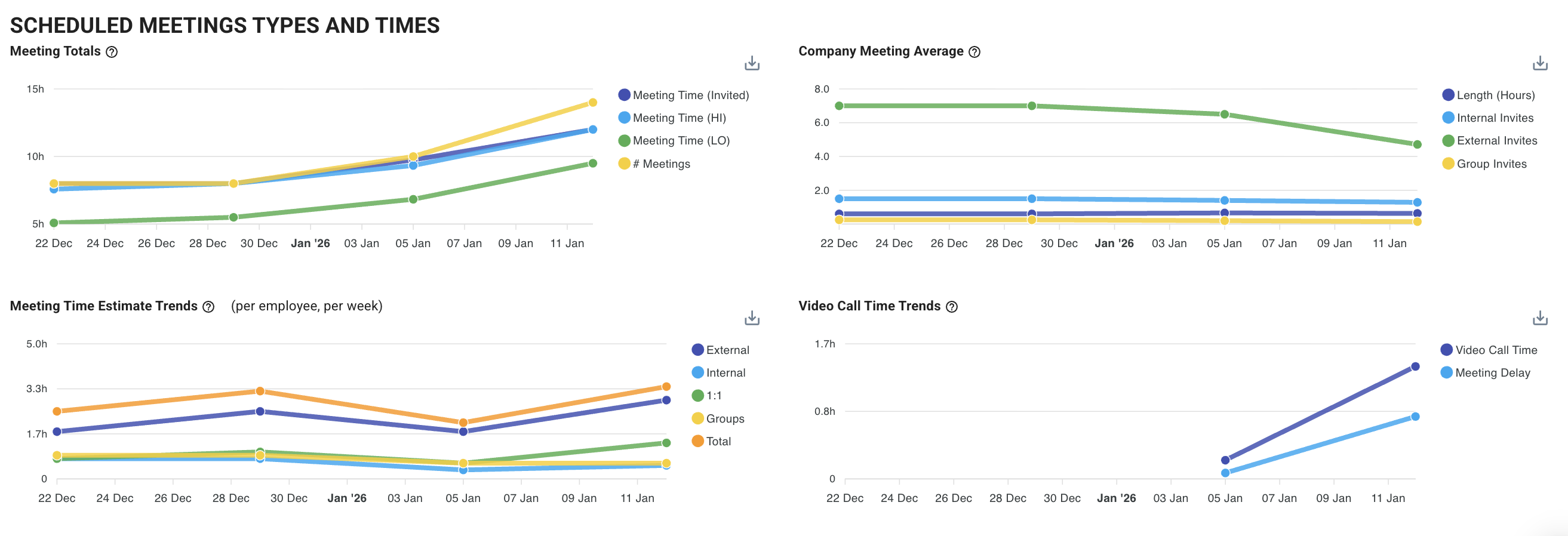
Meeting analytics becomes especially useful when leaders already know meeting load is high but need to understand why. The problem may not be meeting volume alone. It may be weak preparation, too many attendees, poor agenda discipline, unclear ownership, or recurring meetings that continue without a clear decision-making role.
Our data shows that 60% of one-off meetings lack a structured agenda. That is a meeting behavior problem, not just a calendar problem. A meeting without a clear agenda is more likely to become a status update, a loose discussion, or a call where the decision point is unclear.
Meeting analytics turns those patterns into management signals. Leaders can see where agenda quality is weak, which meetings are oversized, where recurring meetings need review, and which teams need clearer meeting standards.
Flowtrace calendar analytics helps leaders understand how time is allocated across teams, departments, and the wider organization. It shows the patterns behind meeting load, focus time loss, recurring calendar pressure, schedule fragmentation, and team-level differences in how work is coordinated.
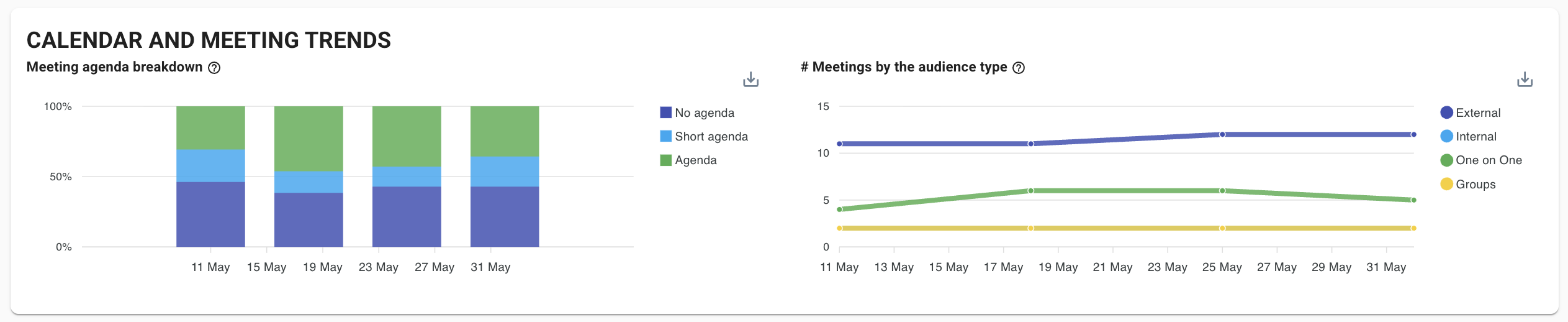
This is useful when leaders need to understand whether the calendar is supporting execution or absorbing too much working capacity. A calendar audit can show which teams carry the heaviest meeting load, where recurring meetings are building up, how much uninterrupted focus time remains, and whether collaboration is concentrated or spread inefficiently across the week.
Our data shows that recurring meetings make up 48% of all meetings, while 92.4% of all meetings do not have an end date set on the calendar. That matters because recurring meetings are not just individual events. They reserve future capacity by default. Without review, they can become permanent fixtures in the operating rhythm even when their original purpose has changed.
Flowtrace helps organizations make those patterns visible across Google Calendar and Outlook. Leaders can use that visibility to review recurring meetings, benchmark teams, protect focus time, and understand how calendar behavior changes over time.
Flowtrace meeting analytics looks more closely at the meetings themselves. It helps organizations measure whether meetings are well structured, appropriately attended, clearly owned, and worth the time they consume.
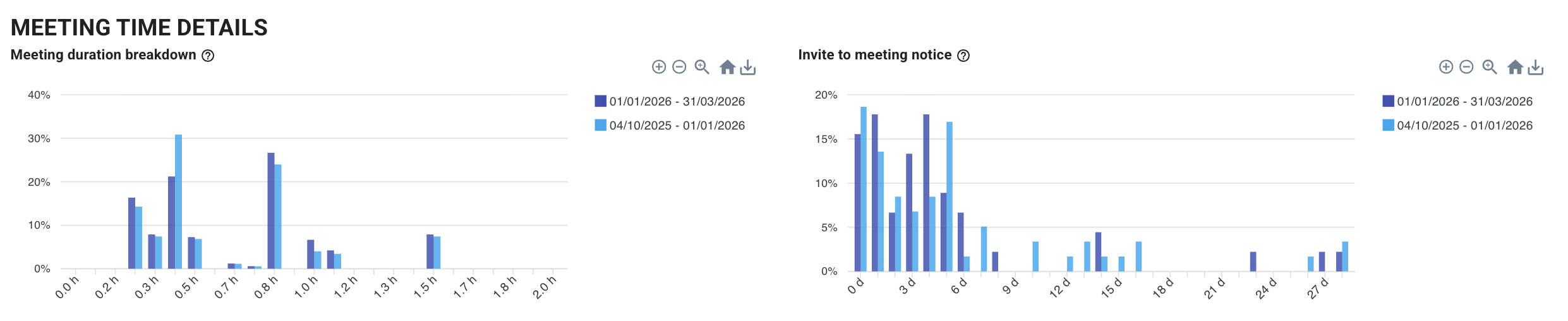
This includes meeting cost, attendee count, agenda quality, duration, punctuality, attendance behavior, and recurring meeting governance. These measures help leaders move beyond broad complaints about too many meetings and identify the specific behaviors creating meeting waste.
Our data shows that 64% of recurring meetings lack a structured agenda, and 29% of recurring meetings have seven or more participants. For leaders, that points to a common meeting culture problem: recurring meetings often become routine before they are reviewed for purpose, preparation, or attendee discipline.
Flowtrace meeting analytics gives teams a practical way to improve those habits. Instead of relying on broad meeting reduction targets, leaders can set clearer standards for agendas, attendee lists, meeting length, and recurring review cycles. The aim is not simply to remove meetings, but to make the meetings that remain more intentional and easier to measure.
The distinction between calendar analytics and meeting analytics matters because they solve different parts of the same operating problem. Calendar analytics shows how time is distributed. Meeting analytics shows whether that time is being used well.
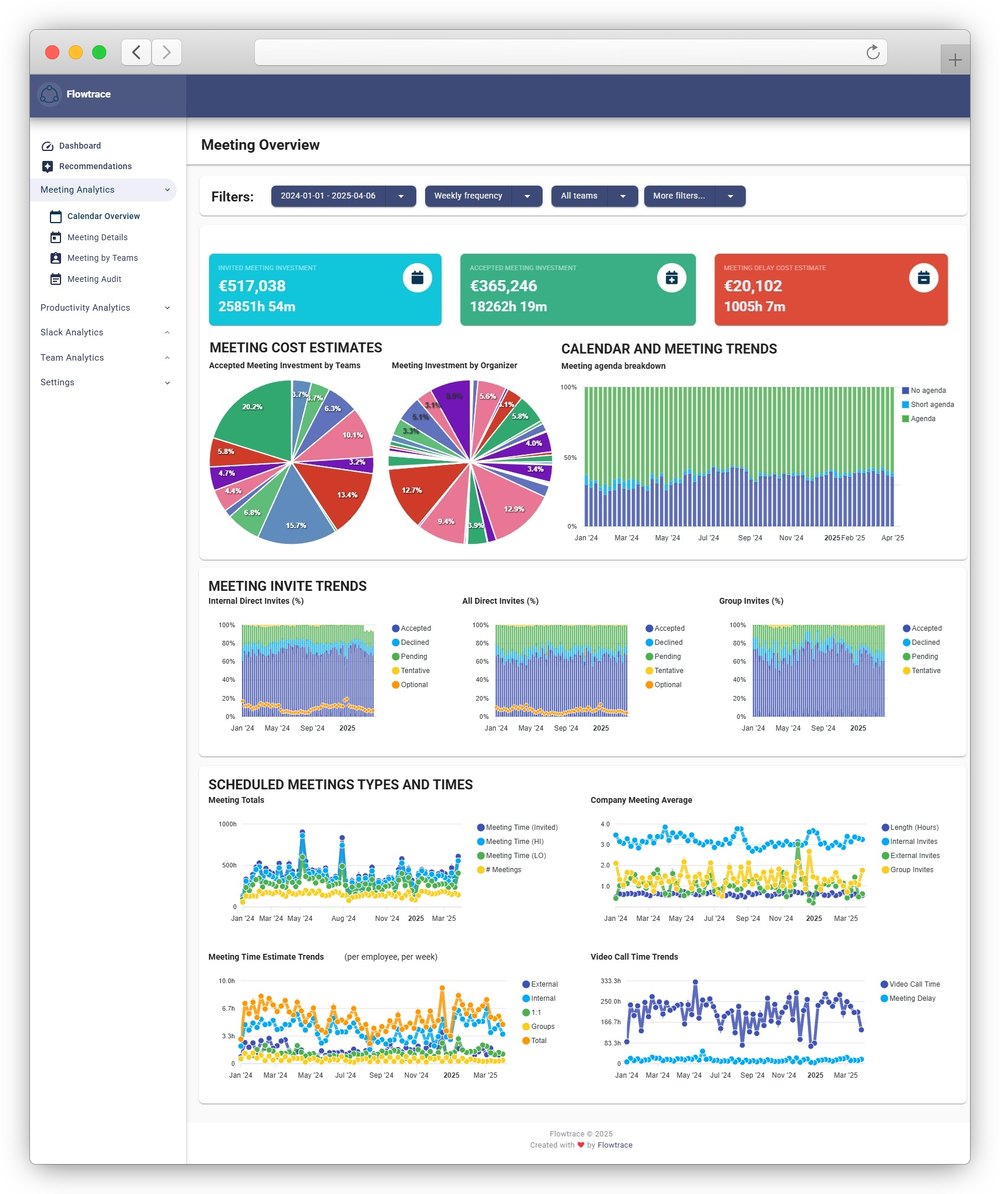
Flowtrace connects both views so leaders can move from visibility to action. Calendar analytics can show that a team has too little focus time or too much recurring meeting load. Meeting analytics can then show whether the cause is weak agenda discipline, too many attendees, oversized recurring meetings, or meetings that no longer have a clear decision-making role.
This is where meeting analytics and calendar analytics become more useful together than separately. Calendar data identifies the pressure points. Meeting data explains the behaviors behind them. Together, they help leaders change the operating rhythm rather than running a one-off meeting cleanup.
Calendar analytics should be the starting point when leaders need visibility into capacity, focus time, and schedule pressure. It is especially useful when teams report overload but the cause is unclear.
Use calendar analytics when you need to answer questions such as:
Atlassian gives a practical example of this type of intervention. In its calendar redesign work, participants were asked to decline lower-priority meetings, group existing meetings together, and schedule focus time in longer blocks. The lesson is that calendar structure affects execution quality. Leaders cannot protect focus time only by asking people to manage their own calendars better. They need visibility into the patterns that make focus time difficult to protect.
Meeting analytics should be used when the goal is to improve the quality, cost, and effectiveness of meetings themselves. This is where leaders move from “how much time is being used?” to “is this meeting worth the time it consumes?”
Use meeting analytics when you need to answer questions such as:
Our data shows that 35% of meetings are created within 24 hours of their start time, while only 8% are booked more than a week in advance. That signals a reactive calendar culture where urgent coordination can crowd out planned work. Meeting analytics helps leaders separate necessary responsiveness from avoidable scheduling habits.
Calendar analytics and meeting analytics work best together because meeting culture operates at both levels. A calendar can be overloaded even if each individual meeting seems reasonable. A meeting can be poorly designed even if the wider calendar looks manageable.
For leaders, the wrong diagnosis leads to the wrong intervention. If the issue is calendar fragmentation, adding stricter meeting agenda rules will not fully solve it. If the issue is recurring meetings without ownership, blocking more focus time may only move the problem around. The right measurement layer matters.
This also changes how leaders approach meeting reduction. The goal should not be to cut meetings blindly. The goal should be to understand which meetings support decisions, which meetings create unnecessary coordination overhead, and which calendar patterns make focused work harder to protect.
Calendar analytics helps leaders understand how time is allocated. Meeting analytics helps leaders understand whether that time is being used well. Flowtrace brings those views together so organizations can measure meeting culture, identify calendar patterns, improve agenda and attendee discipline, protect focus time, and track whether behavior changes over time.
The practical takeaway is: start with a calendar audit to understand where time is going, then use meeting analytics to understand which meeting behaviors are creating the load. That sequence gives leaders a clearer path from visibility to action, and it makes calendar analytics vs meeting analytics a useful distinction rather than another category label.
Discover the top calendar analytics tools of 2026 for real-time insights on meeting habits, focus time, and collaboration patterns to enhance...
Discover how enterprise meeting analytics transforms meeting culture by measuring productivity, decision-making, and costs, leading to improved...
Discover how meeting analytics for Outlook can enhance productivity by improving meeting design, scheduling, and policy enforcement for better...