An eight-person team working a two-week period appears to have 640 hours. It does not.
Before the team makes one delivery commitment, leave, training, support work and recurring meetings have already claimed part of the calendar. Yet many plans either ignore meetings or subtract only the organizer's meeting time. Both approaches create capacity that never existed.
A 30-minute weekly meeting with eight people does not use 30 minutes of team capacity. It uses four attendee-hours every time it runs. Repeat it throughout a quarter and a small calendar habit becomes a standing operational commitment.
Meeting capacity planning calculates the team time left after known commitments and recurring meeting attendee-hours, then checks whether the remaining time exists in blocks that people can actually use. The result is a planning envelope, not a promise that every open hour will become completed work.
The short answer
- Add the actual working hours available in the planning period.
- Remove leave, holidays, training, support and other known non-delivery work.
- Calculate every recurring series as duration x expected attendees x occurrences.
- Subtract those attendee-hours to find the remaining calendar capacity.
- Inspect how that time is distributed. Open hours scattered between meetings are not the same as protected delivery blocks.
- Compare the estimate with real delivery outcomes. Do not apply a generic productivity percentage.
In this article
What meeting capacity planning measures
Meeting capacity planning answers a narrow question: after the team's known commitments and recurring meetings are counted, how much calendar capacity remains for delivery and unplanned demand?
It is not a complete resource plan. It does not allocate work, estimate backlog items, decide headcount or forecast the exact output of a team. It corrects one common planning error: treating recurring meetings as if they happen outside the capacity model.
The distinction matters because recurring meetings are prior claims on future time. A weekly status call, daily team meeting, one-to-one and monthly operational review have different purposes, but they all reserve capacity before the next sprint, month or quarter begins.
Count them without judging them. A useful decision meeting still consumes time. A necessary one-to-one still belongs in the arithmetic. Making the commitment visible is not the same as calling it waste.
The broader Meeting Efficiency Guide explains how to pair calendar signals with work outcomes and decide whether meetings should be kept, removed, replaced, shortened or improved. This article stays with the capacity calculation that comes before that decision.
The four capacity layers
I prefer to keep the calculation in four visible layers. If a planning model hides leave, meetings and interruptions inside one utilization percentage, nobody can tell which assumption failed later.
1. Gross team availability
Add the planned working hours for every person during the same period used for delivery planning.
gross team availability = sum of each person's planned working hours
Use actual working patterns. A part-time employee, public holiday or regional schedule should not be converted into a fictional 40-hour week for convenience.
2. Capacity before recurring meetings
Remove commitments that are already known and are not part of the delivery plan.
capacity before meetings = gross availability - leave - holidays - training - fixed support and admin
Keep the deductions explicit. Support rotations, mandatory training and planned hiring work can be just as real as leave. Hiding them creates a neat number and a bad plan.
3. Recurring meeting attendee-hours
Calculate every recurring series inside the planning window.
attendee-hours for one series = duration x expected internal attendees x occurrences
recurring meeting load = sum of attendee-hours across recurring series
Use expected attendance for a forward plan. Use reliable actual attendance when reviewing what happened. If one person has overlapping invites, do not count the same clock hour twice. The calendar may contain two commitments, but the person still has only one hour of capacity to give.
If you need the underlying meeting-time method in more detail, the guide to average time in meetings and attendee-hours explains how to separate recurring and one-off load without relying on a misleading company average.
4. Remaining calendar capacity and schedule usability
Subtract the recurring load.
remaining calendar capacity = capacity before meetings - recurring meeting attendee-hours
This is the maximum scheduled time left for delivery work, ad hoc coordination and unplanned demand. It is not yet a delivery forecast.
Report a second view that shows whether the remaining time forms useful blocks. The right block length depends on the work. A recruiter may use a short opening between interviews. An engineer debugging a difficult problem may need a much longer uninterrupted window. Choose a definition that fits the team, state it, and keep it consistent.
A worked two-week capacity example
Consider an eight-person product or engineering team planning the next two weeks. The figures below are illustrative, not a benchmark or customer result.
| Capacity item |
Calculation |
Team hours |
| Gross availability |
8 people x 10 days x 8 hours |
640 |
| Leave, training, support and fixed admin |
Explicit planned deductions |
-80 |
| Capacity before meetings |
640 - 80 |
560 |
| Daily 15-minute team meeting |
0.25 x 8 x 10 |
-20 |
| Weekly 90-minute planning or review |
1.5 x 8 x 2 |
-24 |
| Weekly cross-team status meeting |
0.5 x 4 x 2 |
-4 |
| Seven recurring one-to-ones |
0.5 x 2 x 7 |
-7 |
| Remaining calendar capacity |
560 - 55 |
505 |
The recurring meeting commitment is 55 attendee-hours, or 8.6% of the team's gross availability. The team has 505 hours left before ad hoc meetings, incidents, unexpected support and the effect of schedule fragmentation.
That last sentence is the important one. A weak planning process writes 505 into the plan and calls the job finished. A useful process asks where those hours sit and who has them.
The average is 63.1 hours per person across the two weeks. It may hide a product manager with a heavily fragmented calendar, a manager carrying the one-to-ones, and several individual contributors with longer blocks. Capacity belongs to people before it belongs to a spreadsheet.
The calculation also makes changes inspectable. If the two 90-minute planning or review meetings become 60 minutes, the team releases eight attendee-hours. If the cross-team status series moves to a reliable written update, another four hours become available. That is 12 hours of potential capacity. It is not 12 guaranteed hours of completed work.
Why 505 open hours are not 505 delivery hours
Two calendars can contain the same number of meeting-free hours and create very different working days.
One team has recurring meetings grouped into two afternoons. Another has the same meeting load spread across every morning and afternoon. The total meeting time is equal. The second team may struggle to find a usable block for design, writing, analysis or implementation.
Microsoft Viva Insights makes this distinction in its own workplace-analytics definitions. It reports recurring meeting hours separately from conflicting meetings, interrupted time and open one-hour blocks. These are product metrics rather than a universal scientific standard, but the separation is sensible: volume and schedule shape answer different questions in a capacity plan. Microsoft's current metric reference explains the definitions.
Microsoft Research's 2024 Rhythm of Work study reached a similar practical conclusion from a different direction. The researchers combined eight interviews, 165 survey responses and scheduling telemetry covering millions of meetings created by 211,000 workers. Preferences for clustered or dispersed schedules differed, and meeting load, role and time zones were associated with gaps between preferred and actual schedules.
There is no responsible universal fragmentation penalty to apply. Instead, add a schedule-usability view:
- Count open blocks long enough for the team's work, not only total open hours.
- Check whether each person has a realistic opportunity for focused delivery on the days it is needed.
- Separate a concentrated collaboration window from meetings scattered across the full week.
- Flag conflicts and back-to-back chains that make the raw capacity unreliable.
- Leave visible contingency for incidents, ad hoc meetings and other demand the plan cannot know in advance.
A small six-week Microsoft Research focus-time experiment involved 15 treatment participants and 10 controls. The focus-time group reported less frustration, tiredness and stress. The sample is too small to produce a universal output multiplier, but it supports a modest operational point: protected time should be measured as its own condition rather than assumed to appear whenever a meeting ends.
For a deeper view of calendar load, focus time and fragmentation, use the Calendar Analytics Guide.
How to interpret recurring meeting capacity
The number should start a management conversation, not end one.
A recurring meeting consumes capacity, but that does not tell you whether it is good or bad. It may close decisions, resolve dependencies, coach employees, protect customer relationships or prevent expensive rework. Removing it could release time and damage delivery at the same time.
Research describes this tension as the meeting load paradox. In one field study of 199 full-time employees, meeting participation, engagement and creative performance initially rose with meeting load before falling after a threshold. The authors present this as initial evidence, not a universal limit. The useful lesson is that both coordination and overload are real.
When a series creates a large capacity claim, ask:
- What work outcome does this meeting enable?
- Which attendees must contribute, decide or learn in the room?
- Does the cadence match the pace of the work?
- What would replace the coordination if the series changed?
Those questions stop the capacity exercise becoming an anti-meeting campaign. They also reveal the difference between a meeting that earns its time and a meeting that survives because nobody owns the recurring invite.
Once the calculation identifies a high-impact series, use the detailed process to review each recurring meeting series. That process covers ownership, evidence and the choice to keep, remove, replace, shorten or improve the meeting. There is no need to smuggle the whole decision into one capacity number.
Turn the calculation into a planning decision
Capacity planning becomes useful when the team compares the calendar result with work results.
| Pattern |
What it may mean |
Next question |
| High recurring load and stable delivery |
The meetings may be enabling necessary coordination |
Are the outcomes worth the capacity, and is attendance still right? |
| High recurring load, fragmented schedules and slower delivery |
Coordination may be crowding out execution |
Which recurring families create the most attendee-hours and disruption? |
| Moderate meeting load but very few usable blocks |
Placement may be a bigger problem than volume |
Can necessary meetings be clustered without harming time-zone or customer needs? |
| Meeting hours fall but delivery does not improve |
The constraint may be elsewhere |
Did blockers, work in progress, unclear decisions or support demand absorb the released time? |
| Capacity is released and work outcomes remain stable or improve |
The change may be worth keeping |
Does the pattern persist through another planning period? |
Choose one or two delivery guardrails that fit the work. An engineering team may watch cycle time, blocked work and review delay. An operations team may watch queue age or customer response. A leadership group may care about decision latency. Do not use one metric for every team.
The article on Scrum flow metrics and meeting load goes further into engineering delivery measures. The principle here is simpler: capacity released from the calendar should be checked against the work it was meant to help.
If leaders want to translate attendee-hours into a financial view, use a separate company meeting cost calculation. Do not call released hours cash savings unless payroll, contractor spend, overtime, hiring or another real outflow changes.
How Flowtrace supplies the meeting data
A spreadsheet is enough to run this calculation for one team once. It becomes brittle when recurring series, attendee lists, working patterns and calendars change across an organization.
Flowtrace meeting analytics supplies the meeting side of the capacity model. It uses calendar and meeting metadata to show meeting load, recurrence, attendance patterns, cost, focus time and schedule trends by team or comparable group. It does not need to record, transcribe, summarize or interpret meeting conversations.
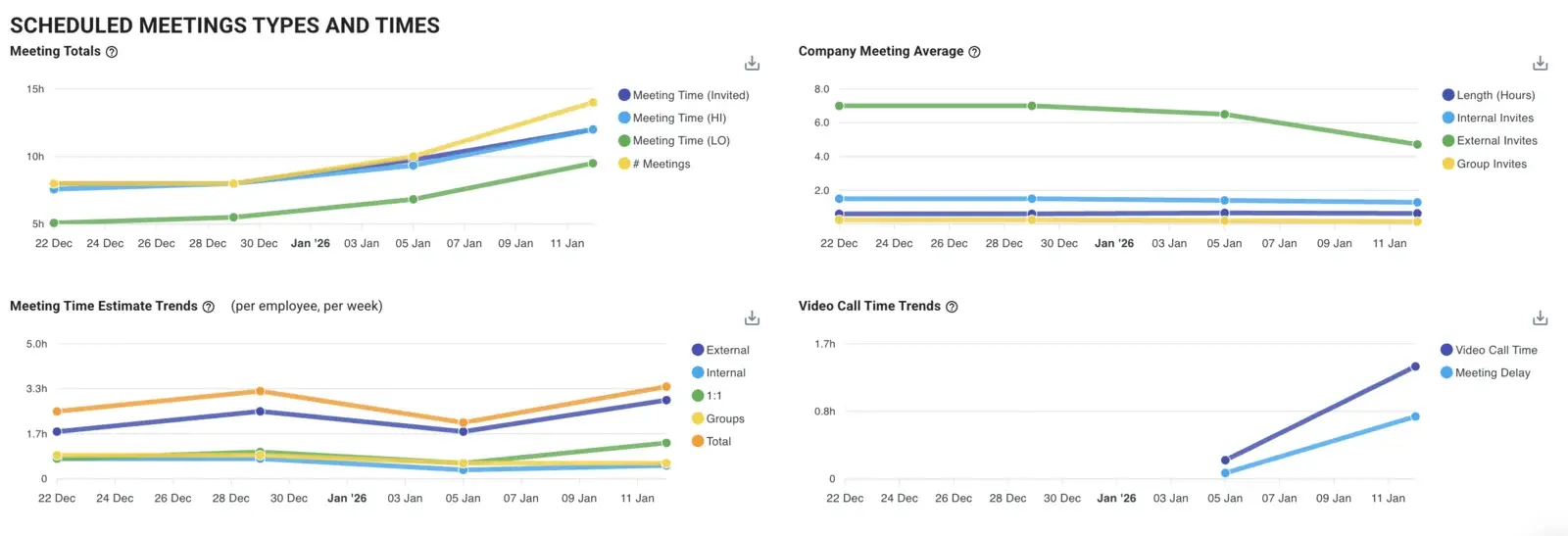
The team still provides the other side: working patterns, leave, support commitments, planned work and delivery outcomes. Flowtrace is not a sprint estimator. It makes the standing meeting commitment measurable enough to include in a real capacity discussion.
The Meeting Analytics Guide explains the wider measurement category. For capacity planning, the practical loop is shorter:
- Establish the recurring attendee-hour baseline for the planning period.
- Inspect whether the remaining time forms usable blocks for each comparable role or team.
- Agree which meeting series, attendee lists, durations or cadences should change.
- Protect the next plan by reinforcing the decision while new invites are created.
- Measure the next period and compare both calendar capacity and work outcomes.
Flowtrace can show meeting cost while a Google Calendar invite is being created and make meeting cost visible in Outlook. Managed rules can also prompt organizers about attendee, duration, agenda, timing and cost conditions where configured. The prompt creates a decision point. It does not create delivery by itself.

Frequently asked questions
What is meeting capacity planning?
Meeting capacity planning calculates how much team time remains after leave, fixed non-delivery work and recurring meeting attendee-hours. It then checks whether the remaining time exists in blocks suitable for the work being planned.
How do you calculate capacity used by recurring meetings?
For each recurring series, multiply its duration by the expected internal attendees and the number of occurrences in the planning period. Add those attendee-hours across all recurring series. Use actual attendance for a historical review when the data is reliable, and avoid double-counting overlapping time for one person.
Should valuable recurring meetings still count against capacity?
Yes. A useful planning or decision meeting still consumes team time, so it belongs in the calculation. Counting it does not label it as waste. It makes the coordination tradeoff visible.
What length should a protected delivery block be?
Use a length that reflects the work. There is no responsible universal threshold. Define the block for a comparable team or role, check that people actually have those blocks, and keep the definition stable enough to compare planning periods.
Does released meeting time guarantee more delivery?
No. Released attendee-hours create potential capacity. Delivery also depends on schedule fragmentation, support demand, blockers, work in progress and the team's operating conditions. Compare the calendar change with the work outcome.
How does Flowtrace support meeting capacity planning?
Flowtrace supplies the meeting side of the capacity model through metadata-first analytics for meeting load, recurrence, attendance, cost, focus time and schedule patterns. Teams combine that view with leave, support and delivery data, then use calendar-side prompts to reinforce agreed scheduling changes.
Plan from the calendar you actually have
Your team does not begin a sprint, month or quarter with a blank calendar. Recurring meetings are already there, quietly spending capacity before the planning conversation starts.
Put those commitments into the plan at attendee-hour level. Keep the non-meeting deductions visible. Inspect the shape of the time that remains. Then compare the calendar with delivery, because a capacity model that ignores the work outcome is only a tidier version of the same guess.
Start by counting the commitment. Change one recurring pattern, then use the next planning period to see whether the calendar and the work both improved.