Meetings
7 Best Calendar Analytics Tools in 2026
Discover the top calendar analytics tools of 2026 for real-time insights on meeting habits, focus time, and collaboration patterns to enhance...
Discover how meeting cost tracking can uncover hidden waste in your organization, improve collaboration, and enhance decision-making efficiency.
Meeting cost tracking is becoming more important because meeting overload is no longer just an employee complaint. It is an operating cost hidden inside the calendar. Every recurring sync, status update, stakeholder review, and last-minute call consumes coordinated time from multiple people at once. When that time is not measured, leaders have limited visibility into one of the largest collaboration costs in the business.
The issue is not that meetings exist. Organizations need meetings to make decisions, resolve ambiguity, align teams, and move cross-functional work forward. The problem is that most companies have weak visibility into which meetings are useful, which meetings are bloated, which recurring meetings have outlived their purpose, and where focus time is being quietly eroded.
Meeting cost tracking gives leaders a practical way to connect calendar behavior to business impact. It shows how much time meetings consume, how much they cost, which teams carry the highest meeting load, and where simple changes to attendance, agenda discipline, or recurrence can return meaningful capacity.

Meeting cost tracking is the process of measuring the financial and operational cost of meetings using calendar data, attendee data, duration, recurrence, and estimated compensation inputs. At the simplest level, it calculates the cost of a meeting by multiplying attendee time by an estimated hourly cost. But that basic calculation is only the starting point.
The more useful version of meeting cost tracking looks at patterns. It shows whether meeting cost is concentrated in specific teams, whether senior employees are being pulled into low-value updates, whether recurring meetings are accumulating without review, and whether calendars are being filled reactively through last-minute scheduling.
A single meeting cost number can be interesting. A trend across hundreds or thousands of meetings is operationally useful. That is where leaders can see whether meeting culture is supporting execution or creating unnecessary drag.
This matters because meeting time compounds quickly. A 30-minute meeting with eight attendees is not a 30-minute cost. It is four hours of organizational capacity. If that meeting repeats weekly, it becomes more than 200 hours per year before preparation, context switching, follow-up, or delayed individual work are included.
Meeting cost is often treated as a productivity issue, but that framing is too narrow. At scale, meeting cost reflects how work moves through the organization. Heavy meeting load can point to unclear ownership, weak async habits, slow decision-making, duplicated stakeholder groups, and a lack of governance around recurring meetings.
Microsoft’s Work Trend Index found that employees ranked inefficient meetings as the number one productivity disruptor, with too many meetings ranked third. The same report also found that Teams meetings and calls per week had tripled since February 2020. That points to a structural problem: organizations have added more synchronous coordination, but many have not added the operating discipline required to manage it.
Flowtrace data shows the same issue from the calendar side. Across our meeting dataset, employees spend about 392 hours per year in meetings, roughly 10 full workweeks. That is not a marginal time-management problem. It is a major capacity allocation decision happening every day without enough visibility.
The practical implication is clear: leaders cannot manage meeting culture through sentiment alone. Complaints about too many meetings are easy to dismiss. Meeting cost data is harder to ignore because it translates calendar behavior into time, capacity, and money.
The cost of a meeting is shaped by more than its length. A short meeting with too many people can be more expensive than a longer meeting with a focused group. A recurring meeting with no end date can cost more over a quarter than a one-off workshop. A meeting without an agenda can create additional cost because attendees arrive unclear, decisions are delayed, and follow-up work expands.
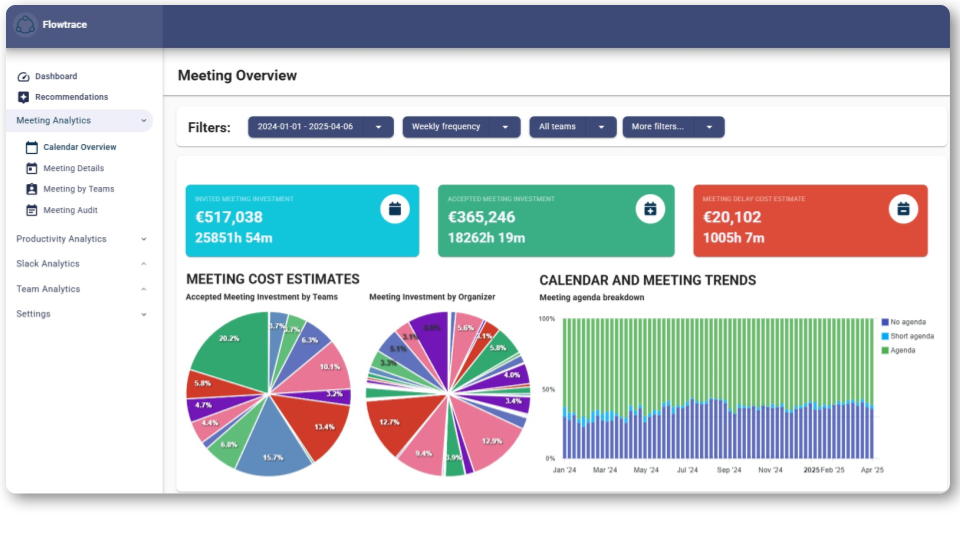
The core variables in meeting cost tracking are:
These variables matter because they give leaders options. If a meeting is valuable, the goal is not to remove it. The goal may be to reduce the attendee list, shorten the duration, change the cadence, clarify the agenda, or move updates to async channels.
Recurring meetings are one of the largest sources of calendar debt because they are easy to create and hard to remove. They often begin with a clear purpose, but over time the work changes, attendees change, and the meeting remains.
Flowtrace data shows that recurring meetings make up 48% of all meetings. That is not automatically a problem. Recurring meetings can be essential for leadership cadence, delivery governance, customer operations, and cross-functional coordination. The risk is that they become permanent by default.
Flowtrace data also shows that 92.4% of all meetings do not have an end date set on the calendar. This is where meeting cost tracking becomes valuable. A recurring meeting without an end date is an open-ended claim on future capacity. If no one reviews the meeting, it continues whether or not it still supports a decision, deliverable, or operating rhythm.
The practical fix is recurring meeting governance. Every recurring meeting should have an owner, purpose, attendee logic, agenda standard, and review date. Without those controls, recurring meetings become part of the operating system without being tested for value.
Attendee discipline is one of the fastest ways to reduce meeting cost without damaging collaboration. Most organizations do not need a broad meeting purge. They need better rules for who should be in the room.
Flowtrace data shows that removing two attendees from a 30-minute meeting saves one full-time employee day per 100 meetings. That may sound small at the individual meeting level, but it becomes significant across departments, recurring cadences, and leadership-heavy meetings.
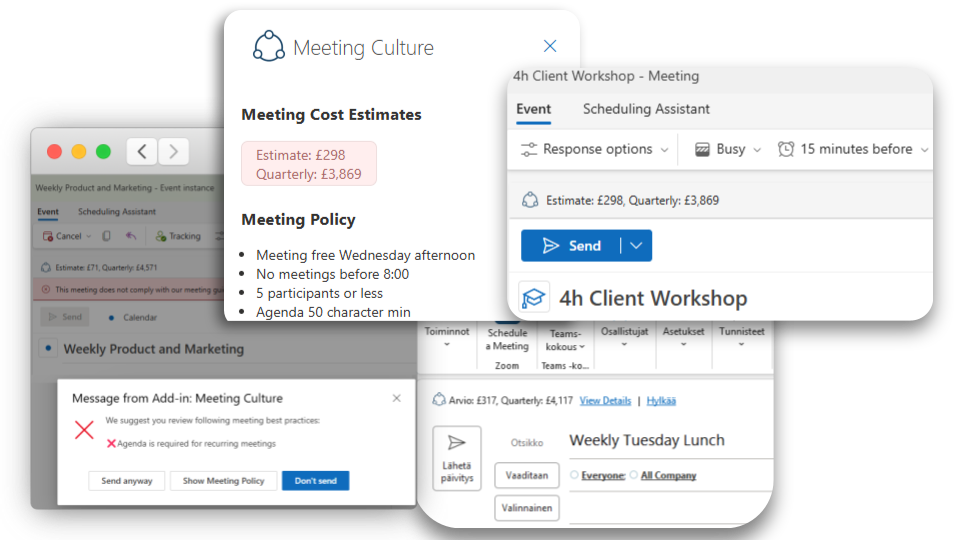
The underlying issue is often not laziness or bad intent. People invite too many attendees because ownership is unclear, decision rights are vague, or async documentation is weak. They add people “for visibility” because there is no better mechanism for keeping stakeholders informed.
Meeting cost tracking exposes this pattern. It shows where meetings have more attendees than the work requires, where optional participants are treated as default attendees, and where senior people are being pulled into meetings that should have been summarized asynchronously.
The practical fix is to assign attendee roles. Every person in a meeting should be there as a decision-maker, contributor, accountable owner, or necessary context holder. Everyone else should receive notes, a recording, a decision log, or an async update.
Meeting cost is not only a function of time and salary. It is also shaped by meeting quality. A poorly structured meeting often creates more cost after the meeting because decisions are unclear, action items are vague, and follow-up meetings become necessary.
Flowtrace data shows that 60% of one-off meetings lack a structured agenda. This is a major signal. One-off meetings are often where new work, urgent issues, cross-functional coordination, and decisions happen. When those meetings lack structure, attendees have less ability to prepare, challenge whether they need to attend, or understand the intended outcome.
Microsoft’s Work Trend Index found that 55% of people said next steps at the end of a meeting are unclear, while 56% said it is hard to summarize what happened. That supports the same point: meeting cost does not end when the calendar event ends. Poor meeting design pushes cost into rework, clarification, follow-up, and slower execution.
The practical fix is agenda discipline tied to meeting type. Decision meetings need the decision to be made, required inputs, and the accountable owner. Status meetings need a reason they cannot be async. Planning meetings need clear scope and constraints. Without this structure, meeting cost tracking will show the spend, but leaders also need meeting design standards to reduce waste.
The cost of meetings becomes clearer when leaders stop looking at individual calendar events and start tracing the full chain of support around them. Bain research published in Harvard Business Review found that one large company spent 300,000 hours per year supporting a single weekly executive committee meeting. The meeting itself was only the visible layer. The real cost came from the preparation, pre-meetings, follow-up discussions, and downstream coordination required to support it.
That is the point of meeting cost tracking. The cost is rarely contained inside the scheduled slot. A high-value leadership meeting may justify the time. But when the supporting system around that meeting becomes bloated, duplicated, or unclear, the organization pays for it through lost capacity, slower execution, and more coordination work.
This is why meeting cost tracking should not be limited to calculating the price of a 30-minute call. Leaders need to understand the wider operating pattern: which meetings create follow-on meetings, which forums require excessive preparation, which recurring cadences exist because decision ownership is unclear, and which meetings create more work than they resolve.
The practical fix is to track meeting cost alongside meeting design. High-cost meetings should have a clear owner, defined decision rights, a structured agenda, tight attendance, and a visible output. Without those controls, expensive meetings become harder to challenge because they look important from the outside while quietly draining capacity underneath.
Meeting cost tracking works best when it is used as an operating improvement tool, not a surveillance tool. The goal is not to shame meeting organizers or force every meeting through a finance lens. The goal is to give teams better visibility so they can make better trade-offs.
A useful meeting cost tracking program should help leaders answer five questions:
From there, leaders can make targeted changes. They can shorten default meeting lengths, remove unnecessary attendees, review recurring meetings quarterly, move status updates to async formats, and create clearer standards for agendas and decision ownership.
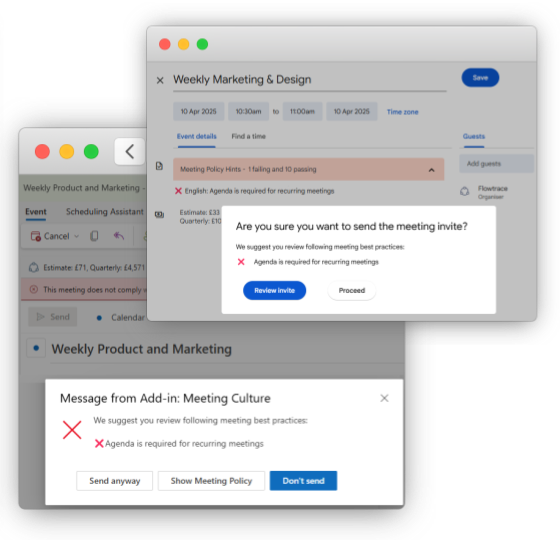
Meeting cost tracking is most effective when it appears where meeting decisions are made: inside the calendar. Post-meeting dashboards are useful for analysis, but the best moment to change behavior is before the invite is sent.
Flowtrace provides meeting cost tracking through its Google Calendar extension and Outlook add-in, bringing cost visibility directly into the scheduling workflow.
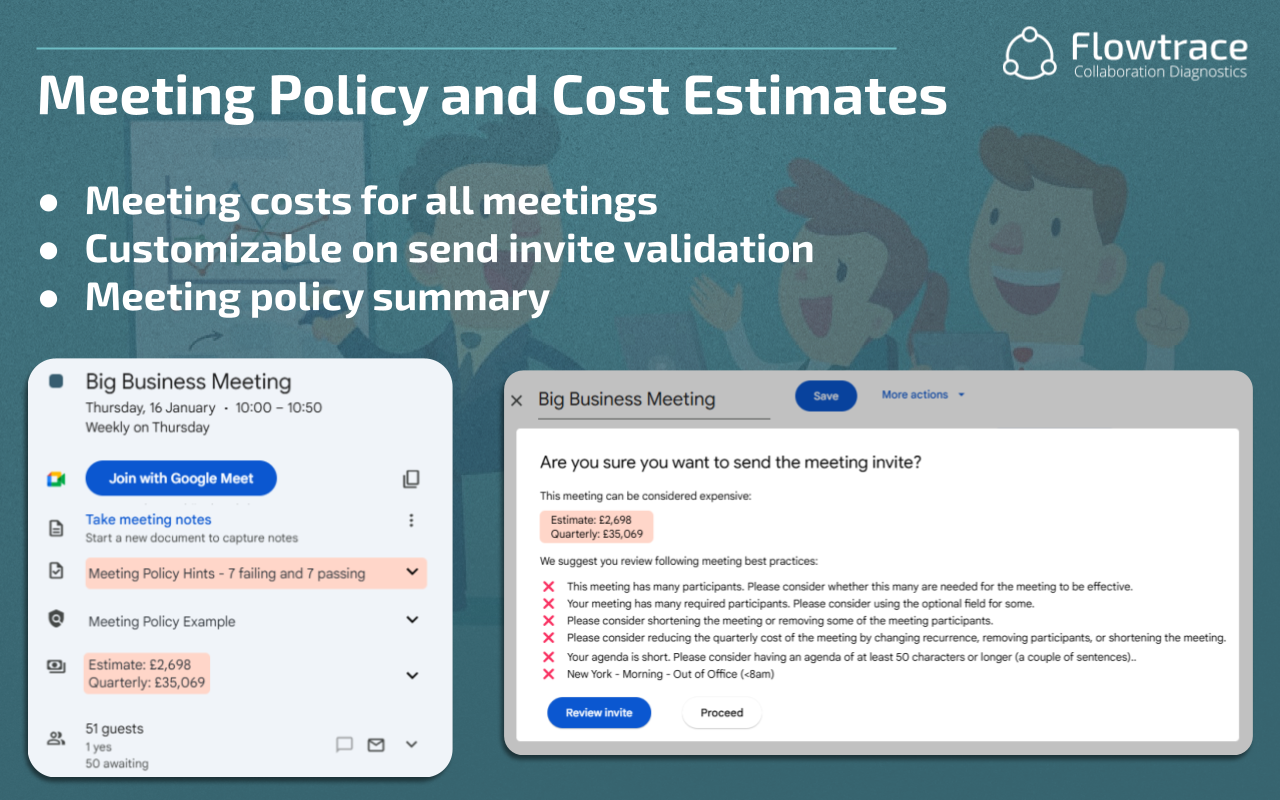
Organizers can see estimated meeting cost while creating or editing invites, including one-off and recurring meetings. Flowtrace also supports invite governance, policy reminders, and configurable cost logic so companies can align the calendar experience with their meeting standards.
This is important because meeting cost tracking should not depend on leaders reviewing dashboards once a quarter. It should influence everyday scheduling behavior. When organizers can see the cost of adding attendees, extending duration, or creating a recurring meeting, they are more likely to make intentional choices.
Meeting cost tracking gives leaders a clearer view of how collaboration consumes organizational capacity. It turns meeting overload from a vague complaint into a measurable operating issue. That matters because the real problem is not meetings themselves. The problem is unmanaged meeting cost, weak attendee discipline, poor agenda standards, and recurring meetings that continue without review.
The practical fix is not a one-time meeting purge. It is ongoing meeting cost tracking, stronger recurring meeting governance, clearer attendee discipline, and better visibility at the point where meetings are created. That is how organizations reduce unnecessary meeting cost without weakening collaboration.
Discover the top calendar analytics tools of 2026 for real-time insights on meeting habits, focus time, and collaboration patterns to enhance...
Discover the top meeting cost tools of 2026 that enhance visibility into meeting expenses, helping teams optimize their time and resources...
Discover the key differences between calendar analytics and meeting analytics, and learn how to improve organizational efficiency and meeting...