The survey result arrives with an uncomfortable pattern. Employees say they have too many meetings. The comments mention interrupted work, repeated discussions, unclear decisions and invites that feel impossible to decline.
Leadership usually feels pressure to respond quickly. Three reactions are common. Defend the meetings because the work is complex. Announce a company-wide reduction target. Or hand the issue to the People team as another engagement action.
None of those responses establishes where the problem sits or what better would look like.
When employees say there are too many meetings, treat the result as a credible operating signal, not a complete diagnosis. Leadership should sponsor the response. Operations should locate the affected work, establish a baseline, run one reversible change and verify that people regain useful capacity without decisions, delivery or coordination getting worse. The People team can protect survey quality and anonymity, but it should not become the default owner of the meeting system.
This is the practical response that sits between listening and a wider meeting culture transformation.
The short version
- Acknowledge the complaint and name who will respond.
- Ask what consequence employees experience, not only how many meetings they attend.
- Pair survey themes with aggregate, privacy-safe calendar patterns.
- Select one comparable meeting family instead of imposing a blanket rule.
- Test one change for a defined period and protect the work outcome.
- Report back with what changed, what happened and what comes next.
In this article
Why “too many meetings” is a signal, not a diagnosis
Employees experience the meeting system as a whole. They see the invite that breaks a focus block, the status call that repeats a written update, the decision that gets reopened and the recurring series that no longer has a clear owner. A survey comment can compress all of that into four words: too many meetings.
The comment is still useful. The 2026 Annual Review of Organizational Psychology and Organizational Behavior describes meetings as several things at once: stressors, communication technology, a place for employee voice and participation, a stage for leadership and power, and an expression of culture and identity. A meeting complaint can therefore point beyond personal preference. It can reveal how the company coordinates work and how much control people feel they have over their time.
Earlier research on organizational meeting orientation found a similar connection. Across two exploratory studies, employees' perceptions of meeting policies, strategic use and overuse were associated with meeting satisfaction, work engagement and intentions to quit. The authors were careful to frame the findings as exploratory and associative. The study does not show that a meeting complaint causes disengagement or attrition. It does show why leaders should not dismiss perceived meeting overuse as harmless noise.
The diagnosis begins by translating a broad complaint into observable work consequences.
| What employees report |
What Operations should inspect |
What not to conclude yet |
| “I cannot get my work done.” |
Back-to-back load, focus-time fragmentation, time-zone reach and role differences |
Every meeting is unnecessary |
| “We discuss the same things again.” |
Reopened decisions, duplicate forums, weak records and unclear decision rights |
The problem is meeting frequency alone |
| “I attend just to stay informed.” |
Documentation, invite expectations, optional attendance and stakeholder visibility |
Everyone should decline more invitations |
| “These meetings are pointless.” |
Purpose, preparation, decision output, follow-through and current ownership |
A short agenda proves the meeting has value |
| “There are too many recurring meetings.” |
Series age, cadence, attendee drift, review dates and changed business context |
Recurring meetings are waste by definition |
| “Meetings keep appearing at short notice.” |
Notice patterns, escalation routes, planning quality and cross-team dependencies |
Employees need better personal time management |
Survey feedback describes lived experience. Calendar metadata helps locate structural patterns. Business evidence shows whether the work is improving. A credible response needs all three.
What leaders should not do
Do not defend the calendar before investigating it
Leaders often know why each meeting was created. Employees experience the combined burden, including meetings that cross functions and reporting lines. Explaining each invite separately does not answer whether the total system still works.
Start by accepting that the reported consequence is real to the people doing the work. You can validate the experience without agreeing that every proposed remedy is correct.
Do not announce an arbitrary reduction target
A target such as “cut meetings by 30%” creates visible movement, but it does not identify which coordination should disappear. Teams may cancel useful forums, compress the same confusion into shorter calls or move work into fragmented chat and follow-up meetings.
Research on the meeting load paradox gives leaders a useful warning. A 2025 Business Horizons field study of 199 full-time employees found initial evidence of an inverted-U relationship: participation, engagement and creative performance increased with meeting load up to a point, then declined. One field study does not establish a universal optimum. It does show why fewer is not automatically better.
The target should be local and paired: reduce a defined burden while protecting a defined work outcome.
Do not make HR the owner of an operating-system problem
People or HR teams may run the survey, code comments, protect anonymity and advise on change communication. Those are important responsibilities. They do not give the function authority to remove a portfolio review, change decision rights or redesign how dependent teams coordinate.
Leadership owns the priority and trade-off. Operations owns the cross-functional response. Meeting owners change the work. HR contributes employee-experience evidence and safeguards.
Do not turn the data into employee surveillance
High meeting load can reflect role design, customer responsibility, managerial span or a temporary delivery period. An individual leaderboard cannot distinguish those contexts and can punish the people who carry the most coordination work.
Analyze teams, meeting families and comparable operating contexts. Use aggregate patterns to find questions worth asking, not to score employee productivity.
The five-stage response
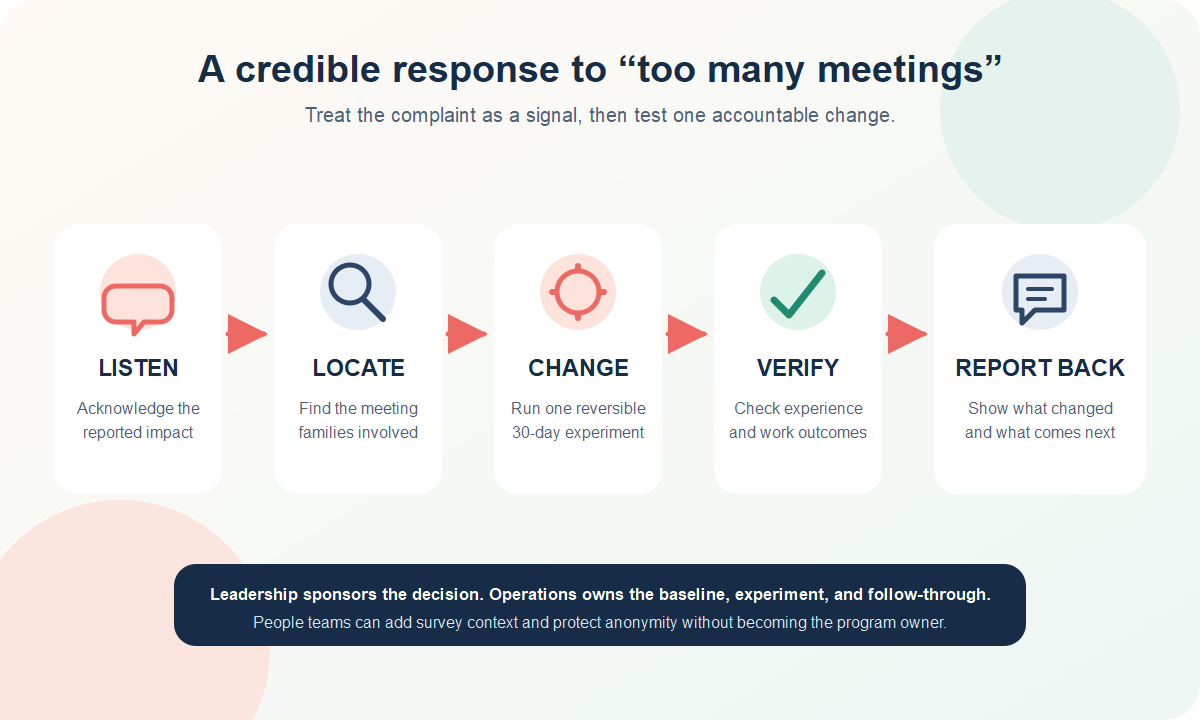
A credible response turns employee feedback into one owned experiment, then reports the result back to the people who raised it.
The response has five stages:
- Listen. Acknowledge the reported impact and preserve the language people used.
- Locate. Find where that experience appears in the work and calendar.
- Change. Test one accountable, reversible intervention.
- Verify. Check both employee experience and operating outcomes.
- Report back. Explain what changed, what happened and what the company will do next.
The last stage matters. A survey followed by silence teaches employees that feedback is collected, not used. A visible response does not need to promise that every request will be accepted. It needs to show that leadership investigated the signal and made a reasoned decision.
Eight steps for leadership and Operations
1. Acknowledge the result and name an executive sponsor
Respond while the survey is still recognizable. State what employees reported, the consequence leadership heard and who will sponsor the response. Avoid promising a number before the baseline exists.
A useful opening is specific: “You told us repeated and overlapping meetings are fragmenting work across Product, Sales and Operations. Our COO will sponsor a 30-day review, and Operations will report the first result by this date.”
That is stronger than “we are committed to improving collaboration.” It names the problem, owner and next checkpoint.
2. Preserve anonymity and the original wording
The People team should confirm the anonymity threshold, reporting groups and handling of open-text comments before data reaches operators. Small teams and distinctive comments can make supposedly anonymous feedback identifiable.
Operations needs themes, affected work and enough context to investigate. It rarely needs raw comments tied to individuals. Keep the original survey wording available so leaders do not soften “meetings stop me doing focused work” into a vague “collaboration opportunity.”
If the feedback mechanism itself needs improvement, use a bounded method for collecting actionable meeting feedback before adding more questions.
3. Define the consequence behind the complaint
Ask employees what the meeting load prevents or makes harder. Useful consequences include:
- focus work repeatedly broken into short intervals
- decisions taking several meetings to close
- the same update being repeated for different audiences
- unclear attendance expectations
- important work happening after normal hours
- missing preparation creating extra discussion
- actions reopening because ownership was not recorded
This converts a sentiment into an operating question. It also separates problems that need fewer meetings from problems that need better meeting design, clearer decisions or stronger follow-through.
The 10 signs of bad meetings can help meeting owners examine a specific session. The current task is broader: find which recurring patterns create the reported experience across teams.
4. Pair the feedback with privacy-safe calendar patterns
Survey results and calendar evidence have different jobs. Survey responses show how people experience the system. Aggregate calendar metadata can show where to look: meeting hours, attendee-hours, recurrence, invite size, duration, notice, time-of-day load and fragmentation.
Research by Yasaman Hosseinkashi and colleagues used embedded post-meeting surveys alongside objective meeting attributes to examine effectiveness and inclusiveness in real-world remote meetings. The study also discusses the limits of predicting subjective experience from objective attributes alone. That is the useful principle for operators: pair subjective and objective evidence, but do not pretend one can replace the other.
A calendar pattern cannot prove that a meeting is wasteful. A comment cannot show how widespread the structural pattern is. Together, they can create a defensible review queue.
5. Select one comparable meeting family
Do not start with every meeting in the company. Choose a group with a shared purpose and enough repetition to observe change, such as regional portfolio reviews, leadership risk forums, customer escalation calls or candidate debriefs.
Recurring series are often a practical place to begin because one ownership decision affects future meetings. In Flowtrace's 2026 meeting statistics work, based on 1,240,880 scheduled meetings from 2025, 48.5% were recurring, or 602,387 meetings. Those figures do not prove that any recurring meeting was unnecessary or ineffective. They show why recurring series deserve deliberate ownership and review.
Use the recurring meeting review guide when the selected series needs a detailed keep, change or stop decision. If the problem is broader meeting quantity, the guide to having fewer meetings without losing alignment covers replacement mechanisms in depth.
6. Define one reversible change and its guardrails
Choose one primary intervention. Change the attendance model, cadence, decision right, preparation rule or follow-through. Avoid redesigning everything at once.
Record three things before the test:
- The calendar burden expected to change, such as attendee-hours or fragmented time.
- The outcome the meeting family must continue to produce, such as decision closure or risk escalation.
- The guardrails that must not deteriorate, such as inclusion, customer response or follow-up workload.
The Meeting Efficiency Guide provides the wider operating model for deciding whether to keep, remove, replace, shorten or improve a meeting.
7. Verify the calendar, the work and the experience
At the end of the test, compare like with like. Did attendee-hours fall? Did the same meeting load appear elsewhere? Did decisions close on time? Did participants regain usable work blocks? Did people outside the core group lose necessary context?
Use a short pulse question that matches the original complaint. If employees said meetings prevented focused work, ask whether the changed meeting family created usable focus time. Do not switch to a general satisfaction score and claim the problem is solved.
Keep the conclusion proportional to the evidence. One 30-day test can justify a decision for that meeting family. It cannot prove a universal company policy.
8. Report back and set the next review date
Close the loop with four facts:
- what employees reported
- what meeting family was examined
- what changed and what the test found
- whether the change will remain, be adjusted or be reversed
If the signal spans several teams, add the next cohort and review date. Once repeated experiments reveal stable rules, move them into a governed meeting policy and reinforce them in the calendar workflow.
A 30-day example
Imagine a growth company whose engagement survey repeatedly mentions “too many meetings.” Follow-up themes point to repeated portfolio discussions, unclear decisions and several functions preparing the same information in different formats.
Operations maps the relevant meeting family. Three regional portfolio forums feed a monthly company review. Senior leaders attend the regional meetings to avoid surprises at the final review. Specialists remain on every invite in case their topic appears. The calendar burden is visible, but cancelling the meetings would remove a genuine risk and investment decision process.
The executive sponsor defines the required outcome: material portfolio risks and investment decisions must reach the right decision-maker with enough evidence, and owners must leave with a recorded decision and next action.
For 30 days, the company tests one redesigned attendance model:
- one accountable owner submits a standard evidence pack for each portfolio area
- the core decision group attends the whole review
- specialists join only for the scheduled item that needs their expertise
- a decision log records the outcome, owner and review date
- an urgent escalation route remains available between reviews
The primary measure is attendee-hours across the meeting family. The outcome measures are decision closure by the required date and reopened decisions. The guardrails are specialist inclusion, risk escalation time and extra follow-up calls. A pulse question asks whether the process still repeats discussion and preparation.
At day 30, leadership has a useful decision even if the result is mixed. If attendee-hours fall and the outcomes hold, keep the attendance model. If specialists lose important context, adjust the distribution of the decision record. If risks wait longer for a decision, reverse the cadence or escalation change.
The point is not to manufacture a success story. It is to respond to the complaint with an inspectable decision.
Who should own the response
Meeting overload crosses reporting lines, tools and workflows. That makes Operations the strongest default program owner in many companies, with leadership providing authority and local meeting owners changing the work.
| Role |
Responsibility in the response |
| Executive sponsor |
Accept the trade-offs, remove organizational barriers and protect necessary coordination |
| Operations |
Define the cohort, establish the baseline, run the experiment and maintain the review cadence |
| Meeting or process owner |
Explain the required outcome, implement the change and maintain the decision record |
| People or HR team |
Protect survey anonymity, preserve employee language and add experience context |
| IT, Security or collaboration-tool owner |
Confirm access, privacy boundaries, integrations and calendar controls |
| Employees |
Explain the work consequence, use the changed process and report displacement or lost context |
The People team remains important. It should guide how feedback is collected and interpreted, especially when response groups are small or trust is weak. It should not be left to negotiate cross-functional decision rights or redesign operational forums without leadership authority.
Operations should also avoid becoming a permanent meeting police function. The aim is to establish evidence, ownership and review rules that meeting owners can sustain.
How Flowtrace supports the response
Flowtrace is a B2B meeting analytics and meeting culture transformation platform. It uses calendar and meeting metadata to show organization-level patterns in meeting load, recurrence, duration, attendance, cost and scheduling behavior. It does not need to record, transcribe or interpret meeting conversations.
That makes Flowtrace useful in three parts of the response:
- Locate the pattern. Aggregate analytics helps Operations identify comparable teams and meeting families with high load, recurrence, attendee reach or fragmentation.
- Measure the change. A baseline and follow-up view show whether the selected calendar burden moved.
- Reinforce the decision. Calendar-side meeting cost and invite validation can help organizers follow agreed rules while scheduling.
Flowtrace does not decide whether a meeting is valuable. Leaders and meeting owners make that judgment with the meeting's purpose, work outcomes and employee feedback. Analytics makes the footprint visible and the change measurable.
The Meeting Analytics Guide explains the measurement model. If you are ready to inspect organization-level meeting patterns, see Flowtrace meeting analytics.
Frequently asked questions
What should leaders do when employees say there are too many meetings?
Acknowledge the signal, name a leadership sponsor and Operations owner, identify the work consequences employees experience, pair that feedback with aggregate calendar patterns, test one reversible change, verify both experience and work outcomes, and report the result back.
Should a company set a meeting reduction target after employee complaints?
Not as the first response. A company-wide target can remove useful coordination or move work into chat, follow-up calls and rework. Set a local target for a comparable meeting family and protect the outcome that the meetings exist to produce.
Who should own the response to meeting overload feedback?
Leadership should sponsor the decision and Operations should usually own the baseline, experiment and review cadence. Meeting owners implement changes. People or HR teams can protect survey anonymity and add employee-experience context without becoming the default program owner.
How can Operations identify which meetings to change?
Combine survey themes with privacy-safe, aggregate calendar patterns such as meeting load, recurrence, attendee-hours, invite size, duration and fragmentation. Use these signals to find a comparable meeting family for review, not to rank employees or declare individual meetings wasteful.
Can Flowtrace support this process without reading meeting content?
Yes. Flowtrace uses calendar and meeting metadata to show organization-level patterns in load, recurrence, duration, attendance, cost and scheduling behavior. It does not need to record, transcribe or interpret meeting conversations.
Give employees a result they can see
The first useful response is not a company-wide meeting target. It is one named owner, one comparable meeting family, one protected outcome and one date when leadership will report back.
That is how a complaint becomes an operating improvement instead of another survey theme. If you need the baseline to run that process, schedule a Flowtrace demonstration.