AI note-takers improve recall, but they cannot replace decision-makers or fix weak meeting design. See where analytics and governance act earlier.
The team has spent 45 minutes working through three options. The trade-offs are clear. Everyone is ready to choose.
Except the person who owns the budget is not in the meeting. They sent an AI note-taker instead.
The bot has captured the conversation. It will produce a tidy summary, extract the actions, and send everything to the absent executive. Nothing has been lost from the record. Yet the meeting cannot reach its intended outcome. The decision is deferred, the executive reads the recap and raises two questions, and another meeting appears in everyone's calendar.
This is the failure mode we miss when we treat meeting documentation as meeting effectiveness.
A note-taker can replace an audience member. It cannot replace a decision role.
I am not arguing that AI note-takers are useless. They solve a real and expensive problem. I am arguing that we need to be much more precise about which problem they solve.
AI note-takers solve a real information problem
If somebody is invited only to stay informed, asking them to attend an hour-long call is usually a poor way to transfer information. A searchable recap can let that person catch up on their own time. It can preserve decisions, surface actions, and reduce the clerical burden on whoever used to write the minutes.
That matters. Microsoft's 2023 Work Trend Index found that only 35% of surveyed workers believed they would be missed in most of their meetings. The same research ranked inefficient meetings as the top reported productivity disruptor and too many meetings third.
There is an obvious opportunity here: stop making information recipients attend merely to collect information.
AI recap research supports that use case, with some important limits. A Microsoft Research study of LLM meeting recaps found that people valued different recap formats, but also encountered missed details, incorrect attribution, and summaries that did not understand what was personally relevant to the reader. It was a small study, so it should not be turned into an industry-wide error rate. It does show that a recap is an interpretation of the conversation, not the conversation's purpose or authority.
For a genuine FYI participant, that may be a reasonable trade. For the person required to approve the budget, resolve the conflict, or contribute essential context, it is a category error.
The meeting did not need another note. It needed the right person
Before an organizer marks someone optional, there is a more basic question:
Is this person here to receive the outcome, or are they required to create it?
Those two roles look similar on a calendar invite. They are completely different in the meeting.
Consider a product and operations review. The team needs to choose whether to delay a launch, reduce scope, or fund temporary support. The budget owner sends a bot because the invite reads like a routine status meeting. The participants share the latest information and debate the choices. But nobody present can authorize the additional spend or accept the commercial risk.
The bot performs perfectly. The meeting still fails.
The root problem is not transcription quality. It is that the organizer classified a required decision role as an information recipient. The organization then used a recap as a substitute for authority. That substitution can produce a costly sequence:
- The first group discusses but cannot decide.
- The absent decision-maker reviews the summary without the full live context.
- New questions reopen part of the discussion.
- The organizer schedules a second meeting with the required people.
- Everyone reconstructs the context before the decision can finally move.
This is not proof that note-takers generally create more meetings. It is a specific operating mechanism. When a bot is sent in place of a role that the meeting needs, easier catch-up can preserve information while increasing decision latency and total meeting time.
Bain's decision-focused meeting guidance makes the underlying point through explicit decision roles: the people required to recommend, agree, provide essential input, perform, and decide are not interchangeable. A meeting does not become smaller or more efficient if a required role disappears. It becomes incomplete.
The meeting record and the meeting system are different jobs
Most AI note-takers use the conversation as their primary unit of work. They join a meeting, capture what was said, and turn it into a more useful record. Broader assistants increasingly help with agendas and preparation too, but their core value still begins with an individual conversation and its information.
An organizational meeting system has a wider unit of work. It asks:
- Which meetings should exist at all?
- Which recurring series have outlived their purpose?
- What outcome is each meeting meant to produce?
- Which roles must be present to produce that outcome?
- Who only needs the result afterward?
- Are organizers giving people enough notice and preparation?
- Did a policy or intervention change the pattern across teams?
These questions begin before the bot joins and continue after the recap is sent.
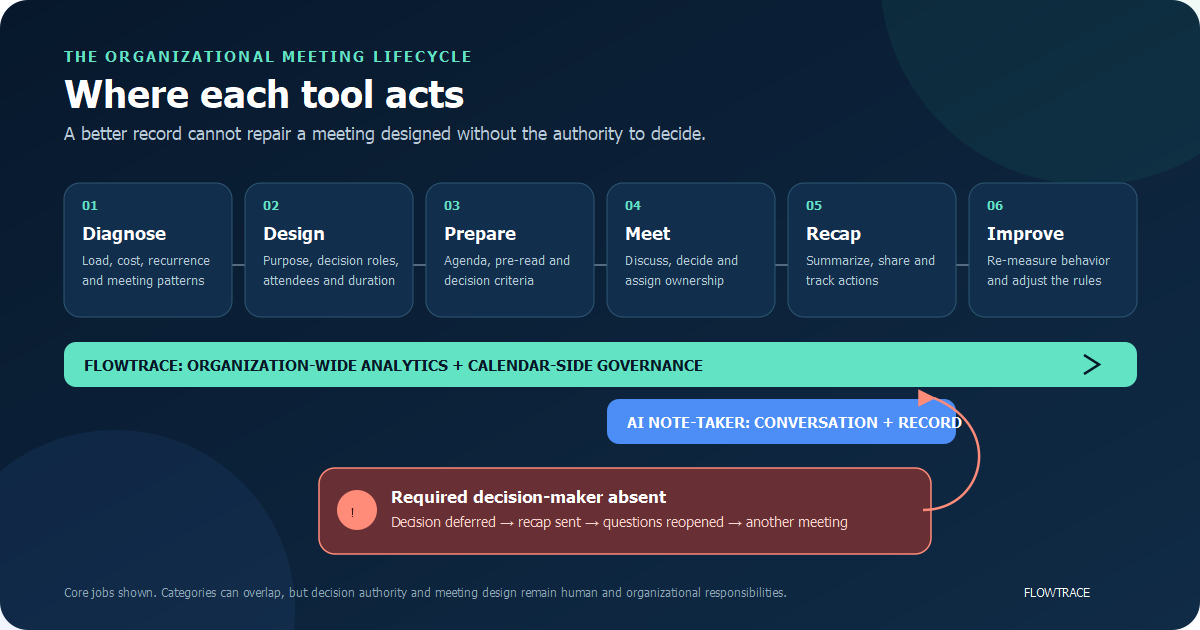
Research on meeting effectiveness points in the same direction. In a large employee survey study, reported meeting effectiveness and inclusiveness were associated with factors across the lifecycle, including pre-meeting communication, agendas, meeting size, participation conditions, and post-meeting summaries. A summary is one useful part of the system. It is not the system.
Where note-taking can mask the real problem
A poor record creates visible pain. People ask what was decided. Actions disappear. Someone spends 20 minutes reconstructing the conversation. A note-taker improves those symptoms quickly, which makes the value easy to see.
Weak meeting design is less visible. It sits in recurring invites nobody reviews, vague titles, short agendas, inflated attendee lists, missing owners, and decisions that require people who were never clearly identified. When the recap becomes better, the organization can feel that the meeting problem has improved even if the same meetings continue to consume the same collective time.
Our own data illustrates how much of the problem exists upstream. In Flowtrace's Meeting Statistics 2026, based on 1,240,880 scheduled meetings from 2025, 33.0% of recurring meetings with invite-size data had seven or more invitees. Among meetings with agenda-length data, 67.4% had fewer than 100 agenda characters. Short agenda text is not the same as no agenda, and those figures should not be treated as universal benchmarks. They are still useful signals of where governance work begins: in the structure of the invite, not the quality of the transcript.
This is why an organization can deploy excellent note-taking software and still hear the same complaints six months later: too many recurring meetings, unclear purpose, the wrong people attending, and decisions that take multiple calls.
The record improved. The meeting portfolio did not.
Use this attendance test before sending the invite
The practical answer is not to invite everyone. It is to distinguish the people needed to create the outcome from the people who only need to receive it.
| Role in the outcome | Attend live? | Can a recap replace attendance? |
|---|---|---|
| Decides or approves | Usually yes | No. The record cannot exercise authority. |
| Recommends or owns the work | Usually yes | Rarely. The meeting may need their judgment and commitment. |
| Provides essential, time-sensitive input | Yes for the relevant decision | Only if the input is complete before the meeting and questions can wait. |
| Performs a clearly assigned action | Sometimes | Often, if ownership and context are unambiguous. |
| Follows or learns | Usually no | Yes. This is the strongest note-taker use case. |
This test should shape the agenda too. If the desired outcome is a decision, name the decision in the invite and verify that the necessary roles are present. If the purpose is an update, ask whether the update should be asynchronous in the first place. Agenda, attendee, and invite rules make those expectations explicit. Calendar agenda validation can reinforce them while the organizer is still able to improve the invite.
And when someone truly is there only for awareness, give them permission to decline. A reliable recap can help break the cycle of meeting FOMO without removing a role the outcome depends on.
The complete operating loop happens around the meeting
The job of meeting analytics and governance is not to compete with the note-taker for the same part of the workflow. It is to manage the parts a meeting record cannot see.
A practical loop looks like this:
- Measure the portfolio. Use organization-wide meeting analytics to find patterns in meeting load, recurrence, duration, attendee reach, notice, and cost. Analyze meeting families and teams, not individual employee behavior.
- Choose the intervention. Decide which meetings to keep, remove, replace, shorten, or improve. The Meeting Efficiency Guide explains that decision model in detail.
- Set meeting rules. Define minimum expectations for purpose, agendas, decision roles, attendee size, duration, recurrence, and review dates. This is meeting governance that works in the calendar, not a policy document employees forget.
- Reinforce the rule at creation. Give organizers context while they are scheduling, when an agenda, attendee list, duration, or recurring pattern can still be changed.
- Use the note-taker where it fits. Capture decisions and actions, and let genuine information recipients catch up asynchronously.
- Re-measure. Check whether meeting load, invite quality, and recurring patterns changed. Then adjust the rule rather than assuming the intervention worked.
One nudge does not guarantee a good meeting. One dashboard does not change behavior. One perfect recap does not prove that the meeting should have existed. The value comes from connecting measurement, rules, calendar-side reinforcement, and review.
That is the layer Flowtrace meeting analytics is built to support. Flowtrace uses calendar and meeting metadata to help organizations understand their meeting system and reinforce better scheduling behavior. It does not record, transcribe, or summarize what people say.
Choose the tool from the problem
If the problem is that people cannot remember what happened, use a note-taker.
If the problem is that optional participants attend only for information, use a recap and let them decline.
If the problem is that meetings lack purpose, carry the wrong participant mix, repeat without review, or fail to reach decisions, work on the meeting system.
The distinction matters because information availability and organizational effectiveness are not the same outcome. You can create a flawless record of an irrelevant meeting. You can also create a flawless record of a meeting that must be repeated because the person able to decide was replaced by a bot.
That is why AI note-takers make meeting analytics and governance more relevant, not less. As documentation gets easier, the harder management question becomes more visible:
Are we recording meetings better, or are we running better meetings?