Company-wide meeting culture is accountable to the CEO and leadership team. See what HR, Operations, IT, managers and local teams own in practice.
When employees say they spend too much time in meetings, I often see the same reflex. The complaint contains the word "culture", so the work is handed to HR.
It sounds sensible. It is usually the wrong starting point.
HR can collect the feedback, help managers change habits and make sure the programme respects employees. But HR cannot decide on its own which product, sales, engineering and executive meetings the business needs. It cannot resolve a conflict where one function wants fewer status meetings while another says those meetings are the only place decisions happen. It cannot change the executive team's calendar without executive authority.
That is the distinction many companies miss:
Company-wide meeting culture is accountable to the CEO and executive leadership team. A capable function can run the programme, but leadership cannot delegate the accountability.
The function that starts, buys or operates the work varies far more than most companies expect. I have seen IT Security, Business Operations, Business IT and vendor management all take leading roles. That variety is real. It does not make meeting culture an ownerless problem.
Why meeting culture is a leadership issue
Meeting culture is not a collection of etiquette preferences. It is the way a company allocates attention, moves information, makes decisions and coordinates work between functions.
A weekly team check-in may belong entirely to one manager. A product launch review involving Product, Engineering, Sales, Marketing, Finance and the CEO does not. Its design affects several departments, carries business trade-offs and consumes time that no single function controls.
The Financial Reporting Council's corporate culture guidance makes a useful distinction. The board establishes and monitors culture, the CEO drives it through the organization, and functions such as HR, risk and internal audit contribute evidence and advice. The guidance covers corporate culture broadly, not meetings specifically, but the accountability pattern travels well.
Meeting science points in the same direction. A 2026 review of thirty years of meeting research treats meetings as communication systems and sites of leadership, power, culture and organizational identity. In other words, meetings do not merely reflect how work gets done. They help determine it.
This is why the CEO sits at the accountability level. Only the CEO and leadership team can consistently do all of the following:
- Change their own executive meeting behaviour.
- Resolve trade-offs between functions.
- Decide which cross-functional forums must exist.
- Allocate capacity to the programme.
- Hold functional leaders to a shared standard.
If the named owner cannot do those things, they administer part of the meeting system. They do not own it.
The route in is inconsistent. The accountability is not
There is no single department that reliably starts or buys meeting-culture work. These three real, anonymised programmes show the range.
A CEO started the work and IT Security ran it
In one company, the CEO initiated the project. Program Management would have been a logical delivery home, but it did not have the capacity. IT Security took on the programme instead.
The pilot focused on project managers. Within that scope, the company identified and cleared 35% of recurring meeting time.
That does not make IT Security the natural owner of meeting culture. It shows something more useful: delivery often follows available capacity, internal trust and the ability to get a pilot moving. The CEO supplied the mandate. IT Security supplied the programme capacity. Project managers supplied a practical test cohort.
A board and CEO asked for change and Business Operations delivered it
In another company, the board and CEO wanted to revamp meeting culture. Business Operations ran the work.
This is closer to the structure people expect. Business Operations already works across functions, understands operating rhythms and can coordinate a strategic meeting management programme. Yet the same boundary applies. Business Operations can build the baseline, organize the work and report progress. It still needs leadership to settle cross-functional disagreements and model the new standard.
A three-bank initiative entered through counsel and Business IT
The third route was different again. Counsel at a three-bank consortium wanted to improve meeting culture across all three banks. Business IT and IT and cloud vendor management handled the purchase and pilot. One bank became the test client.
Here, the person who recognized the problem, the functions that procured the solution and the organization that tested it were not the same. That is normal in complex enterprises. Procurement routes reflect security, vendor, data and contractual responsibilities. They do not answer who can change the operating rhythm across three institutions.
| Where the initiative began | Who ran or bought the work | What the pattern shows |
|---|---|---|
| CEO | IT Security, because Program Management lacked capacity | Programme delivery follows capacity; the executive mandate still matters |
| Board and CEO | Business Operations | Operations is a strong delivery home when leadership supplies authority |
| Consortium-level counsel | Business IT and IT/cloud vendor management; one bank piloted | Initiation, procurement, testing and enterprise accountability can sit in different places |
Trying to explain these programmes through one department would hide how the work actually moves. The stable question is not, "Which department bought the tool?" It is, "Who can make the decisions this change will require?"
Accountability, delivery and adoption are different jobs
The phrase "everyone owns culture" is appealing because everyone does influence it. It is also a poor governance model. Shared participation without named accountability is how a programme becomes a series of workshops with no authority behind them.
A practical ownership model looks like this:
| Layer | Typical role | What they own |
|---|---|---|
| Enterprise accountability | CEO and executive leadership team | Business outcome, executive behaviour, cross-functional trade-offs and final escalation |
| Executive sponsorship | CEO or named executive sponsor | Visible mandate, resources, barriers and leadership communication |
| Programme delivery | Business Operations, Transformation, Chief of Staff, Program Management, IT or another capable lead | Baseline, roadmap, working cadence, deliverables and progress reporting |
| Enablement | People/HR, IT, data, Finance, Communications, Procurement | Employee input, manager support, privacy, integrations, cost context, communication and buying controls |
| Local design | Functional and department leaders | Team rhythms, legitimate exceptions, local outcomes and adoption |
| Daily practice | Managers, meeting organizers and employees | Purpose, attendance, preparation, decisions, follow-through and feedback |
This is also consistent with change-management practice. Prosci's research separates active executive sponsorship from the manager's job of translating change for a team. Both are necessary. They are not interchangeable.
HR should enable the change, not inherit it by default
The argument here is not that HR knows nothing about the business meetings. A good People team often sees the problem first through engagement surveys, manager conversations, burnout signals and retention concerns. It may be the only function with a company-wide view of how employees experience the meeting system.
That is valuable input. It is not enough authority.
HR should normally help define the employee problem, design the listening process, support managers, align incentives and communications, and challenge changes that create surveillance or unfairness. HR may even be the best programme lead in a particular company. But if leadership says "culture belongs to HR" and steps away, HR is left negotiating business coordination one department at a time.
The result is predictable. Each function defends its meetings as essential. Executive meetings remain outside the programme. Local exceptions accumulate. Adoption slows because the function running the work cannot settle the disagreements.
Research on organizational meeting orientation also suggests that meeting experience is shaped by organization-level policies, practices, rewards, strategic use and tolerated overuse. An organizer training course cannot repair a system that still rewards attendance, escalation and constant availability.
Operations can run the programme, but it still needs a mandate
Business Operations, Transformation and Chief of Staff teams are often well placed to run this work. They already connect strategy with execution, work across functions and understand how decisions move through the company.
They also see the downstream symptoms: delivery delays, repeated status meetings, unclear ownership, overloaded managers and teams that cannot protect focus time.
But Operations has a limit too. It can facilitate a decision. It cannot manufacture executive commitment. If leaders continue booking sprawling meetings, tolerate recurring calls that nobody reviews, or exempt their own operating forums, the programme lead becomes a meeting administrator with an impossible brief.
The same applies when IT runs procurement or a pilot. IT should own integrations, access, privacy, security and calendar controls. It should not be expected to decide whether a commercial review, product council or executive committee still earns its place.
Company-wide standards should leave room for local meeting design
CEO-level accountability does not mean identical calendars across the company. A software incident review, a sales pipeline meeting and a bank risk committee have different purposes and constraints.
Leadership should own the small set of rules that protect the whole organization: shared definitions, executive and cross-functional meeting systems, privacy boundaries, review expectations, escalation and the outcomes that matter across departments. The Meeting Policy Guide covers how those rules become practical governance.
Department leaders should own their local meeting types, rhythms and legitimate exceptions. They are closer to the work and know which coordination is necessary.
The boundary appears when a local choice creates a cost elsewhere. An engineering team can redesign its internal stand-up without CEO approval. A product launch forum that pulls six functions into two weekly meetings is no longer a local design choice. The wider leadership team needs to settle that trade-off.
This is also why department-by-department change can delay company-wide adoption. Local pilots are useful. Separate local standards are not, especially when the meetings creating the most friction cross the org chart.
A meeting-culture programme needs deliverables, not committee theatre
Meeting-culture work touches many functions, so companies often respond by creating a large steering group. Everybody has input, the project spends weeks aligning terminology, and very little changes in the calendar.
Organize the work around deliverables instead:
- Define the business problem and combine employee input with a meeting culture audit.
- Name the accountable executive, programme lead, decision rights and intended outcomes.
- Map the executive, cross-functional, departmental and recurring meetings in scope.
- Set a small number of enterprise guardrails and privacy boundaries.
- Let functions adapt the model around real delivery work.
- Reinforce the better choices where meetings are created and reviewed.
- Measure capacity, focus, decision flow and displacement, then adjust.
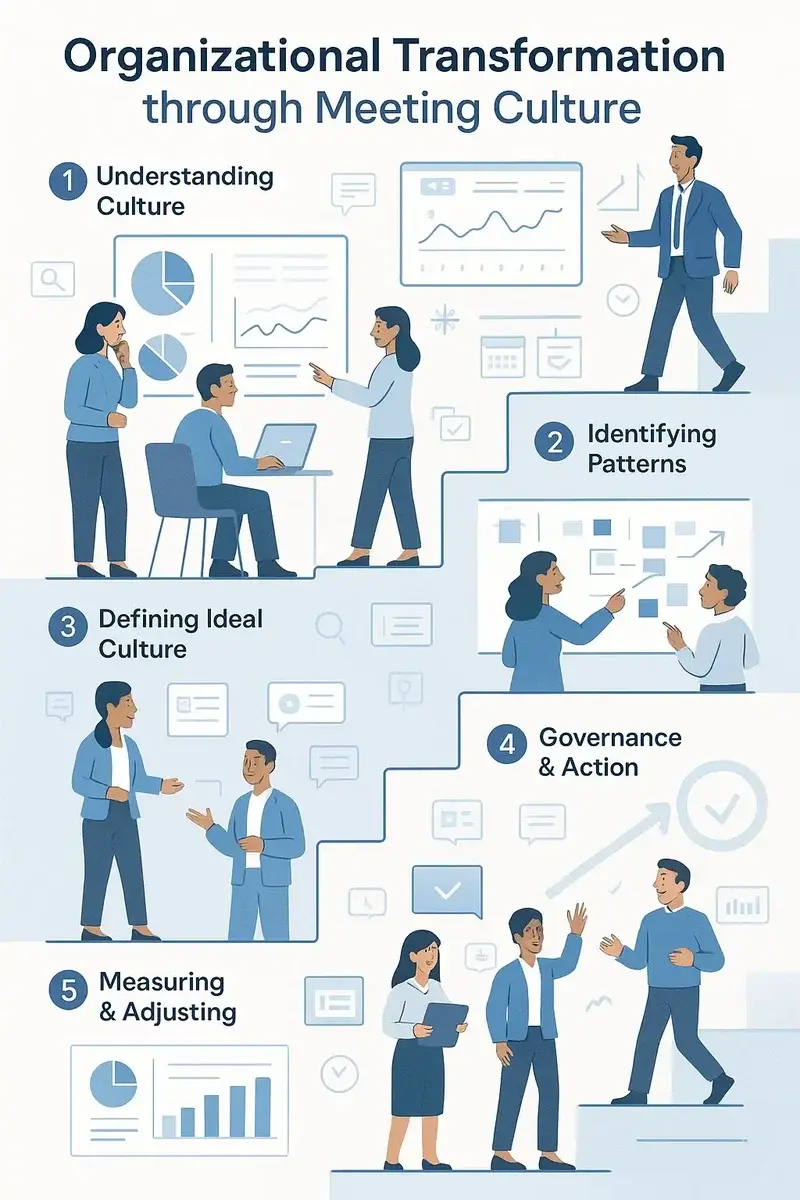
The Meeting Culture Guide explains the wider change system, while the practical guide on how to change company meeting culture goes deeper into programme execution. Ownership comes first because every later step depends on someone being able to settle the trade-offs.
Test whether the named owner has real authority
Before assigning the work, ask five questions:
- Can this person change the executive team's own meetings?
- Can they resolve a disagreement between two functional leaders?
- Can they protect programme capacity and fund the necessary work?
- Can they decide when a local exception creates a company-wide cost?
- Can they hold leaders accountable when the old behaviour returns?
If the answer is no, that person may still be an excellent programme lead. They are not the accountable owner.
This distinction prevents a common conundrum. The team with the best expertise may lack capacity. The team with capacity may lack authority. The person who bought the platform may own neither the business problem nor the transformation. A clear executive mandate lets those roles work together without pretending they are the same job.
Use data to govern the change, not to replace leadership
Leadership accountability does not mean making the programme subjective. The starting point should combine employee experience with meeting analytics: meeting load, recurring time, attendee patterns, notice, cost, focus time and changes after an intervention.
The point is not to monitor individuals or read meeting content. It is to give leaders and programme teams a shared view of the system, so they can decide what to keep, remove, replace, shorten or improve and then see whether the change held.
That is the role of Flowtrace meeting culture transformation and the wider meeting analytics platform. Flowtrace uses calendar and meeting metadata to establish a baseline, support governance and verify change. It does not decide which meetings the business needs. Leadership still has to do that work.
Delegate the programme, not the accountability
The practical first step is not to ask which department should own the culture project. Ask the leadership team to name three things clearly:
- The executive who is accountable for the company-wide outcome.
- The programme lead with enough capacity and mandate to deliver the work.
- The decisions that stay local and the decisions that must be settled across functions.
The programme may then run through HR, Business Operations, Transformation, IT Security or a route nobody would predict from the org chart. That is fine.
What is not fine is asking one of those teams to change how the company coordinates while the leadership team keeps the same meetings, incentives and unresolved decision rights.
You can delegate the work. You cannot delegate the example.
