Time Is Ltd and Flowtrace both turn meeting and collaboration metadata into organisation-level insight. The more useful question is what happens after a company finds the problem.
Choose Flowtrace when the objective is to measure meeting behaviour, apply company meeting policies inside Google Calendar or Outlook, and verify whether those interventions worked. Consider Time Is Ltd when the requirement extends beyond meetings into broader communication and collaboration mapping.
The products overlap on meeting load, focus time, agenda signals, team-level reporting, privacy-minded metadata analysis, and change measurement. Flowtrace is more focused on the meeting system itself, including meeting cost, recurring meeting analysis, configurable policy rules, invite validation, employee feedback, and remeasurement.
Key takeaways
- Both products analyse meeting and calendar metadata across teams and departments.
- Both document meeting-culture insights, focus-time analysis, organisational views, and ways to measure change.
- Flowtrace adds configurable meeting policies, invite validation, cost guidance, and reminders inside Google Calendar and Outlook.
- Time Is Ltd says leaders can develop policies from its analytics. Its public product material does not document equivalent calendar-side rule enforcement.
- Time Is Ltd covers wider communication and collaboration patterns. Flowtrace goes deeper into meeting governance and the full baseline, intervention, and remeasurement loop.
- Time Is Ltd does not publish current pricing on the pages reviewed. Flowtrace publishes Free at £0, Team at £1, and Scale at £2 per user per month, plus custom Enterprise pricing.
Disclosure and comparison basis: Flowtrace publishes this article and is one of the products discussed. We compared Time Is Ltd's current Analytics, Employee Engagement Analytics, integrations, privacy, and terms pages with current Flowtrace product and pricing information. Last verified: 29 July 2026.
In this comparison
What should buyers compare?
A meeting analytics platform should do more than count meetings. It should help a company see the behaviour, decide what needs to change, put that decision into practice, and measure the result.
For this comparison, that means looking at four connected jobs:
- Diagnose: meeting load, recurring commitments, cost, agenda use, notice time, focus time, punctuality, participation, and trends.
- Direct: dashboards and views that help leaders, managers, teams, and employees understand the pattern.
- Intervene: company policies, invite validation, reminders, cost guidance, and employee feedback.
- Remeasure: compare the baseline with later behaviour and calculate whether the intervention produced a useful change.
Time Is Ltd and Flowtrace overlap most strongly in diagnosis and organisational reporting. Time Is Ltd's Analytics page documents meeting overload, agenda use, cancellations, after-hours meetings, focus time, and company, department, and team views. Flowtrace covers the same core buyer problem through a dedicated meeting analytics platform, then connects it to meeting policy and calendar-side action.
Time Is Ltd vs Flowtrace
✓ means the products offer a broadly comparable capability. An empty cell means no equivalent was found. Text highlights a material difference.
| Decision criterion |
Time Is Ltd |
Flowtrace |
| Organisation-wide meeting analytics |
✓ |
✓ |
| Meeting load and duration |
✓ |
✓ |
| Recurring meeting analysis |
Meeting-frequency analysis |
Recurring-meeting audits and trends |
| Agenda analysis |
✓ |
✓ |
| Focus-time analysis |
✓ |
✓ |
| Notice-time analysis |
|
✓ |
| Meeting cost analytics |
Collaboration time and cost breakdowns |
Meeting, series, team, and organisation costs |
| Cost shown while scheduling |
|
Google Calendar and Outlook |
| Punctuality and participation |
|
Punctuality and participation, where integrated |
| Meeting audit and review |
Identifies inefficient meetings |
Meeting audits and recurring-meeting reviews |
| Employee meeting feedback |
|
Feedback, NPS, and effectiveness surveys |
| Meeting policy |
|
Configurable policies with adoption reporting |
| Invite validation and policy reminders |
|
Rules and prompts while scheduling |
| Policy remeasurement |
|
Baseline, intervention, adoption, outcome, and ROI |
| Google and Microsoft calendar data |
✓ |
✓ |
| Metadata-first privacy |
✓ |
✓ |
| Public pricing |
Quote required |
Free £0, Team £1/user/month, Scale £2/user/month, Enterprise custom |
The differences that affect the decision
1. The analytics overlap is real
Time Is Ltd is not merely a communication-mapping product. Its public Analytics material covers inefficient meetings, meeting overload, agendas, cancellations, after-hours meetings, multitasking, and focus time. It also presents results at company, department, and team level.
Flowtrace covers those core meeting questions and adds more meeting-specific depth. That includes recurring meeting audits, notice time, attendee and response patterns, meeting cost by series or team, agenda depth, calendar fragmentation, employee feedback, and punctuality or participation data where the connected platform supports it.
For a buyer, this is the fair starting point: both can identify meeting problems. Flowtrace is designed around a more complete meeting-management workflow.
2. Calendar policy rules change the comparison
Time Is Ltd says its analytics help leadership teams identify inefficient meetings, promote good practice, and develop policies. Its role-based views can track the impact of organisational changes. Those are valid policy and measurement capabilities.
What its public product pages do not document is the enforcement layer between policy and the next meeting invitation.
Flowtrace lets administrators turn a company meeting policy into configurable checks inside Google Calendar and Outlook. Depending on the policy, organisers can be prompted about:
- missing or insufficient agendas;
- meeting duration;
- attendee limits;
- recurrence;
- notice time;
- buffers and focus-time protection;
- meeting-cost thresholds.
The distinction is practical. A dashboard can tell a leader that too many large recurring meetings lack agendas. A calendar policy rule can address the same behaviour when the organiser is about to create another one.
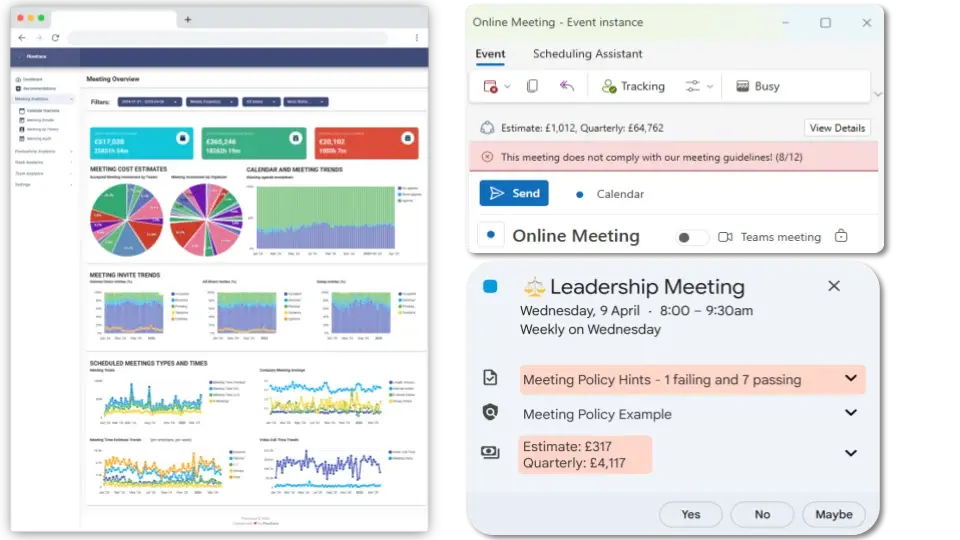
This does not make every warning a hard block, nor should it. The useful outcome is consistent guidance at the point of decision, followed by data showing whether organisers changed their behaviour.
3. Meeting cost is useful before the commitment
Time Is Ltd's Employee Engagement Analytics page documents time allocation and cost breakdowns for company collaboration. That gives leaders a financial view of how time is being used.
Flowtrace supports meeting cost visibility in Google Calendar and meeting cost visibility in Outlook. The organiser can see the cost of attendee time before making the commitment.
The estimate is a prompt, not a judgement about whether the meeting is valuable. Its purpose is to make combined attendee time visible while the size, duration, and recurrence can still be changed. Flowtrace can then track the same cost patterns in organisational analytics.
4. Measurement needs an intervention to measure
Both products describe change measurement. Time Is Ltd documents role-based views for tracking organisational initiatives and a recommendation engine for improving meeting, communication, and collaboration culture.
Flowtrace makes the intervention more explicit:
- Establish the baseline for meeting load, cost, recurrence, agendas, notice time, focus time, and other relevant measures.
- Configure a small number of meeting policy rules or targeted interventions.
- Put prompts, validation, or cost guidance into the scheduling workflow.
- Measure policy adoption and changes in the original meeting pattern.
- Refine the rule if it creates friction without producing a useful outcome.
That closed loop is the central Flowtrace advantage. The product is intended to help a company act on the analytics rather than hand the dashboard to managers and hope that meeting habits change.
5. Both take a metadata-first approach
Time Is Ltd's privacy documentation says it aggregates metadata, analyses results mainly at team or department level, and does not analyse message content. It also documents optional PII masking and EU or US data regions.
Flowtrace also works from collaboration and calendar metadata. It does not need to record, transcribe, summarise, or interpret meeting conversations. Buyers evaluating either platform should still review permissions, aggregation thresholds, employee access, retention, residency, and the precise views enabled for each role.
6. Integrations and pricing
Time Is Ltd documents integrations with Google Workspace, Office 365, Slack, Zoom, Salesforce, Webex, and Tableau. Flowtrace's meeting workflow centres on Google Calendar, Microsoft Outlook, and connected meeting platforms, with wider collaboration integrations available by plan and use case.
Time Is Ltd does not publish a current price on the product pages reviewed. A buyer needs a quote and should confirm included integrations, data history, implementation, support, and minimum contract terms.
Flowtrace publishes its pricing: Free at £0 per user per month, Team at £1, Scale at £2, and custom Enterprise pricing. Plans are not automatically equivalent, but public pricing gives buyers a clear starting point for a focused meeting analytics deployment.
What does Time Is Ltd do beyond meetings?
Time Is Ltd covers a wider digital-workplace problem. Its public material includes communication analysis, focus time, employee experience, sales collaboration, and Sociomaps that visualise relationships between teams or departments. Those capabilities may matter when the programme is broader than meeting management.
They do not need to define a meeting analytics purchase. If the buyer's immediate problem is meeting cost, recurring-meeting load, agenda discipline, or enforcing scheduling standards, the relevant comparison is whether each product can diagnose and change those meeting behaviours.
When Time Is Ltd may fit
Consider Time Is Ltd when:
- Sociomaps and organisational relationship visualisation are central requirements;
- the programme covers meetings, communication, employee experience, sales relationships, and wider collaboration;
- a People, Operations, or change team wants broad digital-workplace analysis;
- calendar-side meeting cost and invite validation are not required.
When Flowtrace is the better fit
Choose Flowtrace when:
- meeting overload is the main problem;
- leaders need a focused meeting analytics framework;
- company meeting policies need to become visible rules in the scheduling workflow;
- meeting cost should be visible before invitations are sent;
- the organisation wants agenda, attendee, duration, recurrence, notice-time, or cost rules in the calendar;
- Google Calendar and Outlook are behaviour-change surfaces, not only data sources;
- transparent entry pricing matters;
- the company wants to measure whether meeting behaviour changed after an intervention;
- a metadata-first alternative to meeting recording and transcription is preferred.
The choice becomes clearer when you name the first behaviour that must change. If the answer is broad, such as understanding communication across the digital workplace, Time Is Ltd may fit. If it is specific, such as reducing oversized recurring meetings without agendas, Flowtrace is built closer to the operating decision.
Frequently asked questions
What is the main difference between Time Is Ltd and Flowtrace?
Both products analyse meeting and collaboration metadata. Time Is Ltd also maps wider communication and organisational patterns. Flowtrace focuses on meeting analytics and adds calendar-side policy rules, invite validation, cost guidance, feedback, and remeasurement.
Does Time Is Ltd enforce meeting policies in the calendar?
Time Is Ltd says its analytics help leaders develop policies and promote better practice. The public product material reviewed in July 2026 did not document configurable invite validation or calendar-side policy rules equivalent to Flowtrace.
Does Time Is Ltd publish pricing?
We did not find current public Time Is Ltd pricing on the product pages reviewed. Buyers should request a current quote and confirm included integrations, history, implementation, support, and minimum contract terms.
Does Flowtrace record or transcribe meetings?
No. Flowtrace uses a metadata-first approach and does not need to record, transcribe, summarise, or interpret meeting conversations to provide meeting analytics.
The practical answer
For a meeting analytics buyer, Flowtrace is the stronger fit when analysis must lead to governed action. It measures the meeting system, applies company rules where meetings are created, and shows whether behaviour changed.
If that is the buying problem, book a Flowtrace demo and bring one real meeting policy or recurring-meeting issue as the test case.
