Meetings
Calendar Analytics vs Meeting Analytics
Discover the key differences between calendar analytics and meeting analytics, and learn how to improve organizational efficiency and meeting...
Learn effective strategies to prevent meetings from becoming too large by defining outcomes, refining agendas, and ensuring the right attendees are present.
Large meetings are not always a problem. Some sessions need broad participation, especially when leaders are communicating strategy, running a workshop, or aligning several teams around a major change. The problem starts when ordinary decision meetings, project check-ins, and recurring syncs grow beyond the number of people needed to produce a clear outcome.
Knowing how to prevent meetings from getting too big is therefore less about enforcing a universal attendee limit and more about improving meeting design. Leaders need to understand why invites expand, which roles actually need to be present, and how to keep stakeholders informed without pulling them into every live conversation.
This matters because meeting size is one of the easiest forms of calendar waste to overlook. A 30-minute meeting with ten people does not feel excessive when it appears as a single event on the calendar. In operating terms, however, it consumes five hours of collective time before preparation, context switching, or follow-up work are included.

Meetings usually become too large because the purpose is unclear. When the organizer is unsure who owns the decision, who has the right context, or who will be affected by the outcome, the safer choice is to invite more people. That feels inclusive, but it often creates a meeting where only a few people contribute while everyone else loses focus time.
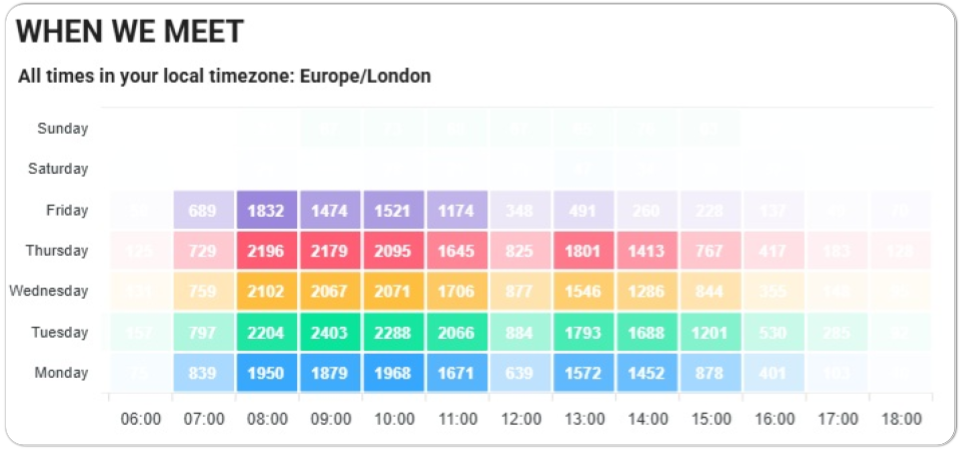
There is also evidence that meeting attendee lists expand when work becomes more distributed and coordination becomes harder. Harvard Business School researchers found that, during the early shift to remote work, people attended 13% more meetings and the number of people invited to each meeting rose by two, or 14%. That points to a common operating pattern: when visibility is weak, organizations often add more people to meetings instead of improving how context and decisions are shared.
Flowtrace data shows a similar reason to watch meeting size closely. Employees spend about 392 hours per year in meetings, roughly 10 full workweeks. When invite lists expand without clear roles, the cost is not just one larger meeting. It is repeated attendee-hours being pulled away from focused work, execution, and decision follow-through.
That does not mean every meeting should be small. It means attendee count should match the purpose. Decision meetings need the people who can make or materially shape the decision. Update meetings need a better async path. Stakeholders who only need the outcome should receive notes, a decision log, or a written summary rather than being added to the live call.
The simplest way to prevent oversized meetings is to define the outcome before adding attendees. A meeting invite should not begin with “who should be included?” It should begin with “what needs to be decided, resolved, reviewed, or created?”
Once the outcome is clear, the attendee list becomes easier to manage. Required attendees are the people who can make the decision, contribute essential context, or unblock the work. Optional attendees may have useful input, but that input can often be collected before the meeting. Informed stakeholders need the conclusion, not necessarily the live discussion.
This distinction keeps transparency intact while reducing meeting load. People are not excluded from the work. They are moved into the right communication path for their role.
A practical attendee filter looks like this:
If someone does not fit one of those roles, they probably do not need to attend live.
Weak agendas are one of the main reasons meetings become too large. When the agenda is vague, attendees cannot tell whether they are required or simply being copied into a discussion. That uncertainty leads to bloated invites and passive attendance.
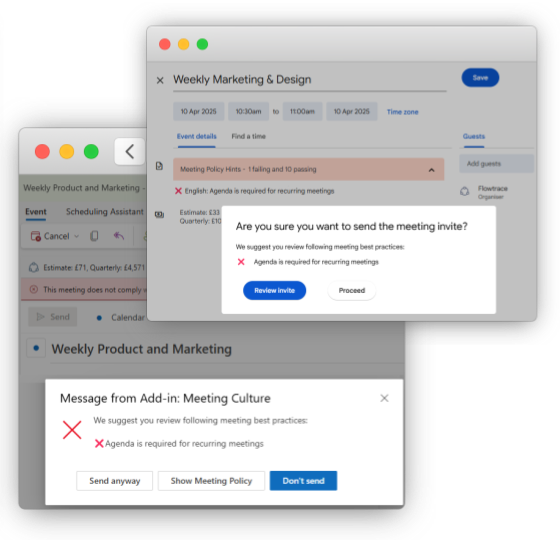
Flowtrace data shows that 60% of one-off meetings lack a structured agenda. That is a direct attendee discipline problem. Without a clear agenda, the organizer has no firm basis for deciding who needs to be there, and invitees have no clear basis for declining.
A useful agenda does not need to be long, but it does need to make the meeting’s purpose visible. It should state the decision or topic, the expected outcome, the preparation required, and the role of the attendees. This helps prevent meetings from becoming too large because every invite is tied to a reason.
For example, “Project sync” invites tend to expand because the purpose is broad. “Decide launch owner for customer migration plan” creates a much clearer attendee boundary. The first title invites anyone connected to the project. The second points to the people who can make or inform the decision.
Many large meetings are update meetings disguised as working sessions. Teams bring everyone together because they want visibility, but the meeting itself does not require live collaboration. This is where meeting size becomes a symptom of weak async habits.
Updates are usually better handled through written summaries, dashboards, project pages, or short recorded walkthroughs. Live meetings should be reserved for decisions, trade-offs, conflict resolution, and complex problem-solving. When leaders make that distinction clear, fewer people need to attend, and the people who do attend have a stronger reason to be there.
Microsoft’s 2025 Work Trend Index describes the modern problem as communication “sprawl,” with large meetings of 65 or more attendees becoming the fastest-growing meeting type. Microsoft connects this to increasingly complex cross-functional coordination, where employees are pulled into more communication streams to keep work moving.
For leaders, the lesson is direct: visibility cannot depend entirely on attendance. If every stakeholder needs to join every discussion to stay informed, the operating system is too dependent on meetings.
Recurring meetings are especially likely to become too large because they grow quietly. A weekly sync may start with five people, then add a stakeholder, a new manager, a cross-functional partner, and two observers. Six months later, the meeting has doubled in size, but nobody has reviewed whether the original purpose still applies.
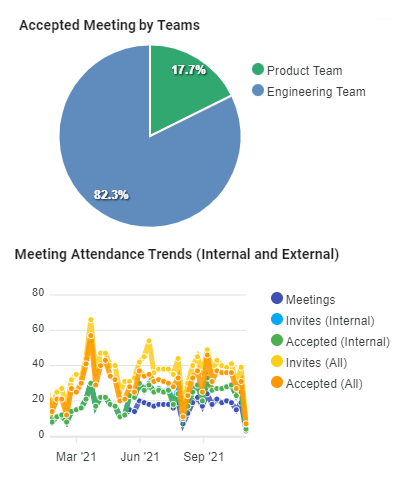
Our data shows that recurring meetings make up 48% of all meetings. Our dataset also shows that 92.4% of meetings do not have an end date set on the calendar. When recurring meetings lack review points, attendee lists can expand without anyone being forced to ask whether the meeting still earns its place.
This is why recurring meeting governance matters. Every recurring meeting should have an owner, a purpose, a review date, and a clear attendee standard. Meetings with seven or more attendees should be reviewed regularly, especially if they lack an agenda or have no documented outcomes.
The review does not need to be complex. Leaders can ask:
This is one of the most practical ways to prevent large meetings from becoming a permanent part of the operating rhythm.
Organizations often focus on the number of meetings, but attendee load is just as important. A team may not have many meetings in total, but if those meetings regularly involve too many people, the cost still compounds.
Our data shows that 64% of meetings have six or fewer participants. That suggests many meetings are already relatively small. The problem is not always company-wide meeting size; it is the concentration of larger meetings in certain teams, recurring forums, or cross-functional processes.
This is where meeting analytics helps. Leaders should track average meeting size, meetings with seven or more attendees, attendee-hours by team, recurring meetings without agendas, and meetings where attendance has grown over time. These metrics show whether oversized meetings are isolated exceptions or part of a wider collaboration pattern.
The financial and productivity impact can be significant. Flowtrace data shows that removing two attendees from a 30-minute meeting saves one full-time employee day per 100 meetings. That is not a theoretical efficiency gain. It is a measurable reduction in time spent attending conversations where people may not need to be present.
Large meetings persist when employees feel unable to question invitations. People attend because they do not want to appear disengaged, miss context, or signal that another team’s work is not important. Over time, that behavior normalizes passive attendance.
Leaders need to make responsible declining part of meeting culture. That does not mean people should ignore meetings casually. It means invitees should be able to ask what role they are expected to play, offer input asynchronously, or request the notes when their attendance is not necessary.
This works best when meeting owners provide enough context in the invite. A clear agenda gives employees the information they need to decide whether they should attend. Without that context, declining feels risky. With it, declining becomes a normal part of calendar discipline.
Cross-functional work often creates large meetings because every team wants representation. The mistake is inviting every person who might have a stake in the work. A better approach is to assign clear representatives.
One person can gather input from their function before the meeting, participate in the live discussion, and share the outcome afterward. This keeps the meeting small enough to make progress while still giving teams a voice in the process.
This is especially useful for project reviews, planning sessions, customer escalations, and operational decision meetings. The representative model prevents bloated attendee lists without cutting teams out of decisions that affect them.
The goal is not to eliminate large meetings. Some meetings are designed for scale. Company all-hands meetings, department briefings, training sessions, and major change communications may need many attendees. In those cases, the meeting should be designed as a broadcast, briefing, or structured Q&A rather than a collaborative working session.
The issue is when large-format behavior leaks into ordinary team operations. A 50-person all-hands is not the same problem as a 14-person project decision meeting where only three people speak. Leaders should judge meeting size against meeting purpose, not against a single universal number.
The best way to prevent meetings from getting too big is to make attendee discipline part of how work is coordinated. Every meeting should have a clear purpose, a defined owner, a structured agenda, and a reason for each person to attend live.
Meeting analytics makes this easier to manage at scale. By measuring attendee count, recurring meeting growth, agenda quality, and attendee-hours, leaders can see where collaboration is becoming unnecessarily heavy. The outcome is not just smaller meetings. It is clearer ownership, better decisions, stronger focus time, and a meeting culture where live time is used with more care.
Discover the key differences between calendar analytics and meeting analytics, and learn how to improve organizational efficiency and meeting...
Discover how to cut company meeting time by redesigning workflows, implementing async updates, and ensuring meetings are purposeful and...
Combat meeting FOMO by establishing clear decision systems, enforcing agenda rules, and promoting async updates to enhance productivity and reduce...