Meeting problems are often obvious in day-to-day work, but much harder to define clearly.
Teams say they are spending too much time in meetings. Focus time disappears. Decisions take longer than they should. Recurring meetings stay on the calendar because nobody wants to challenge them. One-off meetings appear with little notice and no real structure. The result is not just frustration. It is a pattern of work that makes execution harder than it needs to be.
That is why meeting health matters.
At Flowtrace, we use meeting health as a broader concept than attendance, duration, or frequency alone. A healthy meeting environment is one where meetings are well prepared, proportionate to the work, run with discipline, and followed by clear outcomes. It is also one where meetings do not quietly overload the calendar and crowd out focus time.
This matters because meetings consume far more of the workweek than many teams realize. In our dataset, employees spend about 392 hours per year in meetings, which is roughly 10 full workweeks. Our 2025 meeting analysis covered 1.3 million real meetings and 1.75 million hours of meeting time, which gives a useful view of how meeting habits play out at scale.
The challenge is not just volume. It is quality and overload happening at the same time. In our data, 35% of meetings are created within 24 hours of their start time, 60% of one-off meetings lack a structured agenda, and 92.4% of all meetings do not have an end date set on the calendar. Each of those patterns creates drag in a different way. Together, they point to a broader meeting health issue.
This is where a meeting health audit becomes useful.
Rather than treating meetings as a vague culture issue, a meeting health audit gives leaders a structured way to review how meetings are designed, how they run, and whether they are still worth the time they consume. It also creates a clearer bridge between the broad meeting metrics you track across the organization and the more specific meeting culture signals that show where overload is building.

What Meeting Health Actually Means
Meeting health is the overall condition of how meetings function across a team or company.
That includes two sides of the same problem.
The first is meeting quality. Are meetings prepared well, run well, and producing useful outcomes?
The second is meeting overload. Even if a meeting is well run on its own, too many meetings, too many recurring series, too much fragmentation, and too little focus time can still create an unhealthy system.
This distinction matters. A single weekly team meeting might be perfectly fine in isolation. But if it sits alongside many other recurring sessions, arrives with weak preparation, and pushes important work into evenings or Fridays, it becomes part of a wider health problem.
External research points to the same conclusion. Microsoft reports that 68% of people say they do not have enough uninterrupted focus time during the workday, and that inefficient meetings are the number one productivity disruptor in its Work Trend Index findings.
That is why meeting health should be audited as a system, not judged one meeting at a time.
The Flowtrace Meeting Health Audit Framework
The simplest way to audit meeting health is to assess it across five points:
- Preparation
- Meeting design
- Execution
- Outcomes
- Workload impact
These five points give you a balanced view. Together, they answer a practical question: are our meetings helping work move forward without creating unnecessary drag?
1. Preparation
The first sign of healthy meetings is whether they are prepared properly before they begin.
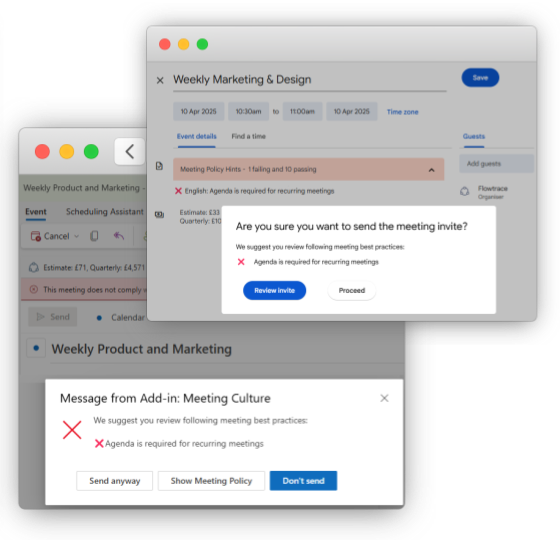
This means the organizer has defined the purpose clearly, added enough agenda structure for attendees to prepare, invited the right people, and given enough notice for the meeting to be useful.
Preparation matters because many meeting problems start before the call begins. In our data, 60% of one-off meetings lack a structured agenda, which is one of the clearest indicators that meeting quality often breaks down at the planning stage rather than in the meeting itself.
When auditing preparation, ask:
- Was the purpose of the meeting clear in advance?
- Was there an agenda or expected outcome?
- Were pre-reads or background materials shared when needed?
- Were the right people invited, rather than a padded attendee list?
- Was the meeting scheduled with enough notice to prepare properly?
A meeting can still happen without these things. It is just less likely to be healthy.
2. Meeting design
A healthy meeting is also designed in a way that fits the job it needs to do.
This includes the meeting’s length, size, recurrence pattern, and position in the workday. It also includes whether the meeting should exist at all in its current form.
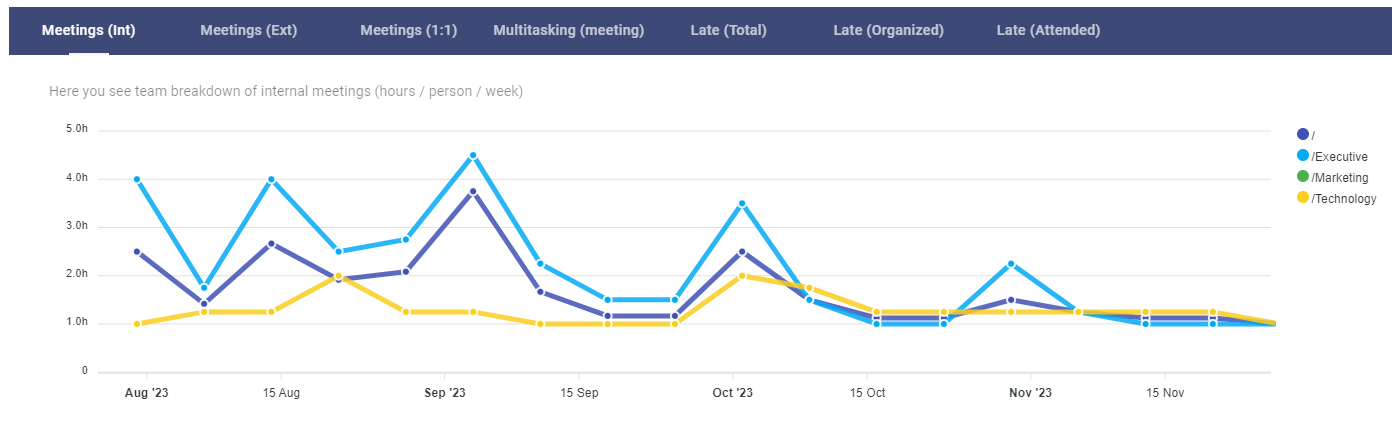
Good meeting design is usually the result of a few practical choices: shorter default durations, smaller attendee groups, recurring meetings with an end date or review point, and enough space between meetings to prevent the day from becoming a chain of back-to-back calls.
In our data, 64% of meetings have six or fewer participants, 48% of meetings are recurring, and the median meeting duration is 35 minutes. Those are healthy signals in some respects, but they need context. A small meeting can still be unnecessary. A short recurring meeting can still quietly consume a large share of the week if it never gets reviewed.
When auditing meeting design, ask:
- Is the meeting appropriately sized for its purpose?
- Is the duration deliberate, or just a calendar default?
- Is this meeting recurring because it creates value, or because it has always existed?
- Does it have an end date or review point?
- Could this be handled asynchronously or absorbed into another forum?
This is also where overload begins to show up. A badly designed meeting does not just waste its own slot. It often creates follow-up meetings, rescheduling, and context switching around it.
3. Execution
Execution is about how the meeting actually runs.
A healthy meeting starts on time, follows the intended structure, keeps discussion proportionate to the goal, and makes it easy for the right people to contribute. It does not drift endlessly, overrun for avoidable reasons, or spend half its time re-establishing what the meeting is for.
In our current data, the average join lag is 24 seconds, and 84% of meetings begin within the first minute. That is a strong signal that punctuality can be improved and measured, and that disciplined starts matter more than teams sometimes assume.
When auditing execution, ask:
- Did the meeting start close to on time?
- Did it stay within the intended structure?
- Did the right people contribute?
- Was discussion focused on the stated objective?
- Did the meeting end when it was supposed to?
Execution is where poor design becomes visible. If a meeting repeatedly runs over, starts late, or relies on side discussions to do the real work, that is usually a signal that something upstream needs to change.
4. Outcomes
A meeting is not healthy just because it felt useful in the moment.
Healthy meetings produce outcomes. That may be a decision, an action plan, a clear prioritization call, an escalation, or another concrete next step. The key point is that the meeting leaves behind movement, not just discussion.
This is one of the most important parts of the audit because it is where quality becomes visible after the meeting ends. In our guidance on reducing meeting fatigue, we recommend tracking outcome tagging and a simple hit-rate metric, meaning the share of meetings that achieved their stated outcome. We also recommend a lightweight two-question pulse after key meetings: Was this meeting necessary? and Did we achieve the agenda outcomes?
When auditing outcomes, ask:
- Did the meeting end with a clear decision, action, or next step?
- Was ownership assigned?
- Was there a due date or follow-up expectation?
- Did the meeting achieve what the agenda said it was supposed to achieve?
- Would attendees say the meeting was necessary in hindsight?
This is where a lot of teams discover that they are measuring time without measuring usefulness.
5. Workload impact
The final dimension is what turns this into a true meeting health audit rather than a basic meeting checklist.

A meeting can be well prepared, well designed, and well run, but still contribute to an unhealthy calendar if it adds to overload. This is why workload impact needs to be part of the framework.
Workload impact includes recurring meeting creep, back-to-back scheduling, fragmentation of focus time, and the broader cost of meetings on the rest of the workday. This is also where meeting health connects directly to employee energy and execution capacity.
Microsoft’s research shows that 68% of people say they do not have enough uninterrupted focus time, and its 2025 workday analysis found that 50% of all meetings take place between 9–11 am and 1–3 pm, which are key productivity windows for many workers.
We advise using 25- and 50-minute default durations, enforcing minimum buffers, adding two no-meeting blocks per person per week, and reviewing recurring series on a regular cadence rather than treating them as permanent calendar fixtures.
When auditing workload impact, ask:
- Is this meeting contributing to back-to-back density?
- Is it taking place in already overloaded collaboration hours?
- Is it replacing focus time that the team needs for execution?
- Is it one of many recurring meetings with no clear review point?
- Is the value of the meeting proportionate to the time it consumes?
This is the part of meeting health that gets missed when teams only audit individual sessions and never look at the calendar as a system.
For a broader view of the org-wide patterns behind overload, see our guide to meeting culture metrics.
A Simple Meeting Health Scoring System
If you want to make the audit more consistent, turn it into a score.
A practical model is to score each of the five dimensions out of 20 points, giving you a total Meeting Health Score out of 100.
Example scoring model
Preparation — 20 points
- Clear purpose
- Agenda present
- Right attendees
- Enough notice
Meeting design — 20 points
- Sensible length
- Sensible size
- Recurrence justified
- End date or review point in place
Execution — 20 points
- Starts on time
- Stays on track
- Discussion stays focused
- Ends on time
Outcomes — 20 points
- Decision or action captured
- Clear owner
- Follow-up date
- Attendees agree objectives were met
Workload impact — 20 points
- Does not create avoidable back-to-backs
- Does not crowd out critical focus time
- Proportionate to value
- Fits the wider calendar rhythm
You do not need to over-engineer this. The point is not to create a perfect mathematical model. The point is to create a repeatable way to tell the difference between healthy, watch-list, and unhealthy meetings.
A simple interpretation could look like this:
- 80–100: healthy
- 60–79: workable but needs attention
- below 60: unhealthy and likely worth redesigning, resizing, or retiring
This framework works especially well for recurring meeting audits, because it forces teams to judge a meeting by current value rather than historical habit.
How to run the audit in practice
The easiest way to run a meeting health audit is at three levels.
1. Audit a single meeting
Use this when a specific meeting is clearly underperforming or causing frustration.
2. Audit a recurring series
Use this when a weekly or biweekly meeting has become part of the furniture and nobody is sure whether it still creates enough value.
3. Audit a team or department
Use this when the problem feels bigger than one meeting and you need to understand where quality and overload are combining.
For most organizations, the recurring-series audit is the most valuable place to start. In our data, 92.4% of meetings do not have an end date set, which means recurring meetings can continue indefinitely unless someone deliberately reviews them.
A simple review decision works well here:
- Keep if the meeting is healthy and still needed
- Resize if it needs fewer people, less time, or a lower frequency
- Retire if it no longer justifies the calendar space
That one decision model often creates more progress than trying to optimize everything at once.
What Strong Meeting Health Looks Like
Strong meeting health does not mean a calendar with very few meetings.
It means meetings are proportionate, deliberate, and connected to outcomes. Organizers think about purpose before they schedule. Invite lists stay tighter. Recurring sessions are reviewed instead of assumed. Focus time is treated as part of the operating system, not as an optional bonus if meetings happen to leave any room for it.
In our recent data, there are positive signals in that direction. Many teams are already operating with shorter meetings, leaner participant lists, and more punctual starts. At the same time, the audit still matters because structural risks remain, especially around agenda quality, short-notice scheduling, and recurring meetings that continue without review.
That is why meeting health is a useful concept. It captures both the quality of individual meetings and the cumulative load they place on the rest of work.
Using Flowtrace to Improve Meeting Health
We use meeting health as a practical way to move from vague complaints to measurable patterns.
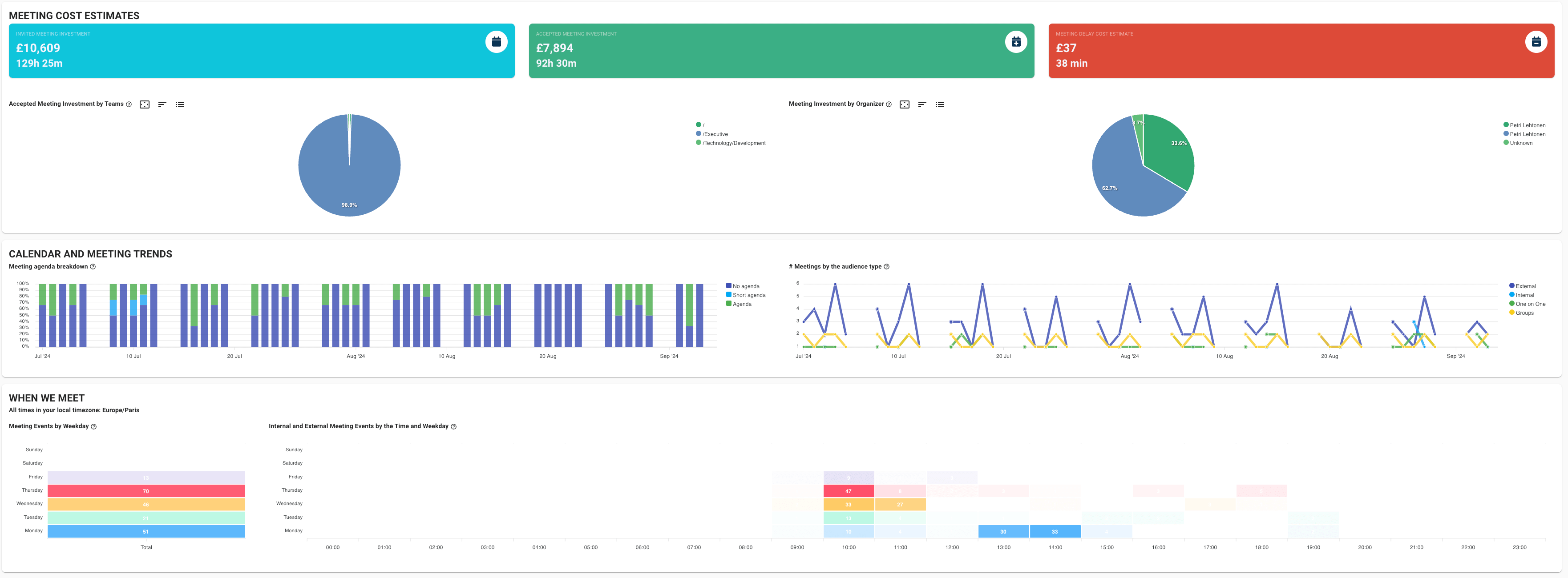
Instead of relying on general feedback like “we meet too much” or “our meetings are not productive,” teams can look at concrete signals: agenda discipline, meeting load, recurring share, back-to-back density, punctuality, focus-time loss, attendee design, and outcome hit-rate. That makes it easier to see where meeting quality is slipping and where overload is building.
It also makes change easier to manage. In our guidance on meeting fatigue, we recommend a light operating cadence: weekly checks for obvious scheduling issues, monthly reviews of top time sinks and outcome hit-rates, and quarterly recurring-series audits plus a simple meeting health scorecard. That kind of rhythm improves meeting health without turning the fix into another heavy process.
Meeting health improves when visibility, rules, and review points work together. Once those are in place, teams do not have to rely on constant reminders. The system starts to support better behavior by default.
Final Thoughts
Meeting health is a more useful standard than simply asking whether people like meetings.
It tells you whether meetings are prepared well, designed well, run well, and proportionate to the work they interrupt. It also helps you see when calendar overload is no longer just an annoyance and has become a real operational constraint.
That is the real value of a meeting health audit.
It gives you a practical way to score what is happening now, identify which meetings need intervention, and improve the meeting system without guessing.
And for most teams, that is the shift that matters most. Not more discussion about meetings. Better visibility into which ones are healthy, which ones are draining the calendar, and what to do next.