A meeting cost plugin puts an estimated time and financial commitment inside the calendar invite while the invite can still be changed. Add or remove attendees, shorten the slot, change the recurrence, and the estimate responds before the organizer sends the meeting.
Flowtrace provides two native versions: a Google Calendar extension and a Microsoft Outlook add-in. Their core features are the same. Both provide meeting-cost estimates, recurring cost visibility, configurable alerts, meeting policy reminders, invite validation, central deployment, and a route into organization-level meeting analytics. You do not need to choose between two different product packages. You choose the version that belongs in your calendar.
There is one functional difference. Google Calendar can show the cost when someone views an incoming meeting invitation. Outlook shows meeting cost in compose or edit mode for the organizer, or for someone else who can edit the meeting. It does not show the estimate to an attendee simply viewing an incoming invitation.
From January through June 2026, Flowtrace calendar extensions displayed meeting-cost estimates 11,073,171 times. These were display events, not unique meetings, because the same calendar event can be opened more than once. The scale matters because cost visibility is most useful when it appears during an ordinary scheduling decision, not only in a report after the meeting has happened.
Using Google Calendar? Get the Flowtrace extension from the Chrome Web Store. Using Microsoft Outlook? Get the Flowtrace add-in from Microsoft Marketplace.
What both Flowtrace meeting cost plugins do
The term “plugin” is useful shorthand, but the native formats differ. Google Calendar uses a Chrome extension. Outlook uses an Office add-in. Once installed, both support the same scheduling job: make the commitment visible to the person who can still change it.
Show cost while the invite is being built
The estimate updates as the organizer changes the people, time, recurrence, or other relevant invite details. This turns a vague sense that a meeting may be expensive into a concrete prompt.
The number is not a verdict. A customer workshop, incident review, or board decision can be expensive and still earn the investment. The useful question is whether the purpose requires that duration, recurrence, and group of people.
Expose the recurring commitment
A weekly meeting can look harmless when the calendar shows only its next occurrence. Both Flowtrace tools can show the wider cost of the series, helping the organizer see what the recurrence commits over time.
That does not mean every recurring meeting should be cancelled. It means the series is easier to review before another quarter of invitations is created. If the purpose is still useful but the cadence is wrong, review the recurring meeting rather than treating cancellation as the only option.
Reinforce meeting policy before send
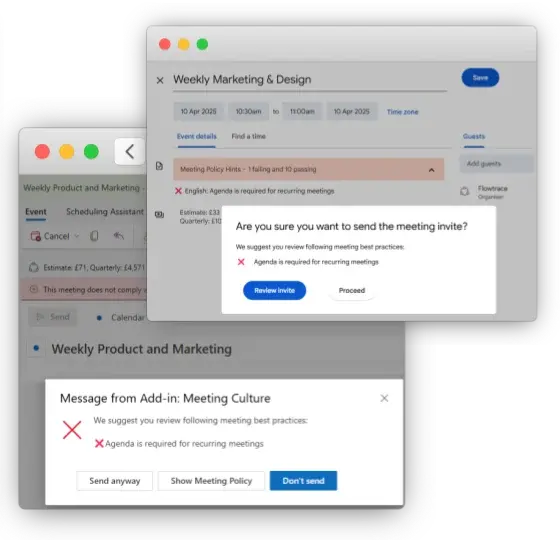
Managed customers can place meeting policy reminders and validation rules inside the invite workflow. A rule might ask the organizer to review a missing agenda, a large attendee list, an unusually long meeting, a meeting-free period, or a costly recurring series.
These prompts support judgment. They do not need to turn the calendar into a rigid approval system. In Outlook, for example, the organizer can review the warning and still send a legitimate exception. The same principle applies in Google Calendar: reinforce the policy where scheduling happens and leave room for work that genuinely needs a different shape.
For the wider governance model, including ownership and rule design, use the Meeting Policy Guide. For the agenda-specific mechanism, see how agenda validation works before an invite is sent.
Connect scheduling prompts to meeting analytics
An individual cost meter can change one invite. A managed rollout can connect calendar-side prompts to organization-level meeting analytics, where leaders can review cost, recurrence, attendee patterns, team differences, and changes over time.
That creates a practical loop: identify a costly pattern, configure a useful prompt, observe how organizers respond, and verify whether the meeting pattern changes. Flowtrace does this from calendar and meeting metadata. It does not need to record or transcribe the conversation in the meeting.
What changes between Google Calendar and Outlook?
The products are deliberately aligned. The useful comparison is about where each version lives and who can see the estimate, not a long feature grid.
| Practical question |
Google Calendar |
Microsoft Outlook |
| What is installed? |
Chrome extension for Google Calendar |
Office add-in for Outlook |
| Who sees cost while creating or editing? |
Organizer or another user editing the event |
Organizer or another user with permission to edit the event |
| Can cost appear when viewing an incoming invite? |
Yes |
Not by default |
| Where does validation appear? |
In the Google Calendar event and review flow |
In the Outlook side panel and send-time review flow |
| How is it deployed centrally? |
Managed Google Workspace and Chrome deployment |
Microsoft 365 integrated app assigned to users or groups |
Cost estimates, recurring visibility, configurable policy, validation hints, alert thresholds, organization settings, and the Flowtrace analytics connection are shared capabilities. The table is intentionally short because the underlying product job is the same.
How the meeting cost estimate works
The estimate begins with the meeting duration and the number or cost profile of the people involved. Configuration can add assumptions such as working hours, salary or role averages, currency, and time padding for the surrounding coordination cost. A recurring meeting also carries a series estimate, which makes the effect of cadence visible.
Changing the invite should therefore change the estimate. Shortening a 60-minute slot to 45 minutes reduces the scheduled commitment. Removing someone who only needs the decision afterwards reduces attendee time. Changing a weekly meeting to monthly can have a larger effect than negotiating a few minutes from one occurrence.
The estimate remains an estimate. It prices the capacity committed to the meeting using a consistent model. It does not prove that the capacity was wasted, and reducing scheduled capacity is not automatically a cash saving. The Meeting Cost Guide explains how to interpret meeting cost, value, released capacity, and avoidable waste without mixing them together. If you only need to price one meeting manually, use the meeting cost calculator.
See meeting cost and policy in Google Calendar
This short product video shows the Google Calendar experience. It demonstrates cost visibility and meeting policy guidance in the Google interface; the Outlook version uses its own native add-in interface.
In Google Calendar, Flowtrace can show meeting-cost estimates in the calendar view as well as create and edit views. That includes viewing an incoming meeting invitation. During create or edit, the organizer can also see policy hints and, when configured, a review dialog before saving or sending an invite that breaches a rule or cost threshold.
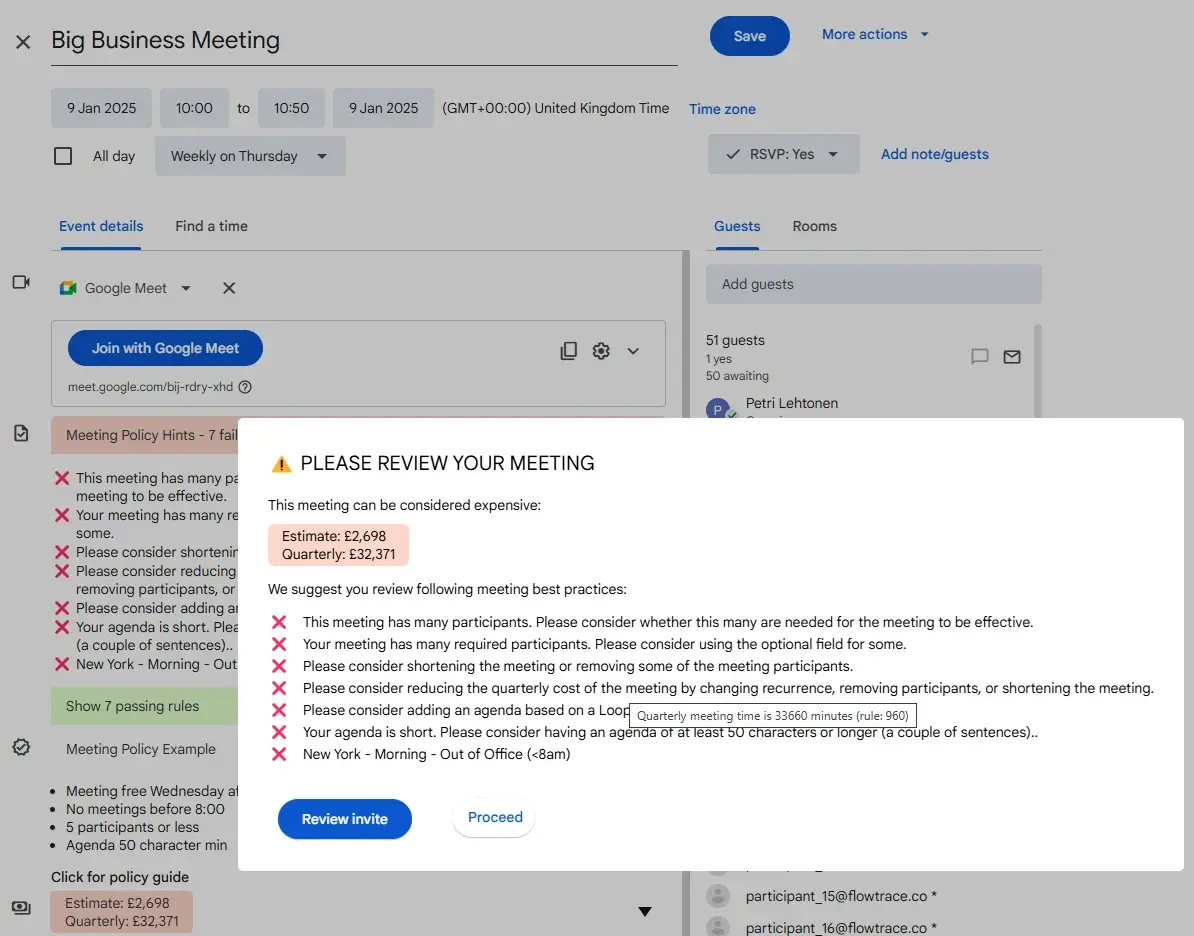
For an individual test, install Meeting Cost for Google Calendar from the Chrome Web Store. For company settings, central deployment, and managed policy, review the Google Calendar deployment options.

See meeting cost and policy in Outlook
The Outlook add-in displays the meeting estimate while the organizer creates or edits the meeting. It can update when the organizer changes the time, recurrence, attachments, or people involved. Managed configuration can add company cost assumptions, cost thresholds, policy text, dynamic hints, and a review prompt when the organizer sends the invite.
The incoming-invite boundary is important: Outlook does not show the cost to an attendee who is simply viewing an invitation. The estimate is available to the organizer or another person who can edit the meeting. This reflects where the Outlook add-in can support a scheduling decision.
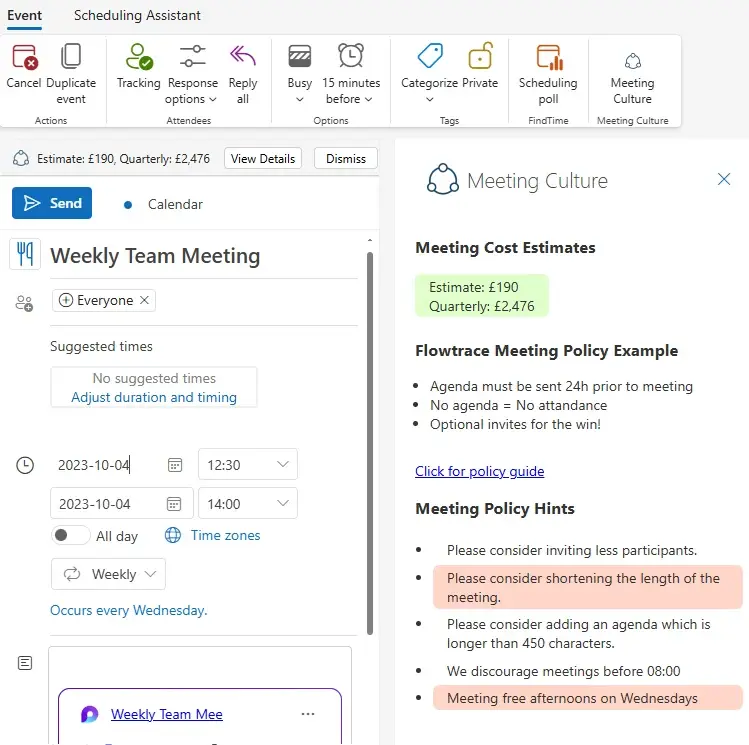
For an individual test, install Meeting Cost for Outlook from Microsoft Marketplace. For central deployment and managed configuration, review the Outlook deployment options.

Choose an individual test or a managed rollout
The right starting point depends on the decision you need to make.
| Starting point |
What it proves |
What it does not provide |
| Individual store installation |
Whether cost visibility is useful in the organizer's normal calendar workflow |
Shared company assumptions, custom policy, central deployment, or organization-wide analytics |
| Small managed pilot |
Whether configured costs and rules change scheduling behavior for a defined group |
Evidence that the same settings will create same change to every team |
| Organization rollout |
Consistent cost assumptions, calendar guidance, deployment, and measurement across selected users or groups |
A guarantee that every expensive meeting is unnecessary or that every team needs identical rules |
For Google Calendar, the Flowtrace help documentation explains individual and organization-wide installation. For Outlook, Microsoft recommends the Integrated apps portal for centrally deploying and managing Office add-ins, including assignment to users and groups.
A pilot should test a real decision, not merely confirm that the extension appears. Choose one group with a clear meeting-cost problem, agree the estimate assumptions, configure a small number of understandable rules, and observe whether organizers make sensible changes. A rule that creates noise will be ignored, however accurate the calculation may be.
Run one meeting-cost policy across Google and Outlook
A company using both Google Workspace and Microsoft 365 still needs two native deployments. It does not need two conflicting meeting-cost policies.
Start by agreeing the shared operating choices:
- Define the currency, cost basis, working hours, and any time padding used in estimates.
- Decide which rules should be common, such as agenda presence, attendee limits, meeting length, expensive recurrence, or meeting-free periods.
- Select pilot groups in each calendar environment and check that the prompts make sense in both interfaces.
- Keep legitimate exceptions possible. The purpose is to improve organizer judgment, not to stop necessary work.
- Review changes in cost, recurrence, attendance, and rule responses through Flowtrace meeting analytics.
The interface differs, but the management question stays consistent: did showing the commitment while the invite was editable lead to a better scheduling choice?
What should an organizer do with the estimate?
An estimate is useful when it leads to a specific question. Before sending the invite, the organizer can check:
- Does the meeting need everyone invited, or can some people receive the decision afterwards?
- Does the purpose need the full scheduled duration?
- Should this repeat at the current frequency?
- Does the invite give people enough purpose or agenda context to use the time well?
- Is there a less costly way to distribute information while keeping a meeting for the decision or discussion?
The lowest-cost calendar is not the goal. The goal is to make the cost visible early enough to protect meetings that earn the investment and change the ones that do not.
Frequently asked questions
Do the Flowtrace Google Calendar and Outlook plugins have the same features?
Yes. They share the same core meeting-cost, recurring-estimate, policy, invite-validation, configuration, alerting, deployment, and analytics model. The main functional difference is that Google Calendar can show cost when someone views an incoming invite, while Outlook shows it to the organizer or someone who can edit the meeting.
Can attendees see the estimated meeting cost?
In Google Calendar, the extension can show the cost when a user views an incoming meeting invitation. In Outlook, the estimate appears in compose or edit mode for the organizer or another person with permission to edit the meeting, not for an attendee simply viewing an incoming invitation.
Do Flowtrace meeting rules block organizers from sending an invite?
No. Configured rules can prompt an organizer to review the cost, agenda, attendee count, timing, or another policy condition before sending. The organizer can still proceed when the meeting is a legitimate exception.
Can an individual try the meeting cost calculator?
Yes. Individuals can install the appropriate Google Calendar extension or Outlook add-in from the official store. Company-wide settings, custom rules, central deployment, and organization-level analytics require the managed Flowtrace setup.
Does Flowtrace record or transcribe meetings?
No. Flowtrace uses calendar invite information and configuration needed for cost estimates, policy checks, and meeting analytics. It does not record, transcribe, summarize, or interpret the conversation in a meeting.
If you want to test one calendar, use the platform links above. If you need shared cost assumptions, meeting rules, central deployment, and measurement across Google Calendar, Outlook, or both, book a meeting-cost rollout demo.
