Meetings are easy to count. What is harder is knowing whether they are actually working.
A calendar full of meetings can look productive from the outside. People attend. Time is blocked. Discussions happen. But none of that proves a meeting was effective. Effective meetings create clarity, move decisions forward, and lead to action. Ineffective meetings consume time, create confusion, and push real work further into the day.
That distinction matters more than ever. In Flowtrace’s analysis of 1.3 million meetings and 1.75 million hours of meeting time, employees spent about 392 hours per year in meetings. That is roughly 10 full workweeks. When that much time is already committed, companies cannot afford to assess meetings based on instinct alone.
This is where meeting effectiveness metrics become useful.
If you want a broader view of the KPIs teams should track, see our guide to meeting metrics.
The goal is not to build a giant dashboard for the sake of it. The goal is to answer a simple question: did this meeting justify the time it took from everyone involved?
At Flowtrace, we see the same pattern across many teams. Meeting problems are often diagnosed too late. A recurring meeting stays on the calendar because nobody challenges it. A one-off meeting gets booked with little notice and no structure. Too many people are invited. The session starts late, runs over, and ends without clear ownership. On paper, the meeting happened. In practice, very little moved forward.
That is why assessing meeting effectiveness needs to go beyond surface metrics like attendance or frequency. You need to look at what happened before the meeting, what happened during it, and what happened after it.
This guide breaks meeting effectiveness into those three stages. That gives leaders a more practical way to judge meeting quality and improve it over time.

What Meeting Effectiveness Actually Means
Meeting effectiveness is the extent to which a meeting helps a team make progress with the least necessary cost in time, attention, and coordination.
That means an effective meeting usually does four things well:
- It has a clear purpose before it starts
- It uses time well while it is happening
- It ends with clear outcomes
- It leads to follow-through after the meeting
A meeting can fail at any one of those stages.
A meeting with a strong topic but weak preparation can drift. A meeting with good discussion but no decision can feel useful while creating no momentum. A meeting with clear decisions but poor follow-up can still become wasted time.
This is why companies need a more comprehensive assessment framework. If you only look at attendance, you miss structure. If you only look at cost, you miss outcomes. If you only look at whether people liked the meeting, you miss whether it actually moved work forward.
The better approach is to assess meetings in sequence.
1. Assess Effectiveness Before the Meeting Starts
The first test of an effective meeting is whether it should happen in the first place.
A surprising amount of meeting waste starts before anyone joins the call. The invite is vague. The agenda is missing. The right people are not identified. The meeting is scheduled with little notice, which forces reactive calendar changes and fragments the workday.
Agenda presence and clarity
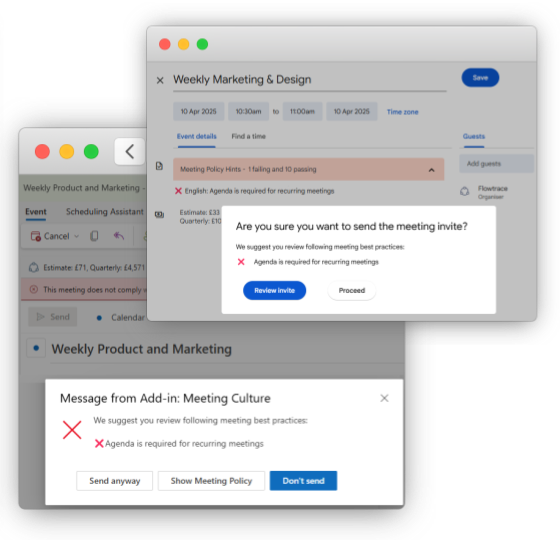
A meeting without an agenda is often a signal that the organizer has not fully defined the purpose of the session.
That does not mean every meeting needs a long document. It means attendees should know why the meeting exists, what will be covered, and what kind of outcome is expected. Without that structure, participants are more likely to arrive unprepared, the discussion is more likely to drift, and the meeting is more likely to end without direction.
This remains one of the clearest gaps in meeting quality. Flowtrace’s meeting data found that 60% of one-off meetings lacked a structured agenda. Looking back at prior-year patterns, agenda discipline was also weak in recurring meetings, where 64% lacked a clear plan.
That matters because poor preparation tends to show up later as poor outcomes. In most companies, ineffective meetings do not begin as a speaking problem. They begin as a planning problem.
Invite quality and attendee fit
One of the most practical ways to assess meeting effectiveness is to look at who was invited and whether that list made sense for the purpose of the meeting.
The more people you invite, the more expensive the meeting becomes. But cost is only part of it. Oversized meetings also tend to weaken participation, slow decisions, and blur ownership.
Flowtrace’s data shows a healthier default in many teams, with 64% of meetings involving six or fewer participants and only 8% going beyond ten. That is useful because it reinforces a basic truth about effective meetings: smaller groups usually lead to clearer discussion and faster decisions.
When assessing a meeting before it happens, ask:
- Were the decision-makers included?
- Were key contributors included?
- Were optional attendees truly optional?
- Could any invitees have received the output asynchronously instead?
If the attendee list is inflated before the meeting starts, the meeting has already become less effective.
Scheduling notice and planning quality
Another strong indicator of meeting effectiveness is how far in advance the meeting was scheduled.
Short-notice scheduling is not always wrong. Some urgent discussions need to happen quickly. But when a large share of meetings are booked within a few hours or within the same day, it often signals reactive coordination rather than deliberate planning.
Flowtrace found that 35% of meetings are created within 24 hours of their start time, while only 8% are booked more than a week in advance. That points to a more agile but also more interruption-prone meeting environment.
This is where leaders need to be careful. Speed is not the same as effectiveness. A meeting booked quickly may solve a real problem. But if fast scheduling becomes the norm, focus time gets squeezed out and employees start operating in constant response mode.
Planned investment
A final pre-meeting test is simple: is the expected value of this meeting high enough to justify the cost?
This is where meeting investment metrics become useful. Estimate the cost of the meeting based on duration, attendee count, and approximate compensation. Then compare that expected investment against the purpose of the session.
At Flowtrace, one of the clearest proof points here is practical rather than abstract: removing just two attendees from a 30-minute meeting saves the equivalent of one full-time employee day per 100 meetings.
That is why effective meetings tend to be designed, not defaulted. The best organizers think about cost before the meeting starts, not after it becomes a pattern.
2. Assess Effectiveness While the Meeting is Happening
A meeting can be well planned and still fail in execution.
This second stage is about how the meeting runs in real time. Does it start promptly? Does it stay focused? Are the right people participating? Does the meeting use the time it was given well?
Start-time discipline
Punctuality sounds basic, but it is one of the strongest signs of meeting discipline.
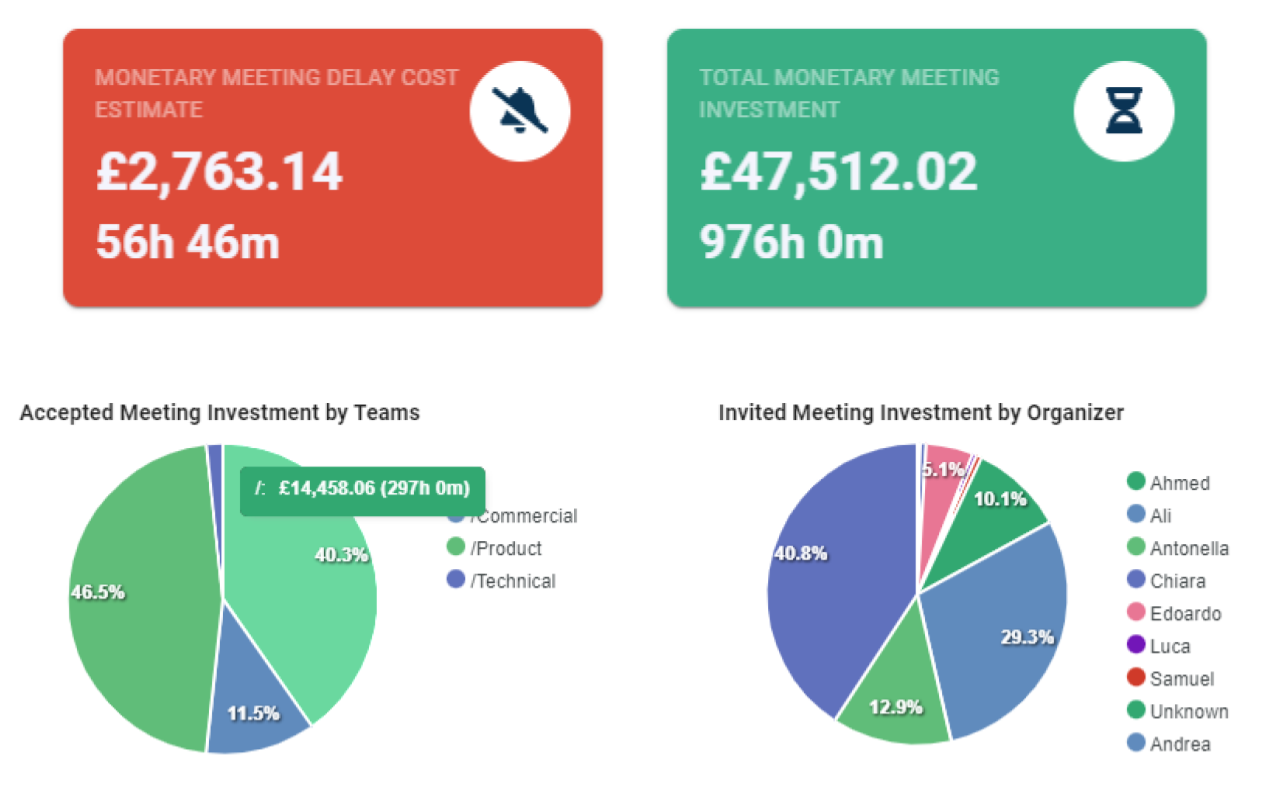
When meetings regularly start late, the effect compounds across everyone attending. Those delays create wasted minutes, push back later commitments, and gradually normalize a culture where time boundaries do not mean much.
Flowtrace’s recent meeting data shows that the average join lag is just 24 seconds, and 84% of meetings begin within the first minute. Compared with older patterns where half of meetings started late, that is a sign that punctuality can improve when meeting norms improve.
This is why start-time discipline matters as an effectiveness metric. It is not just about being polite. It is about whether the organization treats meeting time as something worth protecting.
Duration control
An effective meeting uses the amount of time it actually needs.
That sounds obvious, but many meetings still inherit a default length rather than an intentional one. A meeting gets 30 minutes because that is the default calendar block. Another gets an hour because nobody questions it. Over time, that creates a culture where time expands to fit the slot.
Flowtrace’s data points in a better direction. Median meeting duration is now 35 minutes, only 12% of meetings exceed 60 minutes, and 94% are scheduled for an hour or less. In the 2024 comparison set, 30 minutes was the most common meeting length, accounting for 45% of all meetings.
That is a good sign, but duration alone is not enough. A short meeting can still be ineffective if it produces no clarity. The better question is whether the meeting stayed within the right amount of time for the outcome it needed to produce.
Participation quality
Participation is not about making every meeting perfectly balanced. Different meetings require different roles. Some people need to lead. Others need to approve. Others only need to weigh in at key points.
Still, effective meetings usually make it clear who is there to decide, who is there to contribute, and who is there to stay informed. When that clarity is missing, meetings tend to drift into passive attendance.
This is one reason smaller meetings often work better. Flowtrace found that companies using its data reduced average meeting size by 27% and one-off meeting participants by 34%. That suggests many teams are already moving toward leaner sessions that are easier to manage and easier to participate in meaningfully.
When assessing participation, ask:
- Did the people who needed to contribute actually contribute?
- Did the discussion stay with the people closest to the decision?
- Did the meeting feel like a working session or a broadcast?
Those questions are often more revealing than simple attendance numbers.
Focus and structure in the room
The best meetings do not just have an agenda. They stay connected to it.
That means the organizer or facilitator can move the group through the intended topics, keep side discussions under control, and make it clear when the conversation has reached a decision point or a next step.
This is where poor meeting design becomes visible. If a meeting repeatedly runs off topic, overruns, or ends with “we should discuss this again,” the issue is usually not one bad moment. It is a sign that the meeting format is too loose for the job it is trying to do.
3. Assess Effectiveness After the Meeting Ends
A meeting is not effective just because people thought it was useful in the moment.
The final test happens after the call. Did the meeting produce an outcome? Was that outcome documented? Did anyone act on it?
This is the stage many companies under-measure.
Decisions made
The first post-meeting question is whether the session led to a real decision, a clear alignment point, or a defined next step.
Not every meeting needs a major decision. But most meetings should end with some kind of movement. If the conversation simply circles the topic and ends without clarity, the time may have been consumed without real progress.
This is why outcome measurement matters so much. A meeting should do more than facilitate conversation. It should create movement.
Action item ownership
Effective meetings translate discussion into named ownership.
That means action items should be specific, assigned, and time-bound enough that everyone leaves knowing what happens next. Without that, the meeting may generate energy but not accountability.
This is where many teams overestimate meeting quality. The conversation feels constructive, so the meeting is judged as useful. But once the meeting ends, nobody is sure who is doing what. The next meeting then becomes a recovery meeting for the previous one.
A strong meeting assessment process should always ask:
- Were next steps documented?
- Did each next step have a clear owner?
- Was there a due date or expected follow-up point?
If the answer is no, the meeting was likely less effective than it felt.
Follow-through
The last and most important measure is whether the assigned work actually happened.
This is where meeting effectiveness becomes visible in operational terms. A meeting that leads to completed actions was effective in a way that is easy to justify. A meeting that produces vague notes and incomplete tasks was probably not.
That is why accountability metrics matter. They connect the meeting to execution rather than treating the meeting as an end in itself.
A Simple Framework for Measuring Meeting Effectiveness
If you want a practical way to assess meetings consistently, use a before-during-after framework. For a full breakdown of the specific KPIs behind this framework, start with our guide to meeting metrics.
Before the meeting
Measure:
- Agenda present
- Purpose defined
- Right attendees invited
- Planned meeting cost
- Scheduling notice
During the meeting
Measure:
- On-time start
- Duration adherence
- Participant fit
- Discussion focus
- Decision clarity
After the meeting
Measure:
- Action items assigned
- Ownership clarity
- Follow-up completion
- Decision or outcome recorded
This framework works because it avoids a common mistake: treating meeting effectiveness as one number without understanding what caused it.
A meeting can fail because it was poorly prepared. Another can fail because it was too large. Another can fail because nobody followed through. Lumping all of that together hides the real problem.
A better system is to diagnose the weak stage first, then improve from there.
How Flowtrace Helps Teams Assess Meeting Effectiveness
Flowtrace gives leaders a way to move from opinion to evidence.
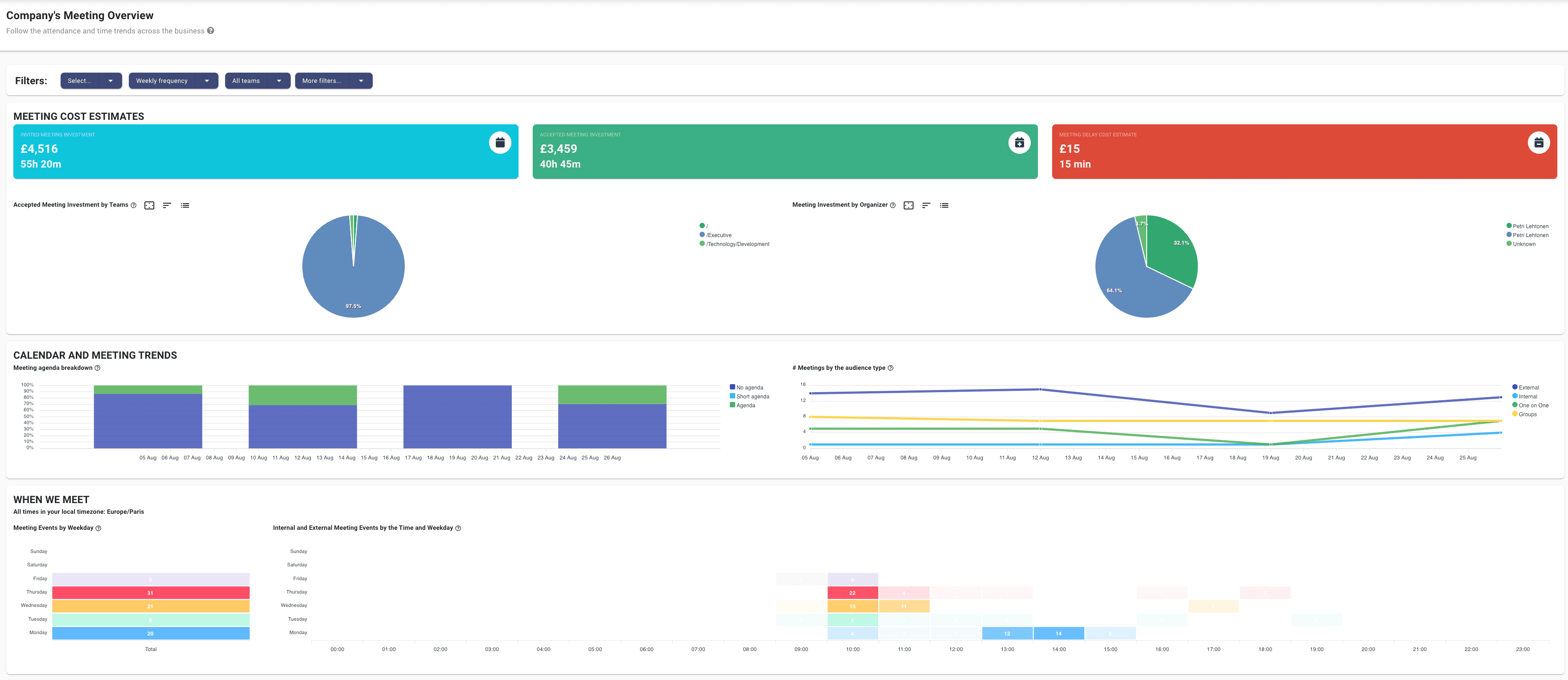
Instead of relying on complaints like “we meet too much” or “this team’s meetings feel inefficient,” leaders can look at actual meeting patterns. That includes how long meetings run, how often they recur, how many people attend, how agendas are used, and how scheduling behaviors shape the workday.
That visibility matters because meeting problems are rarely isolated. A weak meeting culture usually shows up across several related signals at once. There may be too many recurring meetings. Too many short-notice invites. Too many oversized sessions. Too little structure. Too much spillover into the rest of the day.
Flowtrace’s own data already points to the patterns worth watching most closely: employees still spend around 392 hours per year in meetings, almost half of meetings are recurring, 35% are scheduled within 24 hours, and agenda discipline remains a weak point in one-off meetings.
When you can see those patterns clearly, assessing meeting effectiveness becomes much easier. You stop asking whether meetings are “good” in a vague sense. You start asking which design choices are making them better or worse.
Final Thoughts
The most effective companies do not judge meetings by volume alone. They judge them by whether the meeting was prepared well, run well, and followed through properly.
That is the real standard.
A meeting is effective when it brings the right people together, uses their time carefully, and produces a clear outcome that moves work forward. Everything else is noise.
For leaders trying to improve meeting culture, that is the shift that matters most. Do not start by asking whether employees like meetings. Start by asking whether your meetings are structurally designed to succeed.
Because once you measure meeting effectiveness properly, it becomes much easier to improve it.