FLOWTRACE METHODOLOGY
Trusted and tested framework to measure and manage your company's meeting effectiveness and make a long lasting behavioral changes.
FLOWTRACE METHODOLOGY
In employee systems, there are things we do every day that form patterns of behavior – leaving a trail of data when we're working. Most data is not useful, but with the right analytics, you can find insights into how your organization actually conducts its meetings. When used in tandem with out 5 step organizational transformation framework you can ensure lasting behavioral change to your culture.
Our platform is built to maintain privacy and security from the ground up, making sure your employees and security teams are as happy as you are about our results.
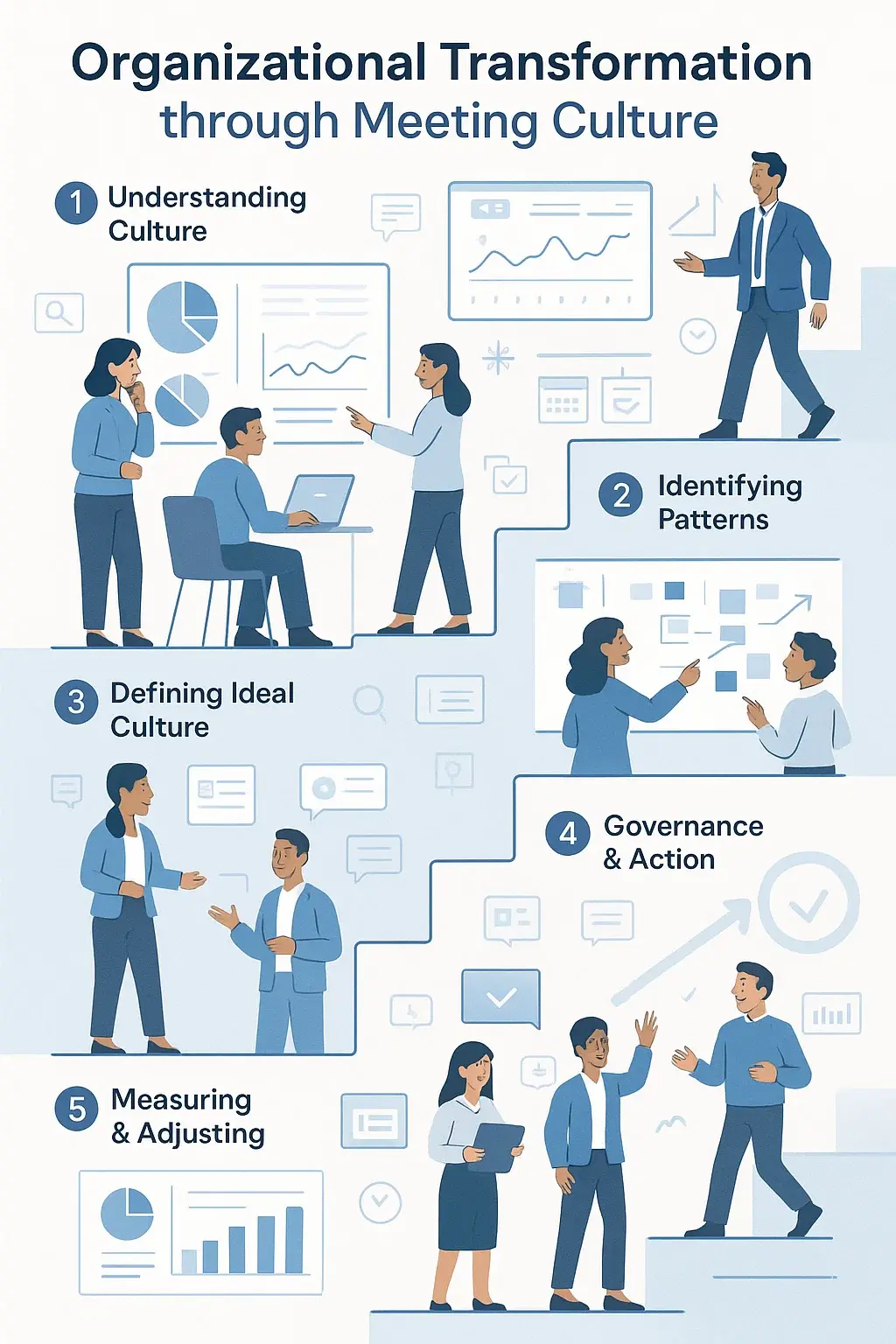
Organizational Transformation by Flowtrace
- Understand your company's current culture:
Your starting point should be to understand what's the status quo, what's working, and what needs fixing. Flowtrace meeting and productivity analytics is built for this. - Flowtrace analytics helps you identify patterns, and trends:
Find out how your company collaborates, and meets over a period of time. Christmas, holidays, and major financial cycles change the way how your team meets, and work together. This baseline ensures you don't plan changes on temporary snapshot of time. - Define what your culture needs to look like:
Before you take an action you should plan for the end goal for your company culture. We recommend taking impactful, but short term achievable steps towards the long term goal. This work forms your organizational policies. - Governance and management actions:
Write a memo, provide training, or deploy Flowtrace calendar tools to guide your employees towards the desired culture. Flowtrace employee apps are self-serve, no training required way to guide your employees towards the desired culture that you manage centrally. - Measure the impact, and adjust toward the new habits:
Transformation of human behavior takes time. Follow the change taking place in people behavior over time with Flowtrace metrics, and adapt your approach to continue changing company culture. Introduce new rules and changes when the team is ready.
PRIVACY AND DATA GATHERING
Flowtrace analyzed data is gathered using passive methods, not to bias the analysis outcomes. An example of Flowtrace data-source is a project management tool's comment fields, and activity feed. This gives us the most complete and natural view of the sharing and communication patterns in a public space. We use active data gathering surveys to calibrate the results on a client-by-client basis for detailed insights, better accuracy and comparability between teams and organizational structures.
We take employee's right for privacy extremely seriously. Our data gathering is limited to company's public domain, and specifically to information that employee have intentionally made pubilcly available within the company. We don't digest, nor surface information which would not otherwise be available to everyone in the company (i.e. 1-to-1 chat message are strictly off limits). Any personalized insights we derive from the data is made only available to the individual themself. Any insights we make available is aggregated either on team, deparmental, or company level.
Any actively gathered survey responses are treated as any other insights and are always aggregated and anonymized to a team, departmental, or company level. You should consider Flowtrace serving as a shield of information privacy between the employee and employer.
ARTIFICIAL INTELLIGENCE, ANALYSIS METHODS AND THEORY
Data exhaust is the trail of data left by the activities of users during their online work activity.
We use a wide array of metrics and data points to do our analysis of the calendar and video call tools. The main scientific principles to understand how we analyze meeting and calendar data are graph theory and statistical analysis. A graph is a set of points (we call them vertices or nodes) connected by lines (
Social network analysis is the study of interlinked relationships and their meaning in the wider context with the help of graph theory. This process of investigating social structures through the use of networks and their interlinked information reveals hidden patterns in your employees’ collaboration and how work actually gets done.
Flowtrace uses state of the art artificial intelligence (AI) to analyze the meta-information that passes through your day to day tools. We also run sentiment analysis, entity extraction and key phrase extraction (natural language processing, NLP) of the message itself to enrich the the communication reasoning in selected deployments.
How does it work?
Flowtrace is a meeting analytics and transformation platform that helps companies measure meeting culture, reduce wasted meeting time, and improve how teams collaborate.
By connecting with calendars, video meeting tools, and collaboration systems, Flowtrace gives leaders a clear view of meeting volume, focus time, meeting costs, team alignment, and collaboration patterns. It helps identify where meetings are creating overload, slowing decisions, or fragmenting deep work.
Flowtrace also improves meeting culture at the point of scheduling. Our Outlook and Google Calendar plugins make meeting cost visible before meetings happen, while configurable meeting validation rules guide teams toward better meeting habits. These rules help organizers create meetings with clearer purpose, better attendee discipline, stronger agendas, and healthier scheduling patterns.
The result is a continuous improvement loop: measure the culture, identify the friction, guide better behaviour, and track progress over time.
Who is Flowtrace for?
Flowtrace is built for leadership teams, managers, and employees who want to improve meeting culture without creating a culture of individual monitoring.
Flowtrace helps organizations understand how meetings affect productivity, focus time, collaboration, and team alignment. It is especially useful for companies that want to reduce meeting overload, improve calendar habits, and create healthier ways of working across teams.
Leadership teams
Get organization-level visibility into meeting culture, focus time, collaboration patterns, meeting costs, information flow, and team alignment. Flowtrace helps leaders identify where time is being lost and where better meeting practices can improve execution.
Managers
Understand how your team spends time, how meeting habits affect focus, and how your team collaborates with other teams. Managers can use Flowtrace to spot overload, bottlenecks, handover issues, and recurring patterns that make work harder than it needs to be.
Employees
Employees benefit from clearer meeting expectations, better scheduling habits, protected focus time, and private personal insights where enabled. Flowtrace is designed to support employees, not monitor them.
People and operations teams
Use meeting analytics, employee feedback, and meeting culture benchmarks to guide policy, improve collaboration norms, and support better ways of working across the organization.
Flowtrace focuses on team-level and organizational insights rather than individual surveillance. This helps companies improve productivity while maintaining trust, privacy, and psychological safety.
Flowtrace works for teams of many sizes, from smaller companies that want early visibility into meeting habits to larger organizations looking to standardize meeting culture across departments.
How do I start with Flowtrace?
Getting started with Flowtrace is simple. Most teams can complete self-service onboarding in a few minutes and begin seeing their first meeting culture insights shortly after connecting their calendar.
You can start by connecting your calendar and enabling the core Flowtrace meeting analytics features. From there, teams can add Outlook or Google Calendar meeting cost plugins, configure meeting validation rules, and begin measuring how meetings affect focus time, collaboration, and team alignment.
Additional collaboration data sources can be added at any time. Common integrations usually take only a few minutes to configure, while more complex enterprise integrations may require additional setup depending on your systems, permissions, and data requirements.
For larger organizations, Flowtrace can also support a structured rollout, including pilot setup, meeting culture baseline measurement, validation rule configuration, and recommendations for improving meeting habits across teams.
How long it takes to see business performance?
You can start seeing meeting culture insights within days, while measurable business impact depends on the scale of rollout and the changes being introduced.
Flowtrace can quickly show what is happening across your meeting culture: meeting load, focus time, meeting costs, collaboration patterns, and where teams may be losing time. This means leadership and managers can identify quick wins early, often within the first weeks of use.
Some improvements can happen almost immediately once teams see the data and enable calendar-based interventions. For example, meeting cost reminders, validation rules, agenda requirements, attendee discipline, and better scheduling guidance can influence behaviour at the point meetings are created.
Longer-term performance improvement usually requires a structured change cycle. Meeting habits are part of company culture, so sustained improvements in focus time, collaboration, and alignment may take several months depending on the starting point of the organization.
For enterprise pilots, we typically recommend a 3-month structure: one month to establish a baseline, followed by two months of targeted interventions. This gives the organization enough time to compare “before and after” behaviour and measure whether meeting culture improvements are translating into better focus, lower meeting load, and stronger collaboration patterns.
Do you offer free trial?
Yes. Flowtrace offers a Free Forever plan for teams getting started, with access to core meeting analytics and employee apps at £0/user/month. This allows teams to start measuring meeting culture, calendar activity, meeting costs, and employee feedback without needing a paid plan first.
For teams that want to evaluate the complete Flowtrace toolset, including more advanced meeting analytics, meeting validation rules, wider integrations, and organization-wide transformation features, we can also support a structured free trial or pilot depending on your use case.
Larger organizations can start with a focused trial, a limited pilot group, or a structured enterprise pilot. This helps you validate the platform, measure a meeting culture baseline, and assess the impact of meeting cost visibility and calendar-based meeting rules before a wider rollout.
Is my data safe with you?
Yes. Flowtrace is designed with privacy, security, and enterprise data protection as core principles.
Flowtrace uses a metadata-first approach wherever possible. We do not read email content, meeting content, private chat messages, or the contents of documents. Instead, Flowtrace analyses collaboration metadata, such as calendar events, meeting patterns, participation signals, and other intentional collaboration activity, to generate meeting culture and productivity insights. This reduces unnecessary data exposure while still allowing organizations to understand how work happens. Flowtrace’s public privacy guidance states that, wherever possible, it analyses metadata rather than work content and does not store the contents of private communication.
Flowtrace does not analyse what is being said in meetings. Unlike many meeting tools, Flowtrace does not need to record, transcribe, summarize, or interpret meeting conversations to generate insights.
Flowtrace also supports GDPR-aligned processing through a published Data Processing Agreement. The DPA confirms that the customer acts as Controller and Flowtrace acts as Processor, and that Flowtrace processes personal data only as necessary to provide the services and in accordance with the customer’s written instructions. It also covers UK GDPR, EU GDPR, DPA 2018, SCCs, and the UK Addendum for relevant international transfers.
From a security architecture perspective, Flowtrace production infrastructure is hosted in AWS in Ireland, with TLS 1.2+/1.3 encryption in transit and AES-256 encryption at rest. Access controls include SSO through Google, Microsoft, or Slack, MFA governed by the customer’s identity provider, quarterly access reviews, and least-privilege IAM roles.
Flowtrace also operates a documented security framework covering secure development, logging, monitoring, incident response, business continuity, and vendor management. This includes SAST and dependency scanning, centralized AWS CloudWatch logging, AWS Inspector, GuardDuty and Security Hub review, a four-stage incident response process, defined RPO/RTO targets, and published sub-processor controls.
Flowtrace’s controls map to ISO 27001:2022 Annex A and SOC 2 Security, Availability, and Confidentiality principles. Detailed security documentation, audit roadmap information, and supporting materials can be shared with customers under NDA where required.
You can read more about our commitment to data security from here.
.png)
CREATE FREE ACCOUNT NOW
Experience Flowtrace in action with powerful calendar integrations to super-charge your meeting culture and meeting effectiveness.